
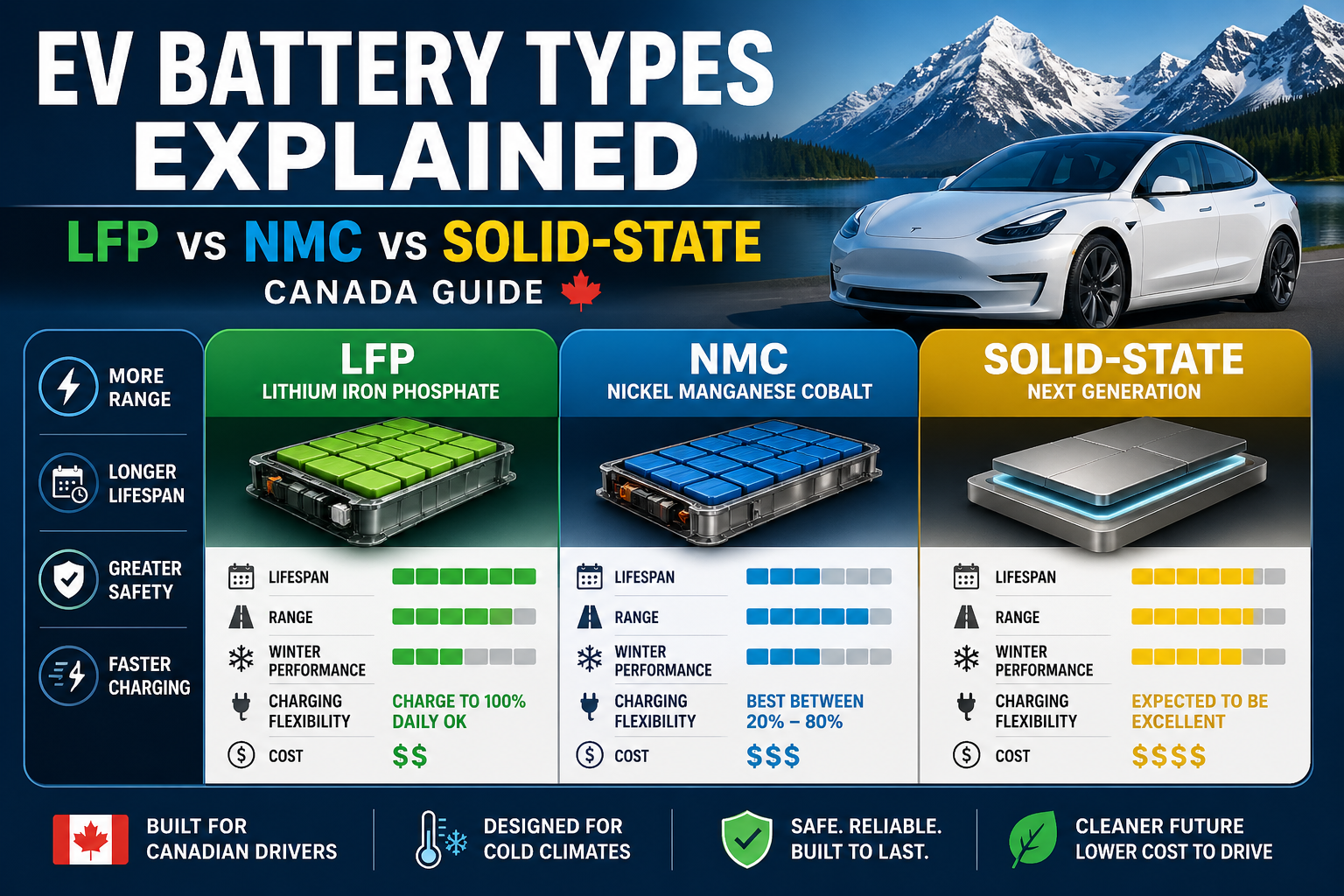
When most people think about electric vehicles, they think about range, charging, and cost.
But there's something even more important under the surface: not all EV batteries are the same.
The type of battery your EV uses can affect:
How far you can drive
How it performs in Canadian winters ❄️
How long it lasts
How you should charge it
If you're buying a used EV in Canada, this is something you absolutely want to understand. Let's break it down simply 👇
🔋 The 3 Main Types of EV Batteries
Today, almost every electric vehicle uses one of these three battery types:
NMC (Nickel Manganese Cobalt) – most common
LFP (Lithium Iron Phosphate) – growing fast
Solid-State – future tech
⚡ 1. NMC Batteries (Most Common in Canada)
Used in: Tesla Long Range & Performance models, Hyundai Kona Electric, Kia EV6, Ford Mustang Mach-E, and many more.
✅ Pros
Higher energy density → more range
Strong acceleration and performance
Widely used and proven
❌ Cons
More expensive materials
Slightly faster long-term degradation vs LFP
Not ideal to sit at 100% charge daily
Real-world take: If you want maximum range for road trips across Canada, NMC is still the go-to.
🔋 2. LFP Batteries (Durability King)
Used in: Tesla RWD models, many newer budget EVs, and brands like BYD (globally).
✅ Pros
Extremely long lifespan (often less degradation over time)
Can be charged to 100% daily without stress
More stable and safer chemistry
❌ Cons
Slightly lower range than NMC
More noticeable range loss in cold weather ❄️
Real-world take: If you're commuting, driving locally, or planning to keep your EV long-term, LFP is an excellent choice.
🧪 3. Solid-State Batteries (The Future)
Used in: Still in development by companies like Toyota and others.
✅ Potential Pros
Much higher range
Faster charging
Improved safety
❌ Current Reality
Not available in most production EVs yet
Expensive and still being tested
Real-world take: Solid-state batteries are exciting — but they're not something to wait for when buying a used EV today.
❄️ How Battery Type Affects Canadian Winters
If you live in Canada, this part matters. All EVs lose range in cold weather — but battery chemistry plays a role:
NMC batteries: better cold-weather performance overall
LFP batteries: slightly bigger temporary range drop in winter
Here's the key point most people miss: cold weather reduces range temporarily, not permanently damaging the battery.
For a deeper dive, see our Winter & Climate guide.
🔌 Charging Differences (Huge for Daily Use)
One of the biggest real-world differences between battery types is how you charge them.
NMC Charging Tips
Best kept between 20–80% for daily use
Only charge to 100% for long trips
LFP Charging Tips
Totally fine to charge to 100% regularly
In fact, manufacturers often recommend it
This is a massive advantage for LFP owners — simpler and more convenient.
🚗 What This Means for Used EV Buyers
If you're shopping for a used EV in Canada, here's the simple breakdown:
Choose NMC if you want:
Maximum range
Better highway performance
More flexibility for long trips
Choose LFP if you want:
Long battery life
Simpler charging habits
A reliable daily driver
⚠️ What to Check Before Buying Any Used EV
No matter the battery type, always check:
Real-world range vs original rating
Remaining battery warranty (typically 8 years / ~160,000 km)
Charging history (heavy fast charging vs normal use)
Pair this with your cost research:
🧠 Simple Summary
NMC = Range + performance
LFP = Longevity + simplicity
Solid-state = Not here yet
📚 Sources & Further Reading
Natural Resources Canada – Electric vehicle battery basics
Tesla Impact Reports (battery performance data)
International Energy Agency – Global EV Outlook
U.S. Department of Energy – Battery technology overview