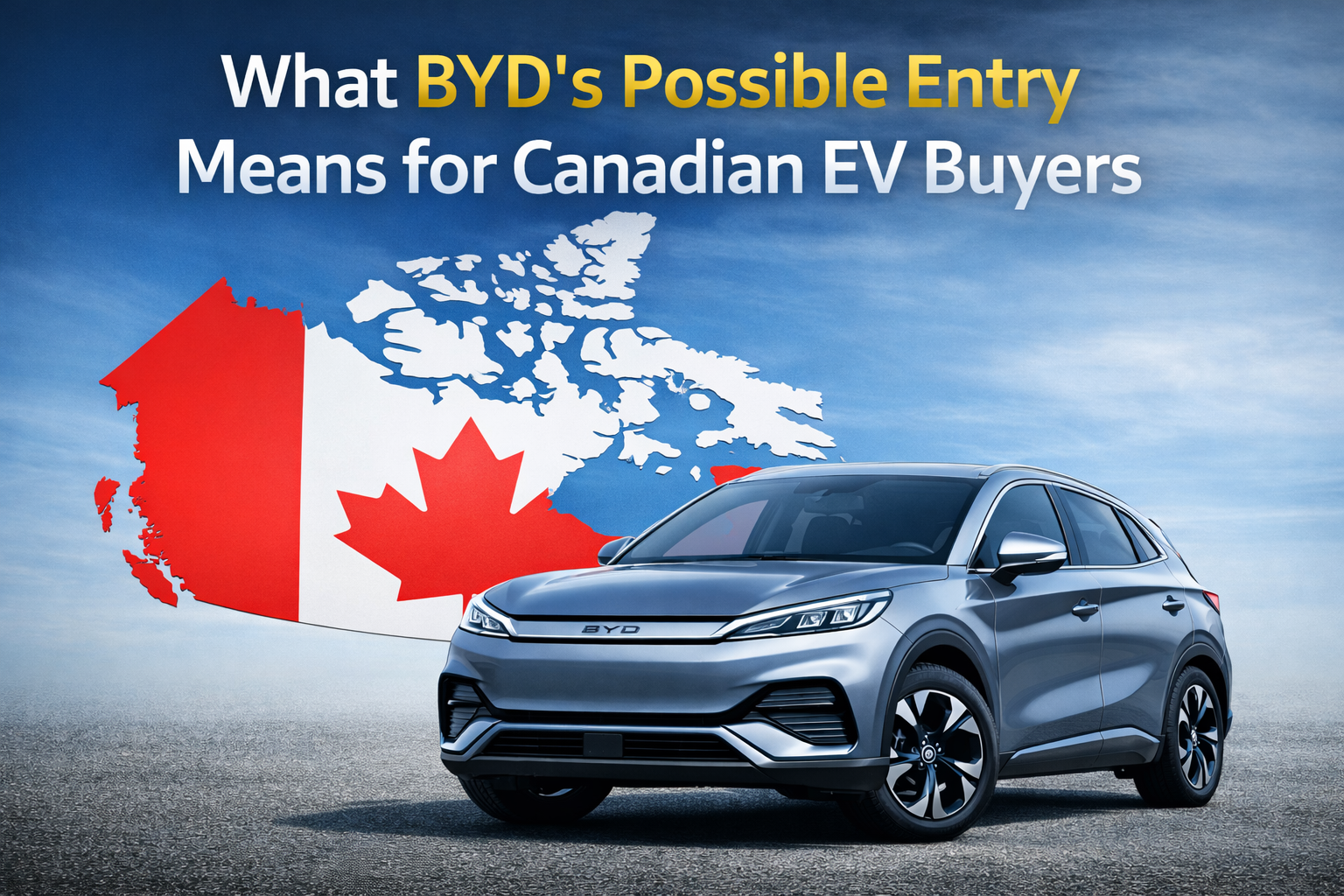
Canada–China EV Trade Deal: What BYD’s Possible Entry Means for Canadian EV Buyers
In January 2026, a new trade development between Canada and China reignited a long-running debate about affordability, competition, and the future of electric vehicles in Canada. A deal reported by USA Today suggests that Chinese automakers — including BYD — may soon gain improved access to the Canadian market after years of steep trade barriers.
For Canadian consumers, especially those watching the used EV market, the implications are nuanced. This is not a sudden flood of cheap EVs — but it could mark the beginning of a structural shift.
This article breaks down what the deal actually does, what it doesn’t, and what it realistically means for used EV buyers in Canada.
What Changed in the Canada–China EV Trade Relationship?
For the past several years, Chinese-built electric vehicles have effectively been locked out of Canada due to 100% import tariffs, mirroring similar policies in the United States. These tariffs made vehicles from Chinese brands economically unviable, regardless of how competitive their base pricing was overseas.
According to reporting by USA Today, Canada has now agreed to reduce those tariffs significantly, replacing them with a managed import system that allows a limited number of Chinese EVs to enter the country annually under lower duties.
This approach attempts to balance:
Consumer affordability
Trade normalization with China
Protection of North American auto manufacturing
It is not a free-for-all — it’s a controlled opening.
Why BYD Matters More Than Other Chinese Brands
Among Chinese automakers, BYD stands apart.
Globally, BYD:
Is one of the largest EV manufacturers in the world
Sells EVs and plug-in hybrids across Europe, Asia, Australia, and Latin America
Produces its own batteries, motors, and power electronics (vertical integration)
Competes aggressively on price while maintaining acceptable build quality
In markets where BYD already operates, its vehicles often undercut established brands by $5,000–$15,000 CAD, depending on segment.
That pricing pressure — not volume alone — is why policymakers and automakers are paying attention.
Will Chinese EVs Suddenly Become Cheap in Canada?
No — not immediately.
There are several limiting factors:
1. Import quotas
The deal reportedly caps the number of Chinese EVs that can enter Canada each year. Even at full allowance, these vehicles would represent a small percentage of Canada’s total new-vehicle market.
2. Certification & compliance
Vehicles must still meet:
Canadian safety standards
Cold-weather performance requirements
Bilingual labeling and compliance rules
These add cost and time.
3. Dealer networks & service
Without an established dealer and service network, early pricing advantages may be partially offset by:
Limited availability
Higher insurance premiums
Unknown long-term service costs
What This Means for Used EV Buyers (The Part That Actually Matters)
1. Price pressure works indirectly
Even modest new-EV competition can:
Force legacy automakers to adjust pricing
Increase incentives
Speed up depreciation on existing models
That matters for buyers shopping used.
If you’re already tracking real ownership costs, this reinforces why depreciation — not fuel — is often the biggest factor in used EV value.
👉 Internal guide:
https://usedelectriccarscanada.ca/charging-costs/real-ownership-costs
2. Used Chinese EVs won’t appear overnight
Even if BYD launches new vehicles in Canada:
It will take 2–4 years before meaningful used supply exists
Early used models may face resale hesitation
Battery warranties and parts availability will matter
This mirrors what happened with early Hyundai and Kia EVs a decade ago.
For buyers focused on long-term reliability, this is where careful inspection becomes critical.
👉 Internal guide:
https://usedelectriccarscanada.ca/buying-guides/used-ev-inspection-checklist
3. Winter performance will be under scrutiny
Canadian buyers care deeply about cold weather performance — and rightly so.
Chinese EVs will be judged heavily on:
Heat pump efficiency
Winter range loss
Battery thermal management
Before any used buyer should consider one, winter data will matter more than price.
👉 Internal references:
https://usedelectriccarscanada.ca/winter-climate/winter-range-loss
https://usedelectriccarscanada.ca/winter-climate/heat-pumps-explained
Why This Won’t “Crash” the Used EV Market
Some headlines suggest Chinese EVs could collapse prices across the board. That’s unrealistic.
Canada’s used EV market is influenced more by:
Lease return cycles
Incentive changes
Charging infrastructure growth
Battery durability confidence
You can see this already in models like the Nissan Leaf, Chevy Bolt, and Tesla Model 3 — where depreciation stabilized once buyers better understood real-world ownership.
👉 Related analysis:
https://usedelectriccarscanada.ca/buying-guides/are-used-electric-cars-worth-it
Chinese EVs may expand the floor, not collapse the market.
The Bigger Picture: Why This Matters Long-Term
This deal signals something broader:
Canada wants more affordable EV adoption
Policymakers are willing to test controlled competition
The used EV market is becoming a policy consideration, not an afterthought
Over time, this could:
Increase entry-level EV choice
Normalize EV ownership outside premium segments
Improve affordability without sacrificing safety or standards
But it will happen gradually, not dramatically.
Bottom Line for Canadian EV Buyers
This deal does not flood Canada with cheap EVs
BYD’s potential entry matters more for future pricing pressure than immediate availability
Used EV buyers benefit indirectly — and slowly
Caution, data, and winter performance still matter more than brand hype
For now, the smartest move remains the same:
Buy proven models, understand ownership costs, and let the market mature.
Sources & Further Reading
Primary reporting
USA Today — Canada–China EV trade deal & BYD discussion
https://www.usatoday.com/story/cars/news/2026/01/20/byd-trade-deal-canada/88217293007/
Additional context
Reuters — North American reaction to Chinese EV trade policy
Automotive News Canada — EV pricing and market impacts
Transport Canada — Vehicle compliance and import standards
Internal UsedElectricCarsCanada resources
Real EV ownership costs:
https://usedelectriccarscanada.ca/charging-costs/real-ownership-costsAre used EVs worth it?:
https://usedelectriccarscanada.ca/buying-guides/are-used-electric-cars-worth-itWinter range loss explained:
https://usedelectriccarscanada.ca/winter-climate/winter-range-loss