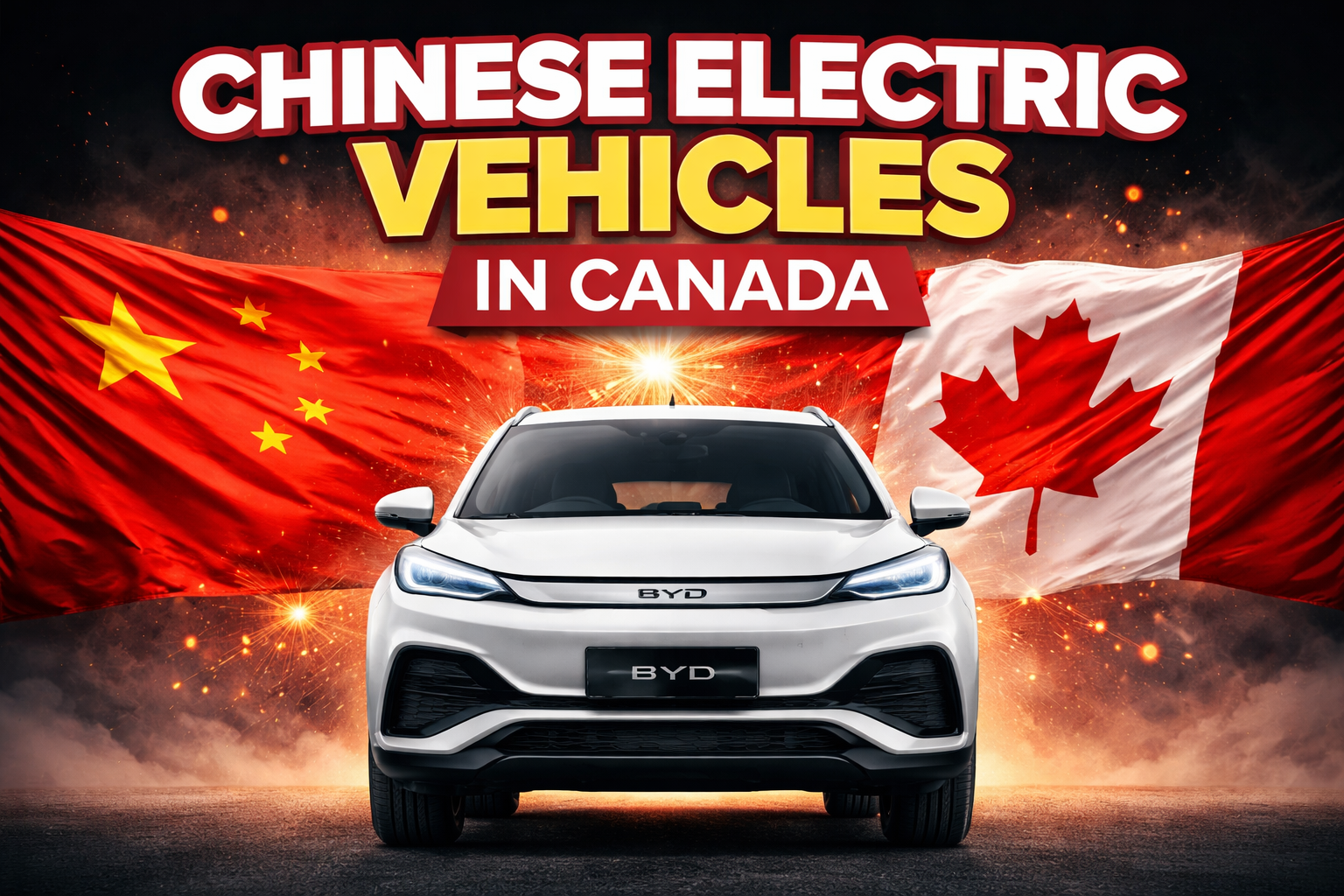
Chinese Electric Vehicles in Canada: What Used-EV Buyers Need to Know
Tariffs, Reliability, Warranties, and What Comes Next
Chinese electric vehicles are one of the fastest-growing forces in the global auto industry — and Canada is paying attention.
If you’ve seen headlines about possible bans, tariffs, or security concerns around Chinese EVs, you’re not alone. The conversation has heated up quickly, and for Canadian buyers — especially used-EV shoppers — it’s created confusion.
Are Chinese EVs coming to Canada?
Will they be banned?
Are they safe, reliable, or worth buying used?
This guide breaks down what’s actually happening, what it means for Canadian consumers, and how to think about Chinese EVs from a used-market perspective, not a political one.
Why Chinese EVs Are Suddenly a Big Topic in Canada
China is the world’s largest EV producer — by a wide margin.
Chinese automakers like BYD, SAIC (MG), Geely, and Chery now dominate:
Battery production
EV manufacturing scale
Cost efficiency
Globally, Chinese EVs are known for:
Competitive pricing
Modern interiors
Strong battery tech
Rapid innovation cycles
The question Canada is grappling with isn’t whether Chinese EVs are capable — it’s whether they should be allowed into the market, and under what rules.
According to the CBC, the federal government is actively reviewing Chinese EV imports due to concerns around trade fairness, data security, and domestic auto manufacturing impacts.
(External source: CBC News – Chinese EVs in Canada: Questions & Answers)
https://www.cbc.ca/news/business/chinese-evs-canada-questions-answers-9.7048637
Are Chinese EVs Currently Sold in Canada?
As of now:
Chinese-branded EVs are not officially sold in Canada
There is no used Chinese EV market yet
Most Canadians have never driven one
However — and this matters — Chinese-made EVs already exist in Canada indirectly.
Examples:
Tesla sources batteries and components from China
Volvo is owned by China’s Geely
Polestar vehicles are built in China
Many global EV supply chains rely heavily on Chinese manufacturing
So the issue isn’t “Chinese involvement” — it’s Chinese brands selling directly to Canadians.
The Government’s Main Concerns (In Plain English)
Based on reporting from CBC and federal statements, Canada’s concerns fall into three main categories:
1. Trade & Fair Competition
Chinese EVs benefit from:
Heavy government subsidies
Lower labour costs
State-backed battery supply chains
This allows them to undercut Western automakers on price — sometimes dramatically.
Canada is worried about:
Domestic auto jobs
Long-term competitiveness
A flood of ultra-cheap imports destabilizing the market
2. Data & Privacy
Modern EVs collect a lot of data:
Location
Driving behavior
Camera and sensor inputs
The concern isn’t that Chinese EVs are unsafe — it’s about where data is stored, who controls it, and whether it could be accessed by foreign governments.
This is one of the same debates happening in:
The U.S.
Europe
Australia
3. National Security & Infrastructure
Some policymakers worry about:
Connected vehicles
Software updates
Charging infrastructure access
These concerns are largely precautionary, not based on proven incidents — but they still influence policy decisions.
What This Means for Used EV Buyers (Right Now)
For Canadian used-EV shoppers today, the impact is simple:
👉 Chinese EVs are not part of your buying decision — yet
Your used EV options remain:
Tesla
Chevrolet
Hyundai / Kia
Ford
Volkswagen
Nissan
Could Chinese EVs Enter Canada in the Future?
Yes — but likely with restrictions.
Possible outcomes include:
Import tariffs
Strict data-localization rules
Limited brand approvals
Delayed market entry compared to Europe
The U.S. is already moving toward 100% tariffs on Chinese EVs, and Canada often aligns trade policy closely with the U.S.
If Chinese EVs do arrive, it’s unlikely to be a “free-for-all.”
What If Chinese EVs Do Arrive? (Used Market Implications)
If Chinese EVs enter Canada, the biggest impact will be price pressure.
That could mean:
Cheaper new EVs
Faster depreciation of existing models
Even better used-EV deals
This is similar to what happened when:
Korean automakers entered North America
Japanese brands disrupted the market in the 1980s
For used buyers, competition is usually a win.
But there are caveats.
Warranty, Parts, and Long-Term Support (The Big Unknowns)
For used-EV buyers, these questions matter more than politics:
Will parts be available in 8–10 years?
Are warranties transferable?
Is there a service network?
Without strong dealer and parts infrastructure, cheap EVs can become expensive quickly.
Battery Tech: Where Chinese EVs Are Actually Strong
One area where China leads globally is battery technology.
Chinese companies are leaders in:
LFP (Lithium Iron Phosphate) batteries
Cost-efficient battery scaling
Thermal management for hot climates
LFP batteries are:
Extremely durable
Resistant to degradation
Safer (lower fire risk)
Should Canadians Be Excited or Cautious?
The honest answer: both.
Chinese EVs are:
Technologically impressive
Cost-competitive
Pushing the global market forward
But for Canada specifically:
Policy uncertainty is real
Long-term ownership support is unproven
Used-market confidence takes time
Until those questions are resolved, established EVs remain the safer used-buy choice.
The Bottom Line: What Smart Canadian EV Buyers Should Do
Right now:
Chinese EVs are not something you need to worry about
Your best used-EV values are already on the market
Battery health, winter performance, and charging access matter far more
If and when Chinese EVs arrive, they’ll likely:
Lower prices
Increase competition
Expand used-EV options
But until service networks, warranties, and long-term support are clear, they’re a future consideration — not a current one.
For Canadian buyers today, the smartest move remains the same:
Buy used.
Buy proven.
Buy with winter in mind.