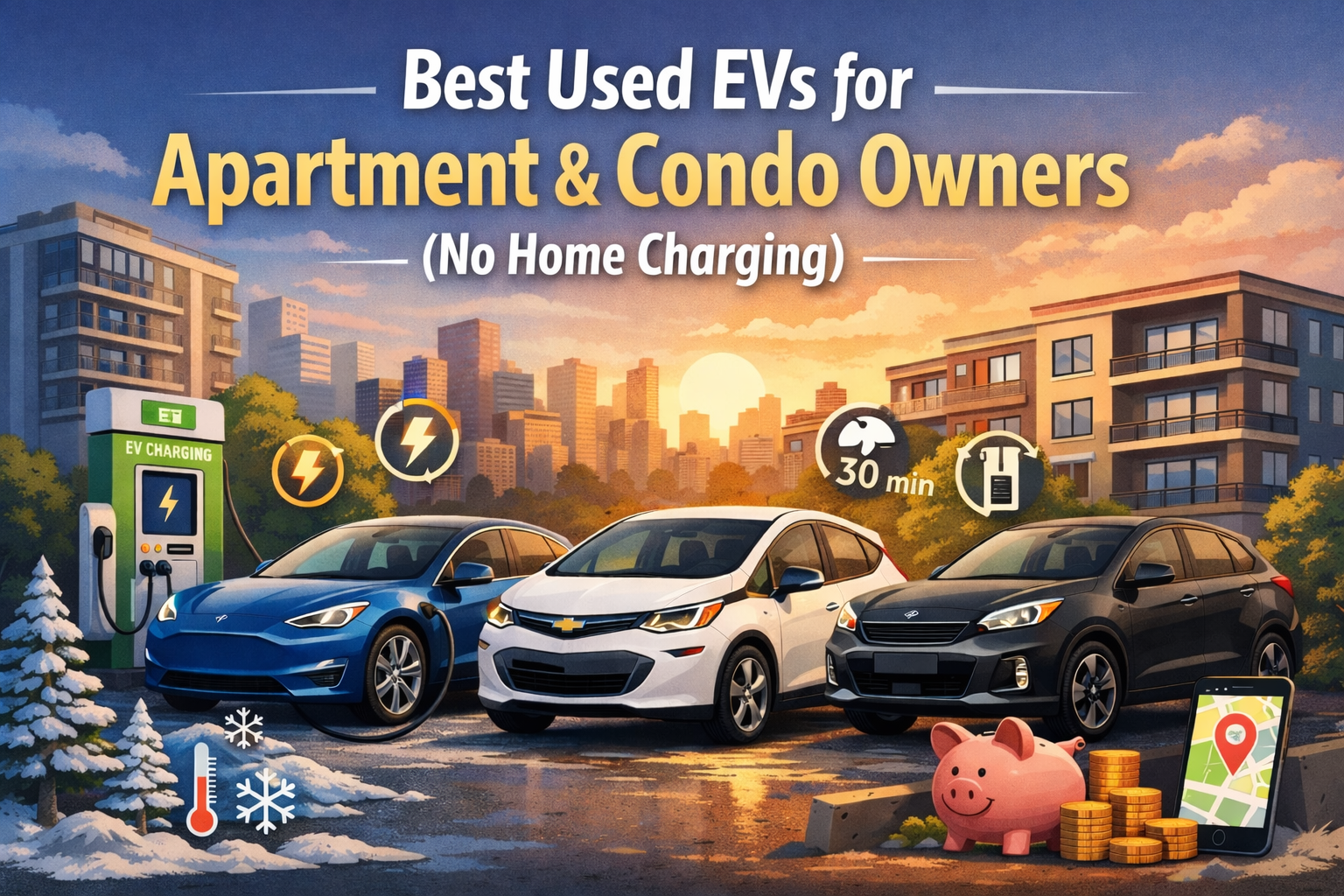
Best Used EVs for Apartment & Condo Owners (No Home Charging)
Buying a used electric vehicle while living in an apartment or condo without access to home charging is no longer unusual in Canada. In many cities, it’s becoming the norm.
The difference is simple: when you don’t have a charger at home, the EV you choose matters far more than most buyers realize.
This guide explains which used EVs actually work for apartment and condo owners, which ones often don’t, and how to avoid the most common mistakes people make when relying on public charging.
The Reality of EV Ownership Without Home Charging
Let’s be upfront.
Owning an EV without home charging can still be cheaper and easier than owning a gas car — but only if the vehicle fits a public-charging lifestyle.
Most negative EV experiences from apartment owners come down to three issues:
Slow DC fast-charging
Overpaying for a battery that’s rarely used
Underestimating winter efficiency losses
Before choosing a vehicle, it’s worth understanding how electric vehicle charging costs compare to gas ownership and how that balance changes without overnight charging. This is covered in detail in Real EV Ownership Costs in Canada.
What Matters Most for Apartment & Condo EV Owners
1. DC Fast-Charging Speed Matters More Than Range
When you can’t plug in overnight, charging speed matters more than advertised range.
An EV that charges from 10–80% in 20–30 minutes fits naturally into errands or grocery runs. One that takes an hour quickly becomes frustrating — even if it has more total range.
What to prioritize:
At least 100 kW DC fast-charging capability
A stable charging curve (not just a high peak number)
Proven reliability on Canadian fast-charging networks
This is why some older long-range EVs feel worse to live with than newer, smaller-battery models.
For a full breakdown of how charging access and speeds vary across the country, see EV Charging Networks in Canada.
2. The Battery Size “Sweet Spot” for Public Charging
More battery isn’t always better when you’re paying public charging rates.
For most apartment and condo owners, the ideal balance is:
55–75 kWh usable battery capacity
Enough range for several days of driving
Reasonable fast-charging time and cost
Oversized batteries:
Cost significantly more to charge
Take longer to refill
Offer diminishing benefits for urban driving
This balance becomes even more important once winter arrives.
3. Cold-Weather Efficiency Is Critical in Canada
Apartment and condo owners often can’t pre-condition their EV while plugged in, which makes winter efficiency a major factor.
Features that matter most:
Heat pumps (a major advantage)
Efficient cabin heating
Predictable winter range behaviour
Cold weather can significantly reduce range, especially during short trips. If you haven’t already, Winter Range Loss in Electric Vehicles explains what to expect and how different models compare.
4. Charging Network Compatibility
Your EV needs to work with the chargers you actually use, not just what exists on a map.
Most apartment owners rely on:
Public Level 2 chargers
DC fast chargers
Workplace or shared residential chargers
Some vehicles integrate more smoothly with Canadian charging networks, apps, and payment systems than others. That difference can dramatically affect day-to-day convenience.
Best Used EVs for Apartment & Condo Owners (Canada)
These vehicles were selected based on:
Public-charging reliability
Urban efficiency
Cold-weather performance
Proven ownership data in Canada
Tesla Model 3 (2019–2022)
Why it works
Excellent DC fast-charging performance
Access to the Supercharger network
Strong winter efficiency
Minimal maintenance requirements
Things to know
Supercharging is not free
Charging costs vary by region
Insurance costs can be higher in some provinces
For apartment owners, charging reliability alone makes the Model 3 one of the easiest EVs to live with. To understand Tesla’s long-term platform strengths and weaknesses, see The Breakdown: Tesla Model S.
Hyundai Kona Electric (2019–2021)
Why it works
Extremely efficient
Affordable public-charging costs
Strong real-world urban range
Good winter performance for its size
Things to know
Slower DC fast-charging than newer EVs
Basic interior
Battery recall history (confirm recall work is completed)
A strong option for city-focused drivers who value efficiency over charging speed.
Chevrolet Bolt EV (2019–2022)
Why it works
Outstanding efficiency
Competitive used pricing
Simple, low-maintenance ownership
Enough range for several days of urban driving
Things to know
Slow DC fast-charging
Battery recall history (verify replacement)
Not ideal for frequent road trips
The Bolt remains one of the lowest-cost EVs for apartment owners who primarily drive in the city.
Kia Niro EV (2020–2022)
Why it works
Balanced efficiency and comfort
Practical interior space
Predictable winter behaviour
Solid reliability record
Things to know
Charging speed is average
Pricing can overlap with larger EVs
A well-rounded option that often gets overlooked.
EVs Apartment Owners Should Approach With Caution
These vehicles aren’t necessarily bad — they’re just poor fits for a public-charging-only lifestyle:
Older Nissan Leaf models with limited range and no liquid battery cooling
Early luxury EVs with slow DC fast-charging
Very large battery SUVs that are expensive to fast-charge
Plug-in hybrids with minimal electric-only range
If you’re comparing EVs against gas vehicles, EV vs Gas Maintenance Costs explains where the real savings — and trade-offs — exist.
Charging Costs Without Home Access
Public charging costs vary across Canada, but generally:
Level 2 charging is cheaper but slow
DC fast charging is faster but more expensive
Most apartment EV owners still spend less annually than gas drivers, but savings depend heavily on how often fast charging is used and where you live. This is covered in depth in EV Charging Costs Explained.
Smart Charging Habits for Apartment EV Owners
Apartment owners who enjoy EV ownership tend to:
Charge opportunistically instead of waiting until empty
Avoid daily fast charging when possible
Stop charging around 80–90% unless needed
Learn which local chargers are reliable early
These habits reduce cost, battery wear, and frustration.
Is an EV Worth It Without Home Charging?
For many Canadians — yes.
EV ownership without home charging works best when:
Daily driving is predictable
The vehicle is chosen for efficiency and charging speed
Winter performance is understood upfront
Public charging costs are realistically factored in
If you’re still undecided, Are Used Electric Cars Worth It? walks through the full cost-benefit equation.
Final Verdict
Apartment and condo living doesn’t rule out EV ownership — poor vehicle selection does.
The best used EVs for this lifestyle are:
Efficient
Fast-charging capable
Cold-weather proven
Affordable to charge publicly
Choose wisely, and an EV fits seamlessly into apartment life.
Sources & Further Reading
Natural Resources Canada — EV efficiency, charging, and cold-weather performance
https://natural-resources.canada.ca/energy-efficiency/transportation-alternative-fuels/zero-emission-vehicles/21346Transport Canada — Zero-emission vehicle infrastructure and adoption
https://tc.canada.ca/en/road-transportation/innovative-technologies/zero-emission-vehiclesCanadian Automobile Association (CAA) — Real-world EV winter testing and research
https://www.caa.ca/electric-vehicles/
https://www.caa.ca/research-and-advocacy/electric-vehicle-research/PlugShare — Public charging availability and reliability across Canada
https://www.plugshare.com/Consumer Reports — EV reliability, battery longevity, and ownership costs
https://www.consumerreports.org/cars/electric-cars/
https://www.consumerreports.org/cars/car-reliability-owner-satisfaction/U.S. Department of Energy (AFDC) — EV charging and efficiency fundamentals
https://afdc.energy.gov/fuels/electricity_basics.htmlInsideEVs — Real-world charging curves, winter testing, and long-term EV data
https://insideevs.com/