Best Model Years to Buy (and Avoid) for Popular EVs in Canada
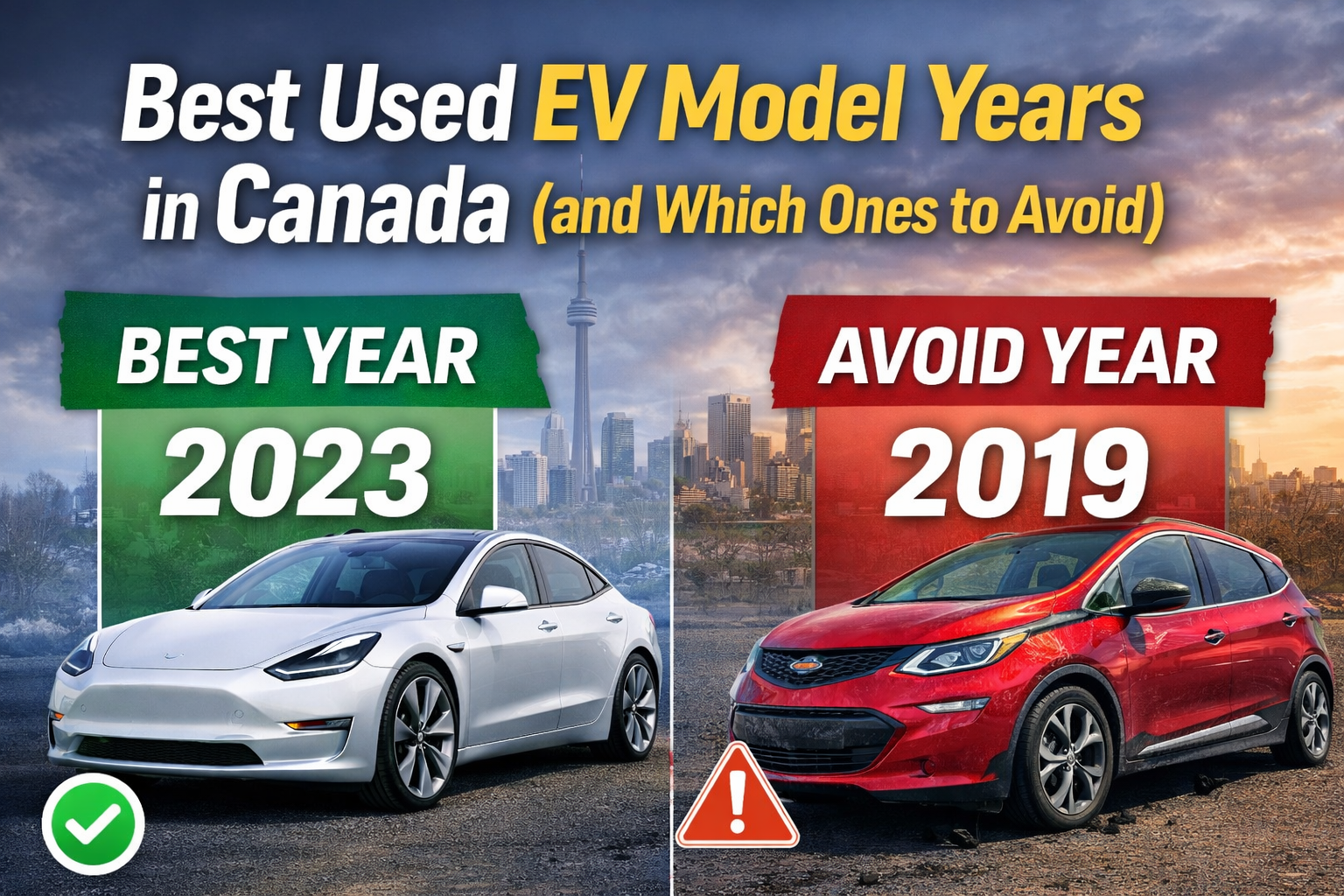
When buying a used electric vehicle, the badge matters less than the model year. A single year can represent a major improvement — or a known problem. Choosing the right year can mean better winter performance, stronger battery confidence, and thousands saved.
This guide breaks down the best model years to buy (and years to be careful with) for the most common used EVs Canadians shop for — and explains why.
Important: Always verify recalls by VIN before buying. Start here:
🔗 https://recalls-rappels.canada.ca/en
If you’re new to used EVs, start with these foundational guides:
🔗 https://usedelectriccarscanada.ca/buying-guides/are-used-electric-cars-worth-it
🔗 https://usedelectriccarscanada.ca/buying-guides/how-to-check-ev-battery-health-before-buying
🔗 https://usedelectriccarscanada.ca/buying-guides/understanding-ev-warranties-for-used-buyers
Tesla Model 3 (Canada)
✅ Best years to buy: 2021–2023
The 2021 refresh marked a major improvement for Canadian buyers, with better efficiency, improved cold-weather performance, and interior updates. These years offer the best balance of modern hardware, winter usability, and depreciation value.
⚠️ Consider carefully: 2019–2020
Still solid cars, but with more variation in build quality and features. Price matters more here — buy only if the value is compelling.
❗ Be extra cautious: 2018 (early builds)
Early production vehicles require closer inspection and clean service history.
What to check:
Heating system type (important for winter range)
🔗 https://usedelectriccarscanada.ca/winter-climate/heat-pumps-vs-resistive-heating-what-mattersBattery and drive unit warranty status
🔗 https://www.tesla.com/en_ca/support/vehicle-warranty
Comparison:
Tesla Model Y (Canada)
✅ Best years to buy: 2022–2024
Newer builds, better software maturity, and often meaningful remaining warranty. These are typically the safest used buys.
⚠️ Consider carefully: 2020–2021
Often well-priced, but inspect tires, suspension, and winter readiness closely.
Winter context:
Chevrolet Bolt EV / Bolt EUV (Canada)
✅ Best value years (only if recall remedy is confirmed): 2020–2022 (EV), 2022 (EUV)
The Bolt offers excellent value — but only if battery recall work is completed.
❗ Avoid unless verified: 2017–2019
Not automatically bad, but these require strict recall confirmation.
GM battery recalls affected 2017–2022 Bolt EV and 2022 Bolt EUV models due to fire risk tied to manufacturing defects.
Verify before buying:
Battery health guide:
Nissan LEAF (Canada)
The LEAF can still be a good city EV — but model year matters more here than almost any other EV.
✅ Best years to buy (city driving): 2018–2020
⚠️ Be cautious: 2021–2022
Certain model years were subject to recalls related to battery fire risk during DC fast charging.
Important checks:
Recall status by VIN
Your reliance on fast charging
Battery state of health
Winter reality:
Hyundai Kona Electric (Canada)
✅ Best years to buy: 2021–2023
These years avoid most headline risks and benefit from improved confidence in battery systems.
⚠️ Be careful: 2019–2020
Earlier Kona EVs were affected by high-profile battery recall campaigns, including full pack replacements in some cases.
Verify recall completion:
Kia Niro EV (Canada)
✅ Best years to buy: 2020–2022
Consistently one of the safest used EVs with reasonable winter efficiency and solid reliability.
⚠️ Consider carefully: 2019
Earlier production — inspect features and battery health closely.
Cost breakdown:
Ford Mustang Mach-E (Canada)
✅ Best years to buy: 2023–2024
Later production years benefit from improved software, fewer recalls, and better long-term confidence.
⚠️ Be cautious: 2021–2022
Certain Mach-E models were recalled for battery overheating risks, along with additional software and latch issues.
Recall lookup:
Winter tips:
Volkswagen ID.4 (Canada)
✅ Best years to buy: 2023–2024
Improved software stability and fewer early-generation issues.
⚠️ Be cautious: 2021–2022
Multiple recalls affected early ID.4s, including door handle and software-related campaigns.
Recall verification:
Model Years That Require Extra Verification (Summary)
Be extra careful with:
Bolt EV (2017–2022) → confirm battery recall completion
Kona Electric (2019–2020) → confirm recall history
Mach-E (2021–2022) → verify recalls by VIN
ID.4 (2021–2022) → software + door handle recalls
LEAF (2021–2022) → DC fast-charging recall context
What to Do Before Buying Any Used EV in Canada
Check recalls by VIN
🔗 https://recalls-rappels.canada.ca/enVerify battery health
🔗 https://usedelectriccarscanada.ca/buying-guides/how-to-check-ev-battery-health-before-buyingConfirm remaining warranty
🔗 https://usedelectriccarscanada.ca/buying-guides/understanding-ev-warranties-for-used-buyersUnderstand charging needs first
🔗 https://usedelectriccarscanada.ca/charging-costs/home-charging-guideFactor in winter performance
🔗 https://usedelectriccarscanada.ca/winter-climate/best-evs-for-winter
Bottom Line
There are very few “bad EVs” — but there are definitely bad years to buy blindly.
Choosing the right model year can mean:
Better winter performance
Fewer recalls
Stronger resale value
Lower long-term risk
And that’s where used EV value really lives.