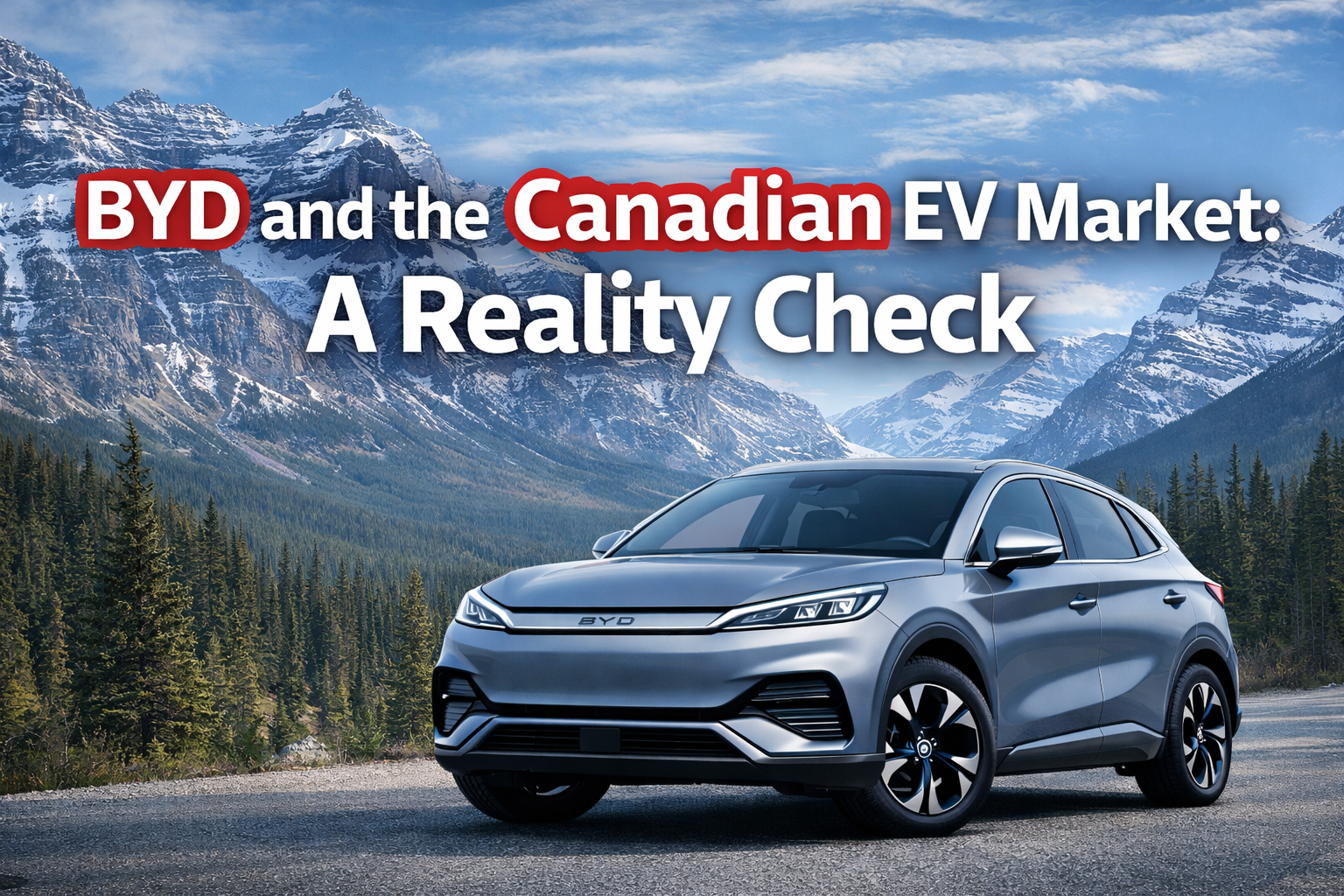
BYD and the Canadian EV Market: A Reality Check
As discussion grows around Chinese automakers potentially entering Canada, one name dominates the conversation: BYD.
BYD isn’t a startup experiment or a speculative brand. It’s already one of the largest electric vehicle manufacturers in the world, selling millions of vehicles annually across Asia, Europe, Australia, and Latin America.
The real question for Canadian buyers isn’t whether BYD can build EVs — it’s whether their vehicles are suited to Canadian realities: cold winters, long distances, charging infrastructure, resale expectations, and long-term ownership.
This comparison looks at BYD’s lineup, technology, and philosophy through a Canadian lens — including where they may perform well, and where caution is still warranted.
Who BYD Is — and Why That Matters
BYD began as a battery manufacturer, not a car company. That origin still defines the brand today.
BYD:
Designs and builds its own batteries
Manufactures electric motors and power electronics in-house
Controls much more of the supply chain than most automakers
This level of vertical integration helps keep costs down — but it also means BYD’s success in Canada will depend heavily on how well its battery systems handle cold climates.
(Primary source: https://www.byd.com/en/about-byd)
BYD’s Global EV Lineup (What Canadians Might See)
BYD already sells EVs in nearly every major segment globally. If the brand enters Canada, the most likely candidates would be:
Compact sedans
Positioned against vehicles like the Nissan Leaf and Tesla Model 3Mid-size sedans
Competing with the Hyundai Ioniq 6 and Tesla Model SCompact SUVs
Similar in size and purpose to the Hyundai Kona Electric and Volkswagen ID.4Mid-size SUVs
Aimed at buyers considering the Tesla Model Y, Kia EV6, or Mustang Mach-E
The key takeaway isn’t radical innovation — it’s pricing discipline and battery focus.
BYD’s Biggest Advantage: Battery Technology
BYD’s signature technology is its Blade Battery, a lithium-iron-phosphate (LFP) design.
LFP batteries typically offer:
Slower long-term degradation
Better thermal stability
Lower fire risk
Lower material costs
For used EV buyers, battery longevity matters more than peak performance — which is why this chemistry is interesting.
However, there’s an important Canadian caveat.
LFP batteries can suffer greater winter efficiency loss if thermal management isn’t strong. That’s why Canadian buyers should care less about chemistry alone and more about how the battery is heated and managed in winter.
For a deeper look at why heating systems matter so much in cold climates, see:
https://usedelectriccarscanada.ca/winter-climate/heat-pumps-explained
And for real-world winter range impacts across EVs:
https://usedelectriccarscanada.ca/winter-climate/winter-range-loss
Cold Weather: The Canadian Stress Test
Canada is where EV marketing claims meet reality.
For BYD to succeed here, buyers will be watching closely:
Battery pre-conditioning behaviour in sub-zero temperatures
Whether heat pumps are standard or optional
Real winter range loss compared to Tesla, Hyundai, and Kia
Without real Canadian winter data, BYD vehicles would likely face the same early skepticism that affected first-generation Leafs and Bolts.
That skepticism isn’t unfair — it’s earned.
Charging Compatibility & Real-World Use
Globally, BYD vehicles support:
Level 2 AC charging
CCS DC fast charging
That aligns well with Canada’s charging infrastructure — but compatibility alone doesn’t guarantee a good experience.
Canadian EV owners care about:
Cold-weather fast-charging speeds
Battery pre-conditioning before DC charging
Software reliability in winter
This is where many EVs struggle early in their lifecycle.
For context on how charging networks actually perform in Canada:
https://usedelectriccarscanada.ca/charging-costs/charging-networks-compared
And for realistic home-charging expectations:
https://usedelectriccarscanada.ca/charging-costs/home-charging-guide
Ownership Costs: Where BYD Could Be Competitive
If BYD enters Canada with aggressive but realistic pricing, ownership costs could be a strong selling point.
Potential advantages include:
Lower purchase prices than established brands
Durable battery chemistry
Simple electric drivetrains
Lower routine maintenance needs
However, early drawbacks are likely:
Insurance uncertainty
Unknown resale values
Limited parts availability in the first few years
If you’re comparing total ownership costs — not just sticker price — this context matters:
https://usedelectriccarscanada.ca/charging-costs/real-ownership-costs
What This Means for the Used EV Market
BYD will not affect the used EV market immediately.
Realistically:
It takes 2–4 years for meaningful used supply to appear
Early resale values may fluctuate
Buyers often hesitate with unfamiliar brands
This is exactly what happened with Hyundai, Kia, and even Tesla in Canada.
For buyers weighing whether used EVs make sense at all, see:
https://usedelectriccarscanada.ca/buying-guides/are-used-electric-cars-worth-it
A Reality-Check Summary (Plain Language)
From a Canadian perspective:
Battery durability: likely strong
Winter readiness: still unproven
Pricing competitiveness: potentially very strong
Brand trust: low initially, improves with data
Charging compatibility: good on paper
Used market confidence: weak early, improves over time
None of this suggests failure — but it does suggest slow, cautious adoption, which is normal in Canada.
Our Take: Cautiously Optimistic, Not Sold Yet
BYD has the engineering capability to succeed in Canada — but success here depends less on specs and more on execution.
To win over Canadian buyers, BYD will need to:
Prove winter performance with real-world data
Offer strong battery warranties
Build reliable service and parts networks
Price vehicles realistically, not recklessly
If those boxes are checked, BYD could become a legitimate value-focused option in the Canadian EV market.
If not, adoption will remain cautious — and that’s appropriate.
Bottom Line
BYD isn’t hype — but Canada isn’t an easy market.
Their vehicles could:
Expand affordable EV options
Add long-term used EV supply
Pressure pricing across the segment
But early buyers should treat first-generation Canadian models as data-gathering vehicles, not automatic bargains.
Proven performance still matters more than promises.