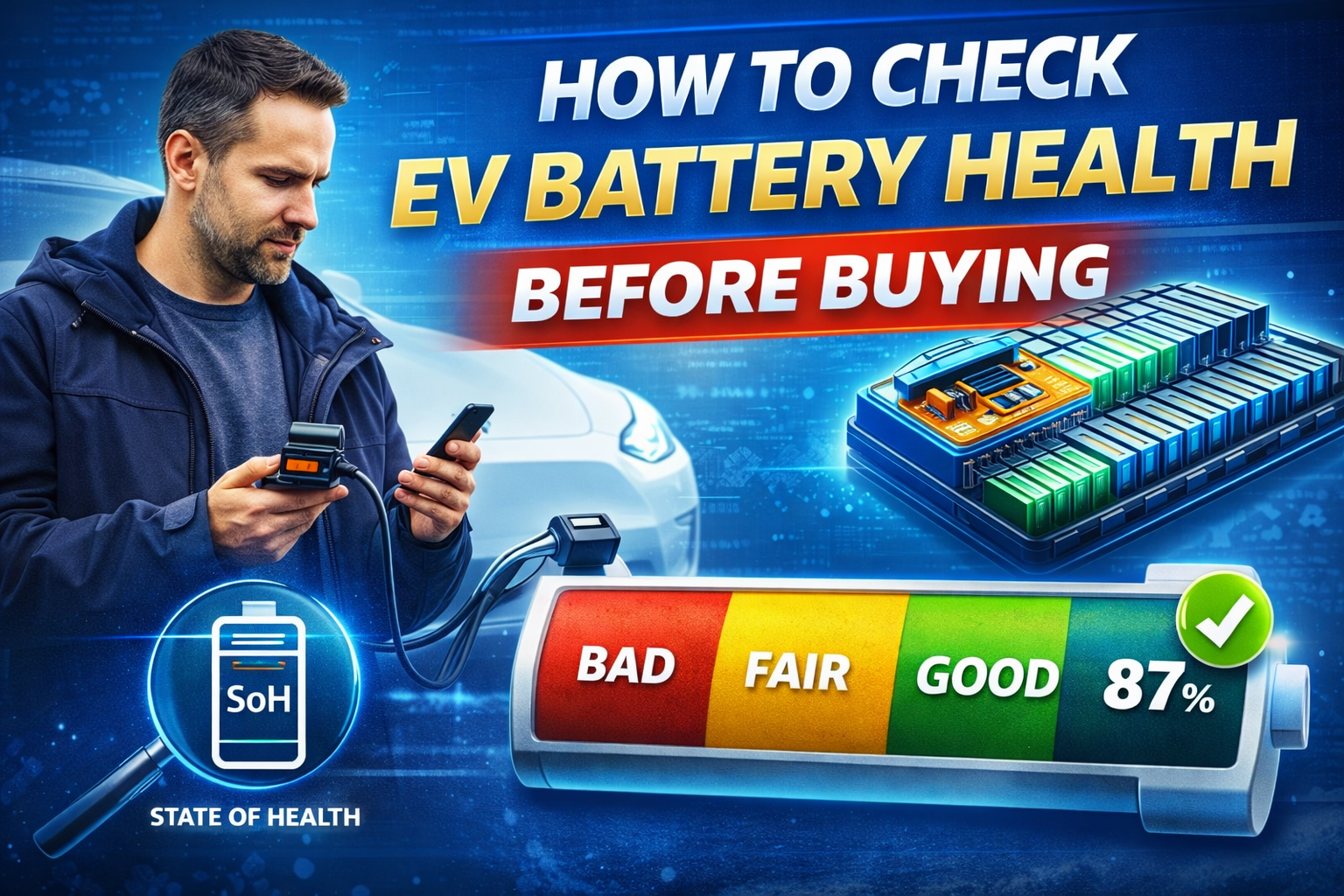
How to Check EV Battery Health Before Buying
Understanding Degradation, State of Health (SoH), and the Tools That Actually Help
If there’s one thing that makes used EV buyers nervous, it’s the battery.
That fear is understandable — the battery is the most expensive component in an electric vehicle. But here’s the reality most people miss:
Battery health is measurable, predictable, and usually better than expected.
This guide walks you through how to properly assess EV battery health before buying, what numbers actually matter, which tools help (and which don’t), and how to spot real red flags.
First: What “Battery Health” Actually Means
EV batteries don’t suddenly fail — they gradually lose capacity over time.
Battery health is usually expressed as State of Health (SoH).
State of Health (SoH) Explained
100% SoH = battery performs like new
90% SoH = ~10% capacity loss (very common)
80% SoH = noticeable loss, still very usable
Below ~70% SoH = often triggers warranty consideration
Most modern EVs are engineered to retain 80–90% capacity well past 160,000 km under normal use.
What Affects EV Battery Degradation?
Understanding why batteries degrade helps you judge risk properly.
Biggest factors:
Time (age matters as much as mileage)
Charging habits (frequent DC fast charging vs home charging)
Climate exposure (heat is worse than cold)
Battery thermal management (huge factor)
Cold Canadian winters do not permanently damage batteries — heat is far more harmful.
Step 1: Check the Remaining Battery Warranty
Before diving into diagnostics, start with the easiest protection.
For more on understanding EV warranties.
Most EVs sold in Canada include:
8-year / 160,000 km battery warranty
Coverage for excessive degradation (usually below ~70%)
Brands like Tesla, Hyundai, and Chevrolet all offer strong, transferable battery warranties.
If warranty remains, your risk drops dramatically.
Step 2: Read the Car’s Own Data (The Quick Reality Check)
Most EVs display estimated range based on recent driving.
How to use it properly:
Check range at a known charge level (e.g., 80%)
Compare against original EPA/WLTP ratings
Expect 10–15% loss on a healthy used EV
⚠️ Don’t panic over:
Low displayed range after aggressive driving
Winter-adjusted estimates
Short-trip bias
The guess-o-meter is a clue — not a verdict.
Step 3: Request a Battery Health Report (If Available)
Some sellers can provide:
Dealer battery reports
Manufacturer diagnostics
Fleet inspection summaries
These often include:
SoH percentage
Cell balance status
Error codes (if any)
Not all brands provide easy reports — which is where third-party tools help.
Step 4: Use OBD Diagnostics (The Gold Standard)
For serious buyers, this is where clarity lives.
What You Need:
OBD-II adapter (Bluetooth)
Compatible app
10–15 minutes with the car
Popular EV Battery Apps:
Scan My Tesla
LeafSpy
Car Scanner
These can show:
State of Health (SoH)
Usable battery capacity
Cell voltage balance
Charge cycles and temperature data
What you want to see:
SoH above ~85% on most 3–5 year-old EVs
Balanced cell voltages
No persistent battery fault codes
Step 5: Compare Mileage vs Degradation (Context Matters)
A common mistake is judging SoH without context.
Examples:
90% SoH at 100,000 km → Excellent
90% SoH at 30,000 km → Concerning
85% SoH at 5 years → Normal
75% SoH at 3 years → Red flag
Time + mileage together tell the real story.
Step 6: Watch for Real Red Flags
Some warning signs should make you pause — or walk away.
🚩 Red Flags
Salvage or rebuilt title (usually voids battery warranty)
Battery warnings on startup
Rapid range drops unrelated to weather
Inconsistent SoH readings
Seller refusing diagnostics
🚩 Model-Specific Caution
EVs without active thermal management (early **Nissan LEAF models) deserve extra scrutiny.
What’s “Normal” Degradation in Canada?
For most modern EVs:
1–2 years old: ~95–98% battery State of Health (SoH)
3–4 years old: ~90–95% SoH
5–6 years old: ~85–90% SoH
7–8 years old: ~80–85% SoH
These are average ranges, not hard limits, but they’re reassuring benchmarks when evaluating a used EV battery.
The Truth Most Buyers Miss
Battery degradation:
Is slow
Is predictable
Rarely ruins an EV’s usefulness
Is often covered by warranty
A used EV with 85–90% SoH still delivers:
Full daily usability
Reliable winter performance
Years of low-cost driving
Final Verdict: Battery Health Is a Number — Not a Mystery
You don’t need to “trust your gut” when buying a used EV.
You can measure the battery.
Check warranty.
Read the data.
Use diagnostics if needed.
Do that, and battery health becomes one of the least risky parts of buying a used electric car — not the most.