The True Cost of Owning a Used EV in Canada: Year 1 to Year 5
Most Canadians buy a used EV thinking about the purchase price. Then the insurance bill arrives, the electricity rate varies by province, and the five-year picture looks completely different from what they expected. The good news: when you run the real numbers, used EVs still win — often convincingly. But only if you go in with accurate expectations across every cost category.
This guide breaks down every dollar of used EV ownership from day one through year five: purchase price, charging costs, insurance, maintenance, and the battery replacement risk most buyers don't think about until it's too late. Then it compares all of it against an equivalent used gas car, province by province, so you can see exactly where you stand.
The Purchase Price Advantage: Why Buying Used Changes Everything
New EVs carry a meaningful price premium over equivalent gas cars — and that premium is largely absorbed by the first owner. By the time a 2020–2023 EV hits the used market, many models have lost 35 to 55% of their original value (GoElectric Calgary, 2026). That's painful for sellers. For you, it's an opportunity.
In 2026, the used market looks like this, according to Canada Drives:
Under $10,000: older Nissan Leafs (pre-2018)
Under $15,000: early Chevrolet Bolts, Kia Soul EVs
Under $20,000: Hyundai Kona Electric, Volkswagen e-Golf, BMW i3
Under $30,000: cleaner Kona EVs, Bolt EUVs, early Tesla Model 3s
Compare that to the used gas market, where the average used vehicle listing on AutoTrader sits around $36,816, versus $45,841 for the average used EV listing (Globe and Mail, 2026). That gap largely disappears once you factor in the depth of depreciation on older EV models — the sweet spot is 3–5 year old used EVs, where the biggest value drop has already happened.
What this means for your five-year TCO: a lower purchase price means less capital tied up, lower financing costs if you're borrowing, and more room for the operating savings to outperform gas from year one.
Charging Costs: What You'll Actually Pay to Drive
A typical mid-size EV uses approximately 16 kWh per 100 km (Natural Resources Canada). At 20,000 km per year — a reasonable Canadian average — that's 3,200 kWh annually. What that costs you depends entirely on where you live.
Province-by-Province Charging Cost at Home
Home charging is where EV economics really work. Public DC fast charging at 35–55¢/kWh is three to five times more expensive and should be considered an occasional convenience, not your primary fuelling strategy (VoltFlow, 2026). The numbers below assume home Level 2 charging at provincial average residential rates:
Quebec — 7.3–7.8¢/kWh → approximately $234–$250/year
Manitoba — 9.5–9.9¢/kWh → approximately $304–$317/year
British Columbia — 10.2¢/kWh (Step 1) → approximately $326/year
Ontario — 14.0¢/kWh average, or as low as 7.6¢/kWh overnight off-peak → approximately $243–$448/year depending on rate plan
Alberta — 16.5¢/kWh average (deregulated market, varies by retailer) → approximately $528/year
Nova Scotia / PEI — 18–18.4¢/kWh → approximately $576–$589/year
Compare all of those to gasoline. At Canada's national average of $1.55/litre in early 2026 (ThinkEV.ca) and a fuel-efficient gas car burning 7.5 litres per 100 km, you're spending approximately $2,325/year on fuel for 20,000 km. Even in the most expensive province for electricity, the EV costs less than a third of that. In Quebec, you're looking at a fuel saving of roughly $2,090 every single year (VoltFlow, 2026).
Over five years, that's $10,000–$11,500 in fuel savings in Quebec alone. In Alberta, where electricity is more expensive and gas is relatively cheaper, the annual saving is still approximately $1,800 per year — still $9,000 over five years.
Ontario drivers who shift charging to off-peak overnight hours (7.6¢/kWh) can reduce their annual charging bill to under $250, making Ontario one of the better provinces for EV economics despite its reputation for higher electricity costs.
Insurance: The Cost Most Buyers Don't See Coming
This is the one area where used EV ownership costs more than gas — and it matters. According to Surex data covering 12 months of Canadian premiums, EV owners pay an average of $3,131 per year in insurance versus $2,289 for gas-car owners — a 36.8% gap (Surex, 2026). Over five years, that's roughly $4,200 more in insurance premiums.
Why the difference? The battery pack is the primary driver. At $7,500 to $25,000 for replacement depending on the model, insurers price in the possibility of a total battery loss after a significant collision or flood event. EV repairs also average more per claim — Mitchell data cited in the Globe and Mail (2026) showed EV repairs averaging $7,026 per incident versus $5,345 for gas vehicles.
The good news for used EV buyers: a used EV is worth less than a new one, which means a lower replacement cost for insurers to price. You will generally pay less to insure a $22,000 used Chevy Bolt than a $45,000 new Ioniq 6. Shop around — rates vary significantly between insurers and the EV insurance market is maturing quickly as more claims experience accumulates.
Also worth noting: Alberta adds a $200 annual EV road-use tax on registration, and Saskatchewan charges $150 annually. Factor those in if you're in either province.
Maintenance: Where Used EVs Win Back the Insurance Gap and Then Some
No oil changes. No transmission service. No timing belt. No spark plugs. No exhaust repairs. These aren't marketing claims — they're engineering realities, and they add up fast.
Typical annual maintenance on a mainstream used EV runs $150–$400 per year for routine items like tire rotations, cabin air filters, brake fluid checks, and battery coolant service. A comparable gas car runs $900–$1,800 per year when you include oil changes, transmission fluid, belts, and the inevitable minor repairs that multiply as the car ages (Recharged, 2025).
That's a saving of roughly $500–$1,400 per year on maintenance alone. Over five years: $2,500–$7,000 back in your pocket.
The one maintenance area where EVs can surprise you: tires. EVs are heavier than equivalent gas cars, and instant torque from the electric motor accelerates tire wear. Budget an extra $150–$250 per year specifically for tires, and make sure you're replacing them with EV-appropriate rubber — a cheap generic tire will cost you range and tread life.
Brakes are the opposite story. Regenerative braking does the vast majority of the slowing work, which means physical brake pads can last 75,000–100,000+ km on an EV versus 50,000–70,000 km on a gas car (Recharged, 2026). Your brake replacement cadence essentially halves. Over five years of normal driving, most used EV owners never need a brake job at all.
Battery Replacement Risk: What Are the Realistic Odds?
Battery replacement is the number one fear used EV buyers have — and in most cases, it's overblown. But it deserves a clear-eyed answer rather than reassurance.
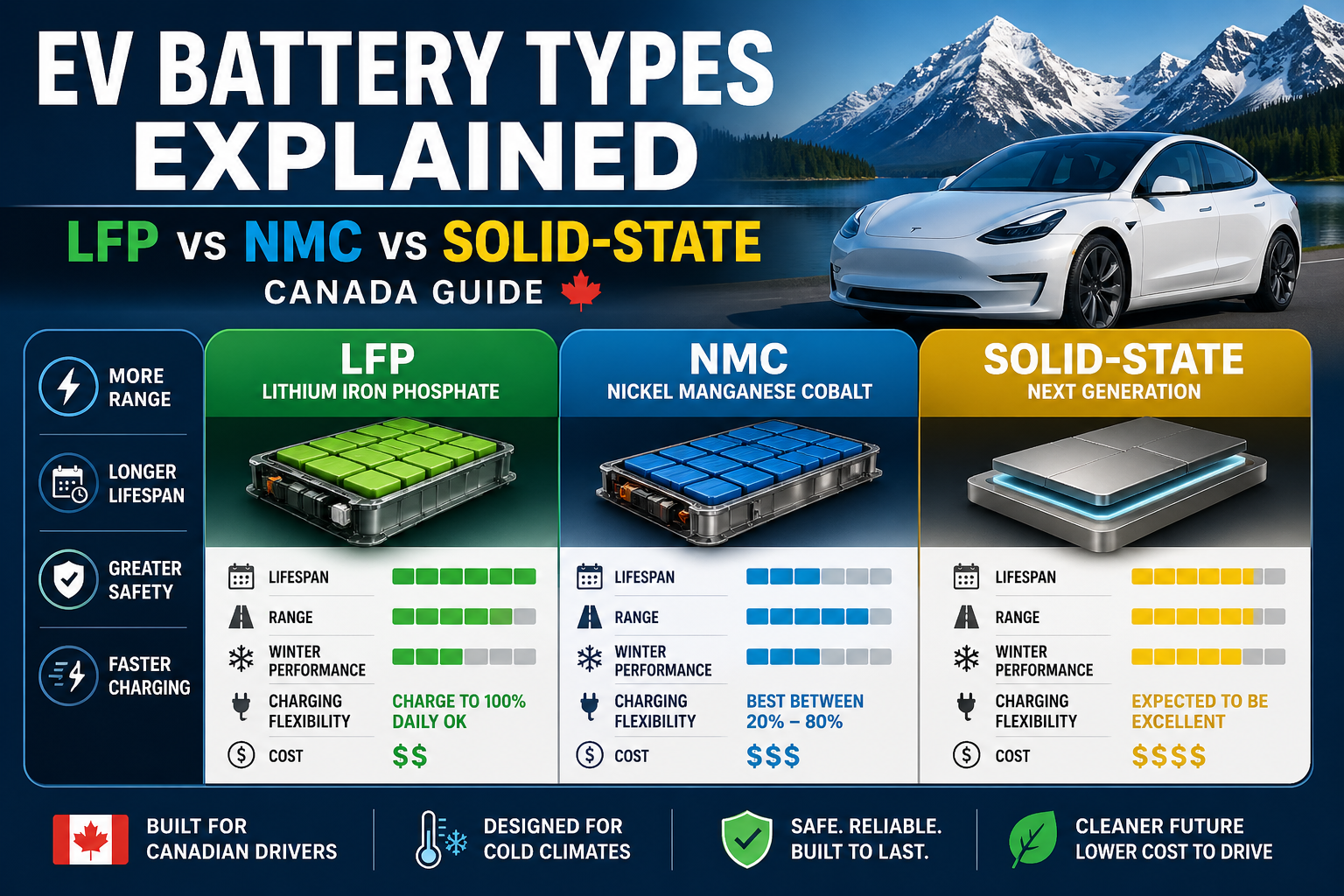
Data consistently shows that most EVs with liquid-cooled thermal management retain 80% or more of their original battery capacity past 160,000 km. The Hyundai Kona Electric, Chevrolet Bolt, Kia Soul EV, and Tesla Model 3 all use liquid cooling, and all have strong real-world track records (Canada Drives, 2026). Most batteries are also covered by manufacturer warranty — typically 8 years or 160,000 km — which means many used EVs you're shopping in 2026 still have active battery warranty coverage.
The genuine exception is pre-2018 Nissan Leafs with passive air cooling. These packs are vulnerable to heat-related degradation and can show significant capacity loss, especially in warmer climates or with heavy fast-charging use. If you're buying one of these, get a battery State of Health (SoH) diagnostic first. Below 70% SoH, the economics of ownership change substantially.
If you do need a replacement pack on a modern EV outside warranty, expect $8,000–$15,000 for most mainstream models. That's a real risk, but it's also a low-probability one on vehicles under 150,000 km with documented charging history. Price it as a low-probability tail risk, not a certainty — and factor it into your purchase price negotiation if SoH is below 80%.
The Five-Year TCO: Used EV vs. Equivalent Used Gas Car
Let's put the full picture together with a realistic comparison. The scenario: a used 2021 Chevrolet Bolt EV purchased for $18,000 versus a used 2021 Honda Civic purchased for $18,000. Both driven 20,000 km per year in Ontario for five years.
Used 2021 Chevrolet Bolt EV
Purchase price: $18,000
Fuel (5 years, Ontario off-peak charging): ~$1,215
Insurance (5 years, $3,131/yr average): ~$15,655
Maintenance (5 years, $300/yr average): ~$1,500
Alberta/Saskatchewan road-use tax: N/A (Ontario)
Five-year total: ~$36,370
Used 2021 Honda Civic
Purchase price: $18,000
Fuel (5 years, $2,325/yr): ~$11,625
Insurance (5 years, $2,289/yr average): ~$11,445
Maintenance (5 years, $1,200/yr average): ~$6,000
Five-year total: ~$47,070
The Bolt saves approximately $10,700 over five years despite paying more in insurance, because fuel and maintenance savings overwhelm the premium gap. In Quebec, where electricity is 7.3¢/kWh and fuel savings are even larger, the advantage grows to roughly $13,000–$14,000 over the same period.
The math flips only in one specific scenario: if you're relying primarily on public DC fast charging at 35–55¢/kWh. At those rates, the fuel cost advantage narrows significantly. Home charging is what makes these numbers work — if you can't charge at home, the economics are less compelling.
Bottom Line
Over five years, a used EV beats an equivalent used gas car on total cost of ownership for the majority of Canadian drivers — typically by $8,000–$14,000 depending on province, with Quebec and Ontario off-peak drivers seeing the largest gains. Insurance is the one genuine cost disadvantage, running about $840 more per year on average, but it's more than offset by fuel savings of $1,800–$2,300 per year and maintenance savings of $500–$1,400 per year. The biggest wildcard is battery health — verify State of Health before you buy, avoid pre-2018 passive-cooled Leafs unless the price reflects the risk, and check whether any remaining manufacturer warranty still applies. Do those things and the numbers speak for themselves.
Sources & Further Reading
VoltFlow — Province-by-province EV charging costs for 2026, annual fuel savings projections — voltflow.net
Surex / BeInsure — Canadian EV vs. gas insurance premium data, 36.8% gap, provincial breakdown — surex.com
Recharged — Annual EV maintenance cost benchmarks, brake pad longevity data, maintenance vs. gas comparison — recharged.com
ThinkEV.ca — Five-year TCO modelling for Canadian buyers, 2026 fuel and electricity price data — thinkev.ca
Canada Drives — Used EV pricing benchmarks by model and budget in Canada, 2026 — canadadrives.ca
EnergyRates.ca — EV vs. gas cost comparison in Canada, depreciation data, road-use tax details — energyrates.ca
The Globe and Mail — Average repair cost data (Mitchell), used EV vs. gas listing prices on AutoTrader — theglobeandmail.com
CAA EV Buyer's Guide — EV ownership cost overview, break-even analysis, Canadian driver survey data — evbuyersguide.caa.ca