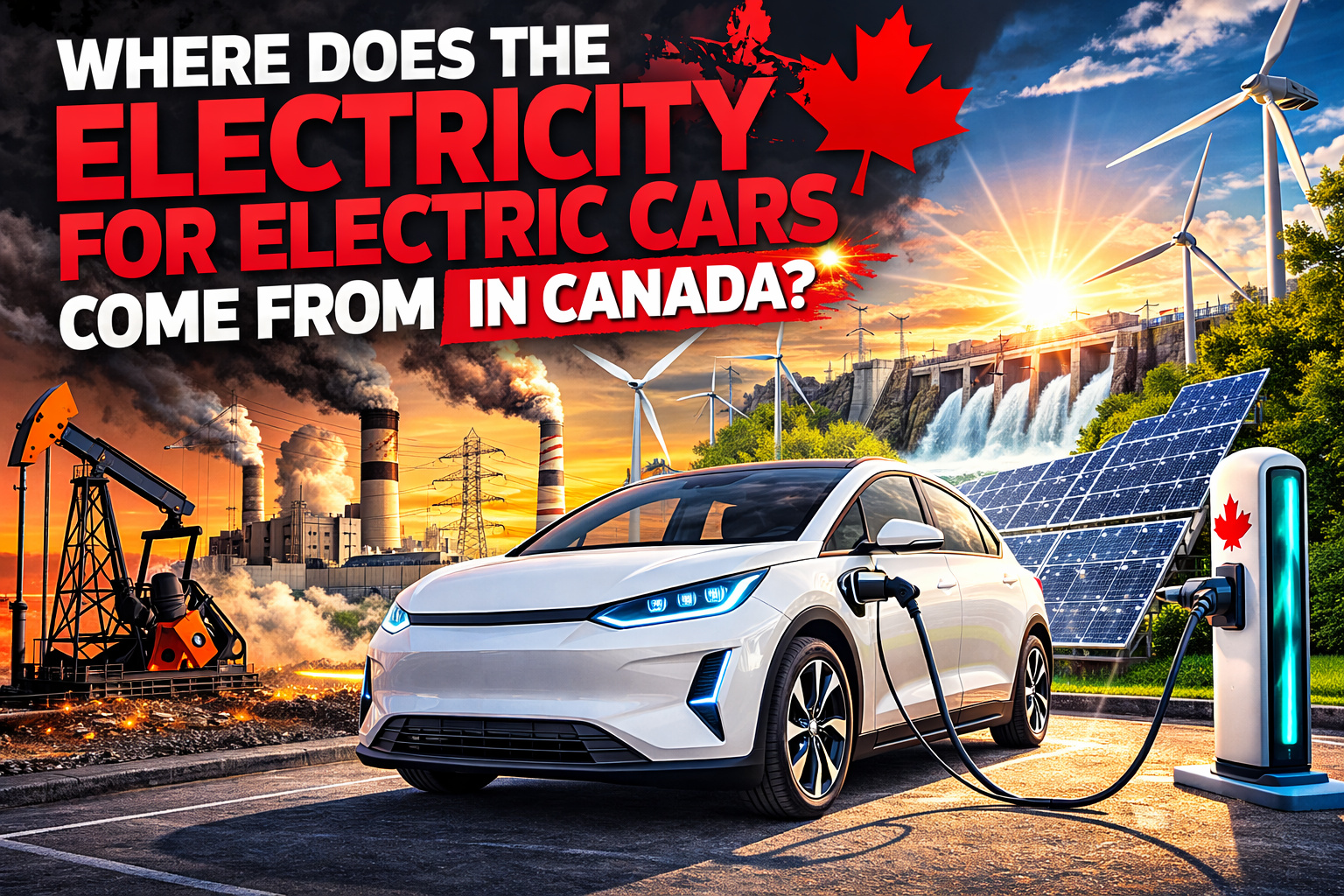
Where Does the Electricity for Electric Cars Come From in Canada?
One of the most common questions about electric vehicles is surprisingly simple:
“Where does the electricity actually come from?”
It’s a fair question. While EVs don’t burn gasoline directly, they still rely on electricity generated somewhere on the power grid.
The answer in Canada is encouraging: most electricity used to charge EVs comes from very low-carbon sources.
In this guide, we’ll break down:
Where EV charging electricity comes from
Canada’s electricity mix by source
How clean EV charging really is
Why EVs still reduce emissions even on fossil-heavy grids
⚡ How EV Charging Works
When you charge an electric vehicle, the electricity comes from the same grid that powers homes, businesses, and cities.
This means the power could come from a variety of sources such as:
Hydroelectric dams
Nuclear plants
Wind farms
Solar power
Natural gas plants
The exact source depends on where you live and when you charge.
If you’re new to EV ownership, you can learn more about the practical side of charging here:
👉 Home EV Charging Guide
https://usedelectriccarscanada.ca/charging-costs/home-charging-guide
Most EV drivers charge overnight at home using a Level 2 charger.
🇨🇦 Canada’s Electricity Is Already Very Clean
Canada has one of the cleanest electricity grids in the world.
According to Natural Resources Canada, about 82% of electricity in Canada comes from non-emitting sources.
The largest sources include:
Hydroelectric power
Hydro is the backbone of Canada’s electricity system.
Large dams in provinces like:
British Columbia
Quebec
Manitoba
generate massive amounts of renewable electricity.
Hydro alone produces roughly 60% of Canada’s electricity.
Nuclear energy
Nuclear power is another major contributor, especially in Ontario.
Nuclear plants generate large amounts of electricity with virtually zero carbon emissions.
Wind and solar
Renewable energy is growing quickly in Canada.
Wind farms in Alberta, Saskatchewan, and Ontario are adding significant capacity each year.
Solar is still a smaller contributor but expanding rapidly.
⚡ Provincial Differences in Electricity
Canada’s grid varies significantly by province.
Here’s a simplified look at the electricity mix in major regions.
British Columbia
Mostly hydroelectric power.
EV charging here is extremely low carbon.
Quebec
Almost entirely hydroelectric.
EVs in Quebec have one of the lowest carbon footprints in the world.
Ontario
Combination of:
Nuclear
Hydroelectric
Wind
Natural gas
Still relatively clean compared to most countries.
Alberta and Saskatchewan
These provinces rely more heavily on:
Natural gas
Some coal (rapidly declining)
Even here, EVs can still reduce emissions compared to gasoline vehicles.
🔋 Are EVs Still Cleaner if Electricity Comes From Fossil Fuels?
Yes.
Even in regions with fossil fuel power plants, EVs are usually more efficient than gasoline vehicles.
Why?
Gasoline vehicles waste a large amount of energy as heat.
Internal combustion engines typically convert only about:
20–30% of fuel energy into motion.
Electric vehicles are far more efficient.
EV drivetrains convert roughly:
80–90% of energy into motion.
This efficiency advantage means EVs often produce lower total emissions even on fossil-heavy grids.
⚡ Charging at Home vs Public Chargers
Where you charge doesn’t usually change where the electricity comes from.
Public chargers are connected to the same grid as homes.
However, some charging networks purchase renewable energy credits or source electricity from clean energy providers.
You can learn more about charging costs in Canada here:
👉 Home Charging Costs in Canada
https://usedelectriccarscanada.ca/charging-costs/home-charging-guide
You can also estimate your savings using our tool:
👉 EV vs Gas Savings Calculator
https://usedelectriccarscanada.ca/calculators
🔌 Charging When Renewable Energy Is Available
Some EV owners try to charge when renewable energy production is highest.
For example:
Solar power peaks during midday
Wind production often increases overnight
Smart charging systems are beginning to help drivers automatically charge during cleaner grid periods.
Over time, this could make EV charging even cleaner.
🚗 EVs and the Future Power Grid
Electric vehicles are also becoming part of the future energy system.
New technologies like vehicle-to-grid (V2G) allow EV batteries to:
store electricity
stabilize the grid
return power when needed
As renewable energy expands, EVs may help balance electricity supply and demand.
🏆 The Bottom Line
Electric vehicles are only as clean as the electricity that powers them — but in Canada, that electricity is already very low carbon.
Because Canada relies heavily on hydro, nuclear, and other non-emitting sources, EV charging here produces far fewer emissions than gasoline vehicles.
As renewable energy continues to grow, the electricity powering EVs will become even cleaner over time.
For many Canadian drivers, switching to electric already means:
lower fuel costs
fewer emissions
a cleaner transportation system overall
Sources & Further Reading
Natural Resources Canada – Electricity in Canada
https://natural-resources.canada.ca
Canada Energy Regulator – Canada’s Energy Future
https://www.cer-rec.gc.ca
International Energy Agency – Global EV Outlook
https://www.iea.org
Government of Canada – Electricity Generation
https://www.canada.ca