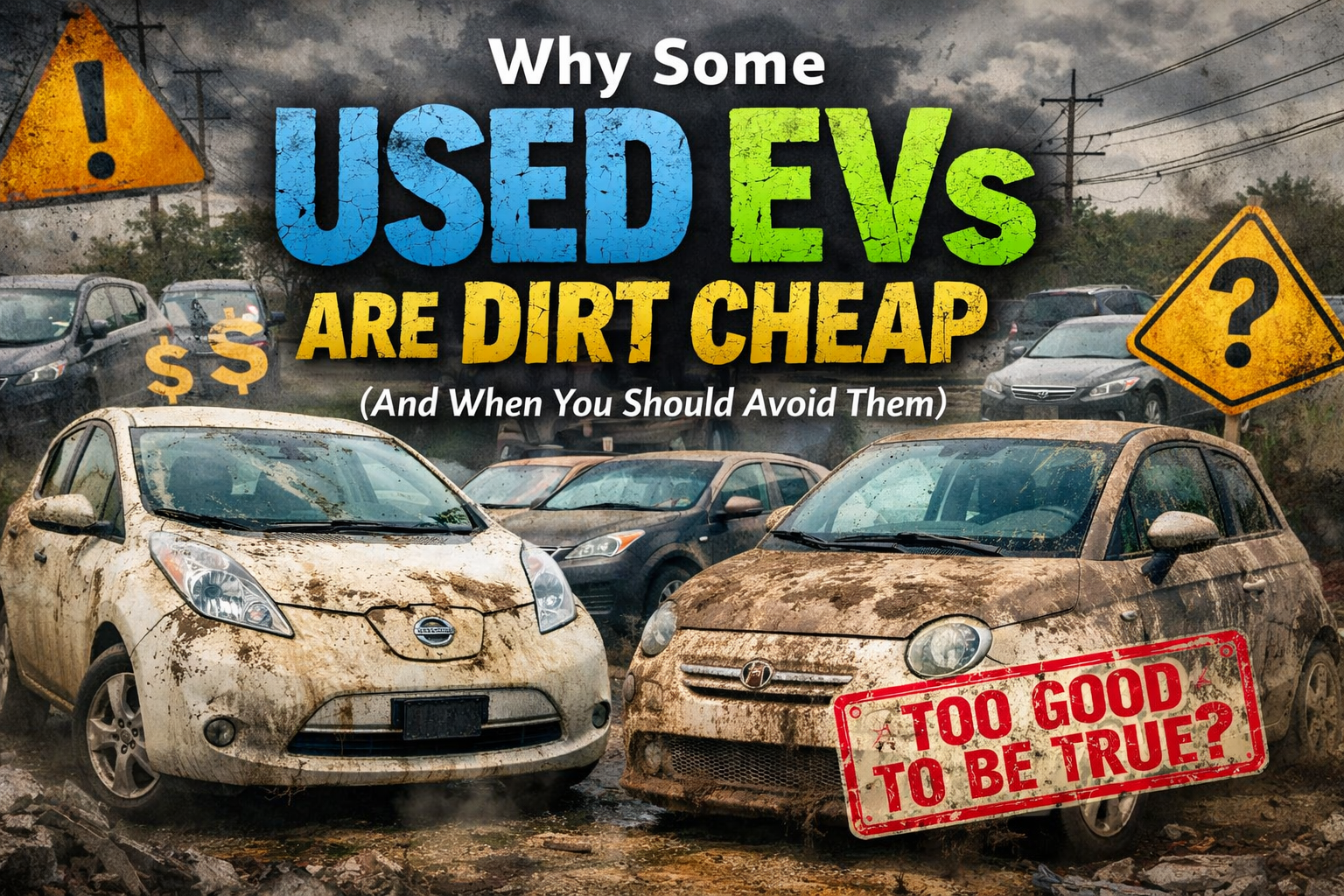
Why Some Used EVs Are Dirt Cheap (And When You Should Avoid Them)
Scroll any used-car marketplace in Canada and you’ll see it: electric vehicles priced shockingly low. $9,000 EVs. $12,000 EVs. Sometimes cheaper than a used Corolla.
So what’s the catch?
The truth is, some used EVs are cheap for good reasons — and others are cheap because buyers misunderstand them. Knowing the difference can save you thousands… or cost you far more than you expected.
Let’s break it down.
The 4 Main Reasons Some Used EVs Are So Cheap
1️⃣ Short Real-World Range (Early EV Reality)
Many early EVs were designed for city commuting, not modern expectations.
Common examples:
2011–2016 Nissan Leaf (24 kWh)
Mitsubishi i-MiEV
Fiat 500e (early years)
Smart EQ Fortwo
Typical real-world range today:
90–140 km in summer
60–90 km in winter
That range drop is especially noticeable in cold climates like Canada. If you haven’t already, this pairs directly with Winter Range Loss in EVs.
💡 When this is OK:
Second car
Short city commute
Home charging every night
🚩 When to avoid:
Highway driving
No home charging
Long winters without battery preconditioning
2️⃣ Battery Degradation Fear (Sometimes Overblown)
Battery health scares people — often more than it should.
Here’s the reality for most modern EVs:
1–2 years old → ~95–98% SoH
3–4 years old → ~90–95% SoH
5–6 years old → ~85–90% SoH
7–8 years old → ~80–85% SoH
Degradation is gradual, not sudden. But early EVs without:
Active thermal management
Liquid-cooled batteries
…can degrade faster, especially if fast-charged often.
This ties directly into How Long Do EV Batteries Last?.
💡 Good cheap buy if:
Battery health is documented
Warranty remains
You understand the reduced range
🚩 Avoid if:
Seller can’t provide battery info
Vehicle sat unused for long periods
No remaining battery warranty
3️⃣ “Compliance Cars” Nobody Wanted New
Some EVs were built just to satisfy emissions rules — not to be great cars.
Common signs:
Sold only in limited provinces/states
Minimal marketing
Poor fast-charging support
Low production numbers
Examples include:
Early Fiat 500e
Chevy Spark EV
First-gen Ford Focus Electric
These cars often:
Charge slowly
Use outdated connectors
Lack DC fast charging altogether
That’s why they age fast in the used market.
Before buying, check EV Charging Networks in Canada to see if your local infrastructure even supports them well.
4️⃣ Expensive Out-of-Warranty Repairs
Here’s the uncomfortable truth: cheap EVs can become expensive cars quickly if something major fails.
Common high-cost risks:
On-board charger failure
DC-DC converter issues
Proprietary parts no longer supported
Limited independent repair options
Unlike gas cars, not every mechanic can service every EV — especially older, low-volume models.
💡 Safe buy if:
Warranty still active
Strong owner community exists
Parts availability is confirmed
🚩 Avoid if:
Dealer support is gone
Parts are discontinued
Repairs require brand-specific tools
When Cheap Used EVs Actually Make Sense
Not all cheap EVs are bad buys. Some are perfect for the right person.
Cheap EVs work well if you:
Drive under 50 km/day
Have reliable home charging
Want ultra-low running costs
Treat it like an appliance, not a road-trip car
They’re especially attractive when compared to gas cars in terms of:
No oil changes
Minimal brake wear
Lower maintenance overall
This cost advantage is detailed in Are Used Electric Cars Worth It in Canada?.
Red Flags That Should Make You Walk Away
🚫 No battery health info
🚫 No charging cable included
🚫 “Fast charging doesn’t work”
🚫 Imported compliance models without Canadian support
🚫 Unrealistically low pricing with vague descriptions
If a deal feels too cheap — it usually is.
The Bottom Line
Used EVs aren’t cheap by accident.
They’re cheap because of:
Short range
Early tech limitations
Buyer misconceptions
Or real ownership risks
But with the right expectations, some of the cheapest EVs in Canada can also be some of the best value transportation available today.
The key isn’t avoiding cheap EVs — it’s knowing which cheap EVs to avoid.
Sources & Further Reading
Natural Resources Canada – Electric Vehicle Range & Cold Weather Performance
https://natural-resources.canada.ca/energy-efficiency/transportation-alternative-fuels/electric-vehicles/understanding-rangeTransport Canada – Zero-Emission Vehicles in Canada
https://tc.canada.ca/en/road-transportation/innovative-technologies/zero-emission-vehiclesConsumer Reports – How Long Do EV Batteries Last?
https://www.consumerreports.org/cars/electric-vehicles/how-long-do-ev-batteries-last-a2799030382/InsideEVs – Battery Degradation Data & Studies
https://insideevs.com/news/525820/ev-battery-degradation-replacement-study/Nissan Canada – EV Battery Warranty Info
https://www.nissan.ca/vehicles/electric-cars/leaf/faq.html