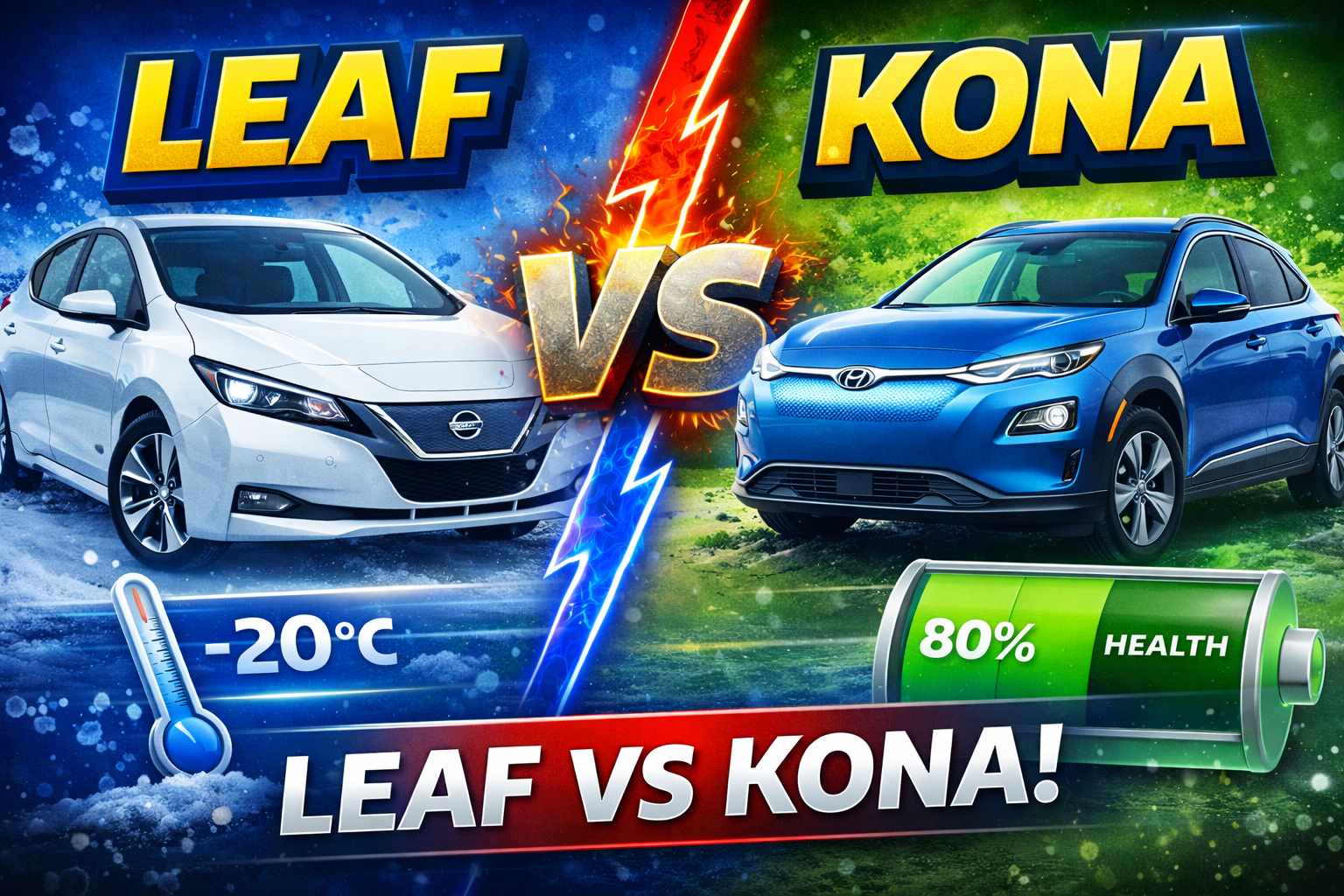
Nissan LEAF vs Hyundai Kona Electric: Which Ages Better as a Used EV?
Battery Longevity, Range Retention, and Long-Term Reliability Compared
If you’re shopping for a used compact electric vehicle in Canada, two names come up again and again:
The Nissan LEAF
and the Hyundai Kona Electric
On paper, they can look surprisingly similar — practical size, strong efficiency, and attractive used prices. But when it comes to long-term ownership, these two EVs age very differently.
This comparison focuses on what really matters to used buyers:
Battery longevity
Range retention over time
Winter performance
Reliability as the kilometres add up
In short: which one holds up better after years on Canadian roads?
The Core Difference (And Why It Matters So Much)
Before diving into numbers, there’s one fundamental design choice that shapes everything else:
Nissan LEAF: Passive Battery Cooling
Hyundai Kona Electric: Active Battery Thermal Management
That single difference explains most of the long-term gap between these two vehicles.
Let’s break it down.
Battery Longevity: The Deciding Factor
Nissan LEAF
The LEAF uses passive air cooling, meaning:
No liquid cooling system
Battery temperature relies largely on ambient conditions
Heat and repeated fast charging accelerate degradation
What this means in real life:
Batteries degrade faster over time
Winter range loss feels more severe as the battery ages
High-kilometre LEAFs show wider variation in health
Typical real-world data:
3–4 years: ~85–90% SoH (best case)
6–8 years: ~70–80% SoH (very common)
Early models can dip lower
If you’re considering a LEAF, understanding how to verify these numbers matters.
(How to Check EV Battery Health Before Buying)
Hyundai Kona Electric
The Kona Electric uses liquid-cooled battery thermal management.
Why that matters:
Battery stays within optimal temperature range
Slower, more predictable degradation
Better long-term health across climates
Typical real-world data:
3–4 years: ~90–95% SoH
6–8 years: ~85–90% SoH
Far fewer outliers
Battery verdict:
➡️ Kona Electric ages significantly better
Range Retention Over Time
Nissan LEAF
Even when new, range mattered — and as LEAFs age, it matters more.
Common experience:
Gradual but noticeable range loss
Winter range feels especially tight on older batteries
Plus models fare better, but still degrade faster
A used LEAF that once felt “fine” can slowly become:
A city-only car
A second vehicle
Or a commuter with strict planning needs
Much of this becomes more obvious in cold weather.
(How Much Range Do You Really Lose in Winter?)
Hyundai Kona Electric
The Kona’s range advantage holds up better over time.
Why:
Better battery protection
Efficient drivetrain
Consistent winter performance year after year
Owners commonly report:
Stable usable range even after 100,000+ km
Predictable winter losses
Less year-to-year change
Range verdict:
➡️ Kona retains usable range longer
Winter Performance in Canada
Nissan LEAF
Winter exposes the LEAF’s weaknesses faster.
Challenges:
No battery preconditioning
Reduced regen in cold conditions
Faster winter degradation over multiple seasons
Short trips are fine — but longer winter drives require careful planning, especially on older packs.
Hyundai Kona Electric
The Kona Electric is far more winter-competent.
Strengths:
Battery thermal management
Available heat pump on many trims
Better cold-weather charging performance
This results in:
More consistent winter range
Faster recovery after charging
Less seasonal anxiety
Why heat pumps matter is often underestimated.
(Heat Pumps vs Resistive Heating: What Matters)
Winter verdict:
➡️ Kona is clearly better suited to Canadian winters
Reliability Beyond the Battery
Nissan LEAF
Positives:
Very simple drivetrain
Few mechanical issues
Cheap parts and service
Negatives:
Battery degradation overshadows everything
CHAdeMO charging standard is aging out
Long-term resale value suffers
Hyundai Kona Electric
Positives:
Strong overall reliability
Conservative battery management
Modern CCS charging standard
Better long-term resale confidence
Watch-outs:
Early battery recall models (mostly resolved)
Verify recall completion before buying
Reliability verdict:
➡️ Kona offers better all-around long-term ownership
For official recall and safety information, it’s always smart to check directly.
(External source: Transport Canada – Vehicle Recalls)
https://recalls-rappels.canada.ca
Charging & Future-Proofing
Nissan LEAF
Uses CHAdeMO fast charging
Fewer new installations each year
Still usable — but clearly declining in support
Hyundai Kona Electric
Uses CCS
Widely supported across Canada
Compatible with most modern fast-charging networks
Charging verdict:
➡️ Kona is far more future-proof
Cost vs Value (Used Market Reality)
Here’s where the LEAF fights back.
Nissan LEAF
Usually cheaper upfront
Attractive entry point into EV ownership
Makes sense as:
A short-range commuter
A second household vehicle
A city-only EV
Hyundai Kona Electric
Higher used prices
Better long-term value
More flexible for:
One-car households
Highway driving
Cold climates
Which One Actually Ages Better?
There’s no contest here — the Hyundai Kona Electric ages better.
It offers:
Slower battery degradation
Better winter resilience
More consistent range
Stronger long-term usability
The Nissan LEAF still has a place — but it’s a narrower one.
Final Verdict: Pick Based on How Long You Plan to Keep It
Choose the Nissan LEAF if:
Price is your top priority
Your driving is short and predictable
You charge at home
You accept declining range over time
Choose the Hyundai Kona Electric if:
You want long-term ownership
Winter driving matters
You need flexibility and range stability
You want a used EV that still feels “modern” in five years
If you’re thinking in years instead of months, the Kona Electric is the smarter bet.