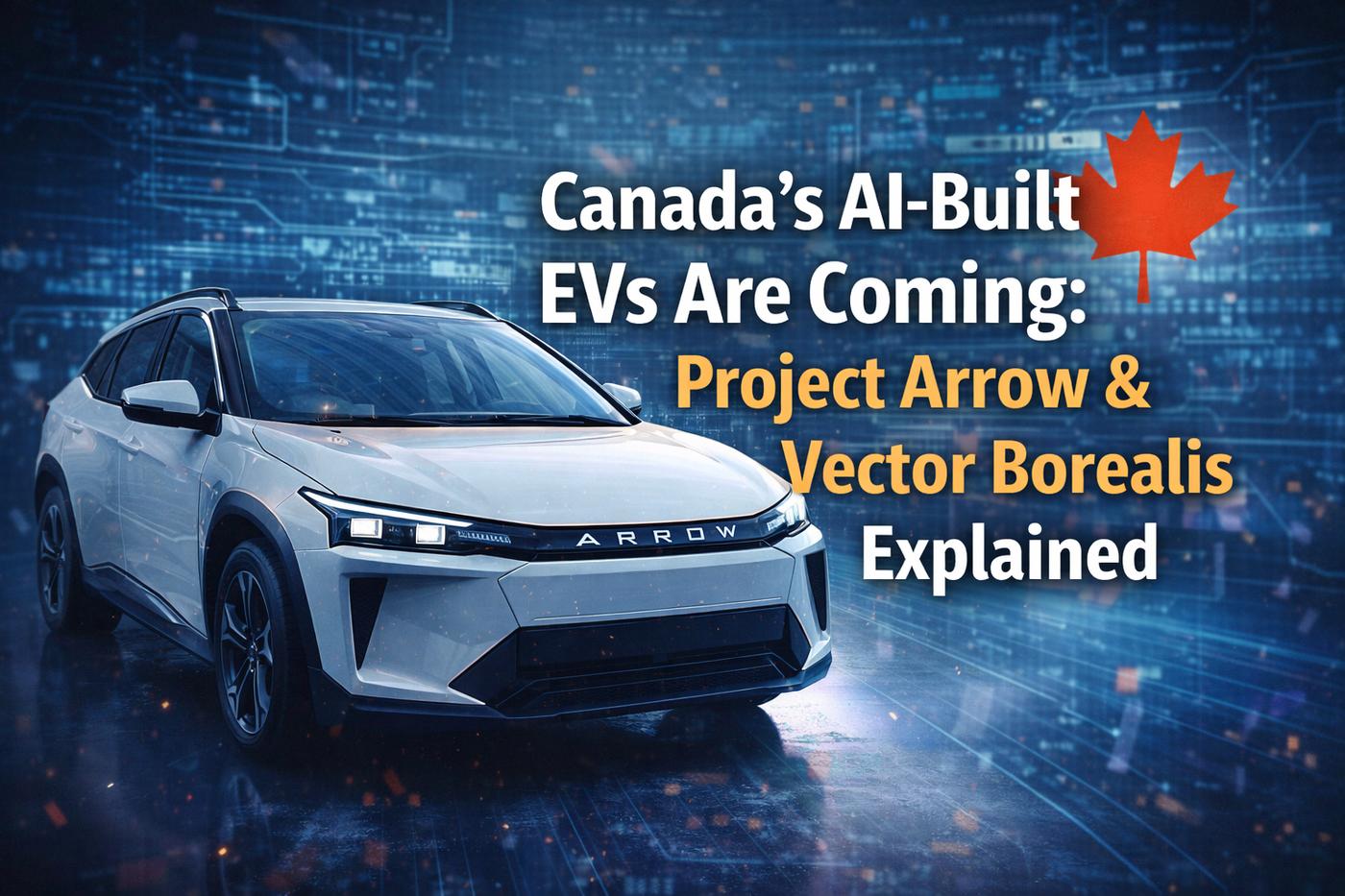
Canada’s AI-Built EVs Are Coming: Project Arrow & Vector Borealis Explained
Canada may not have a Tesla-sized EV giant — but it’s quietly building something ambitious.
Two Canadian-developed electric vehicles — Project Arrow and the Vector Borealis — are aiming to prove that Canada can design, engineer, and manufacture advanced EVs powered heavily by artificial intelligence and domestic supply chains.
Here’s what these vehicles are, why they matter, and whether they’re realistic contenders in the Canadian EV market.
🇨🇦 What Is Project Arrow?
Project Arrow is a fully Canadian-developed electric concept vehicle led by the Automotive Parts Manufacturers’ Association (APMA).
The goal?
To showcase:
Canadian EV innovation
Domestic supply chains
AI-driven vehicle systems
Homegrown battery and software integration
Unlike traditional automakers, Project Arrow is built as a technology demonstrator — meaning it highlights what Canadian companies can do, rather than serving as a mass-production model (at least not yet).
The project emphasizes:
AI-integrated driver assistance
Connected vehicle software
Canadian-sourced components
Advanced battery and electronics systems
It’s essentially a proof-of-concept that Canada can build modern EV platforms end-to-end.
🚙 What About the Vector Borealis?
The Vector Borealis is being positioned as a more production-oriented evolution of the Arrow concept.
According to reporting from InsideEVs, the Borealis aims to become:
A real, drivable Canadian EV
Focused on cold-climate performance
Powered by domestic engineering
It’s expected to lean heavily on:
Canadian battery innovation
AI-enhanced vehicle software
Winter durability design
If it reaches production, it would be one of the few EVs built explicitly with Canadian climate and driving conditions in mind.
That matters.
👉 Related:
Best EVs for Canadian Winters
https://usedelectriccarscanada.ca/winter-climate/best-evs-for-winter
🤖 Where AI Comes In
This isn’t just about electric motors.
Both projects highlight:
AI-powered driver assistance
Smart energy management systems
Software-defined vehicle architecture
Over-the-air updates
Modern EVs are increasingly computers on wheels. Canada’s push here isn’t just about manufacturing — it’s about positioning itself in the AI-driven automotive future.
As vehicles become more software-centric, national strategy matters just as much as battery chemistry.
🔋 Why This Matters for the Used EV Market
At first glance, concept EVs don’t impact used buyers.
But zoom out.
Here’s why this matters:
1️⃣ Domestic EV Supply Stabilizes Prices
If Canada produces more EVs domestically, long-term pricing volatility decreases.
2️⃣ More New EVs = More Future Used EVs
Just like we’re seeing now with lease returns, today’s new EV production becomes tomorrow’s used inventory.
👉 Context:
Why EV Prices Are Falling Faster Than Gas Cars in Canada
https://usedelectriccarscanada.ca/charging-costs/why-ev-prices-are-falling-faster-than-gas-cars-in-canada
3️⃣ AI Integration Changes Resale Value
Software-defined vehicles may:
Age differently
Improve via updates
Retain value based on feature unlocks
That’s a very different resale dynamic compared to traditional gas vehicles.
🏭 Is This a Real Tesla Competitor?
Let’s be realistic.
Project Arrow is:
A technology showcase
A supply chain demonstrator
A strategic industrial statement
It is not yet:
A production-ready mass-market competitor
A nationwide dealer-backed platform
A price-disrupting alternative to Tesla, Hyundai, or Ford
The Vector Borealis moves closer to that vision — but production scale, service networks, and charging compatibility will determine its real impact.
👉 Charging reality:
Tesla vs CCS Charging in Canada
https://usedelectriccarscanada.ca/charging-costs/tesla-vs-ccs-canada
❄️ Built for Canada?
One promising angle is climate focus.
If a Canadian-built EV:
Prioritizes heat pump efficiency
Designs battery thermal systems for -30°C
Optimizes AWD tuning for snow
…it could outperform many global EVs not specifically engineered for extreme winter.
That would be a genuine differentiator.
💰 The Big Question: Will It Be Affordable?
Industrial strategy and innovation are exciting.
But for Canadian buyers, the real questions are:
Will it qualify for federal EV incentives?
Will it be priced under rebate caps?
Can it compete with used EV pricing already falling?
👉 Related:
Canada’s New EV Subsidy: What It Means for Buyers (And Used EVs)
https://usedelectriccarscanada.ca/News/canadas-new-ev-subsidy-is-here-what-it-really-means-for-buyers-and-used-evs
If these vehicles launch at premium pricing, they’ll struggle against rapidly depreciating used EVs already available across the country.
🧠 Final Take
Project Arrow and the Vector Borealis aren’t just cars — they’re strategic statements.
They signal that:
Canada wants a stake in AI-driven vehicle development
Domestic EV production is a national priority
The future of cars is software, not just hardware
Whether these vehicles reach mass production or remain innovation showcases, they reflect a broader truth:
The EV race is no longer just about batteries — it’s about AI, software ecosystems, and national supply chains.
For Canadian buyers, that means the next generation of EVs could look very different from the first.
🔗 Sources
InsideEVs – Canada’s Project Arrow & Vector Borealis report
https://insideevs.com/news/787202/canada-project-arrow-vector-borealis-2026/Official Project Arrow Website
https://www.projectarrow.ca/