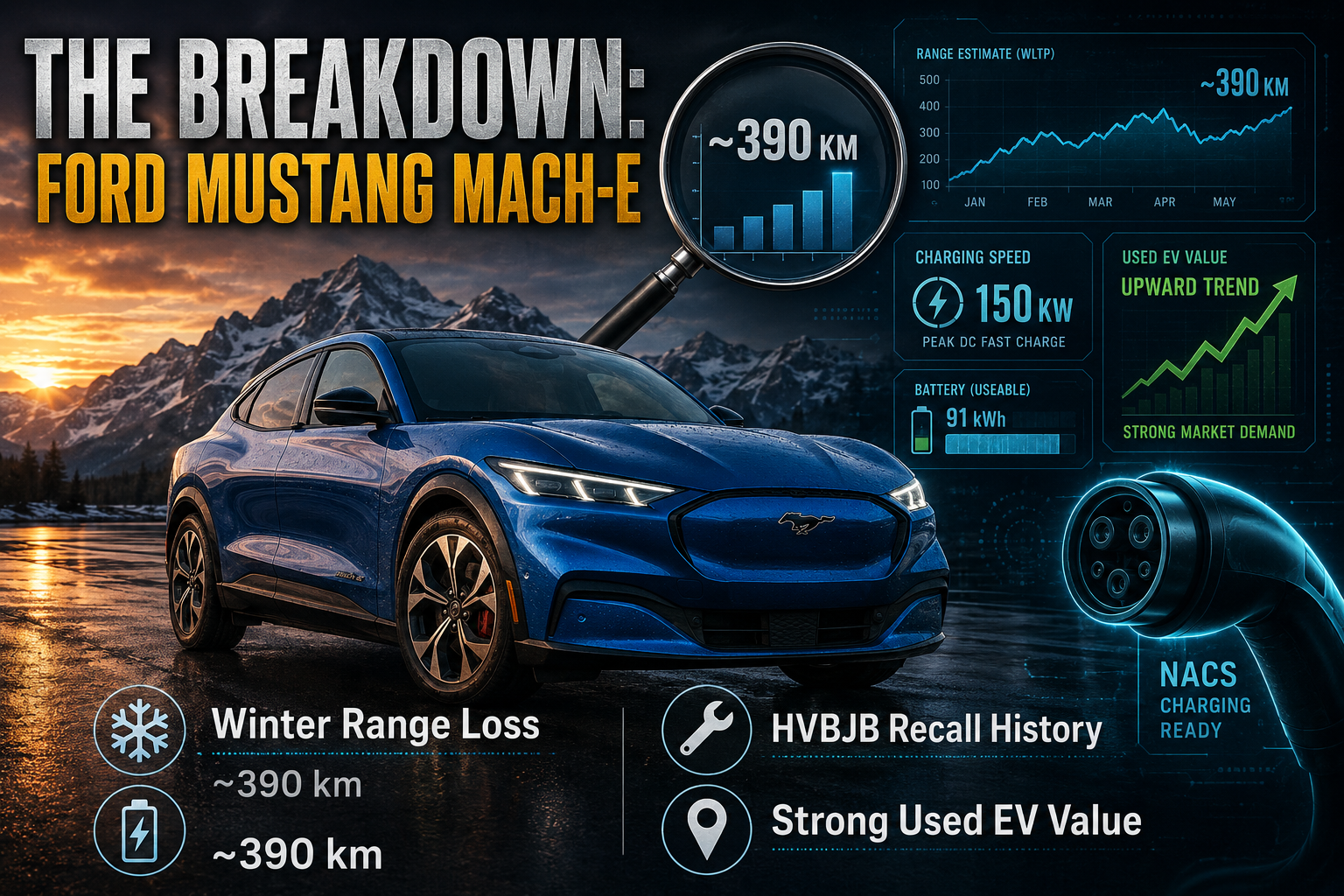
Ford Mustang Mach-E
Big name, big depreciation, and one recall that every buyer needs to know about. Here's the complete Canadian used-market guide.
June 2026 · 8 min read · usedelectriccarscanada.ca
Quick Verdict
The Mach-E is one of the most compelling used EV buys in Canada right now — but only if you choose the right model year and trim. A 2022 or 2023 Premium or GT with the HVBJB recall completed is a genuinely excellent electric SUV at a price that would have seemed impossible three years ago. A pre-recall 2021 extended-range model with no service history? Buyer beware.
Introduction
Ford's Most Controversial EV Is Also One of Canada's Best Used Deals
When Ford unveiled the Mustang Mach-E in 2019, the backlash was swift. Car enthusiasts were outraged that a family crossover had co-opted the Mustang name. Purists signed petitions. Opinion columns were written. Ford did it anyway — and the Mach-E went on to become one of the most successful mainstream EV launches outside of Tesla.
It won the 2021 North American Utility Vehicle of the Year. It outsold the Volkswagen ID.4. In Canada, it found its way into driveways from Victoria to Halifax, becoming a practical, stylish, and relatively affordable alternative to the Tesla Model Y in a market that was desperate for exactly that.
Now, in 2026, thousands of those early Mach-Es are hitting the used market at prices that represent genuinely dramatic depreciation. A car that left the showroom for $55,000 can be found today for under $30,000. For the right buyer, that is an extraordinary opportunity. But the Mach-E has a complicated history — a significant recall, notable model-year differences, and a battery chemistry story that matters enormously to long-term ownership. This guide covers all of it.
Model Year Guide
2021, 2022, 2023, 2024: Which Year Is the Right Buy?
More than almost any other EV on the used market, the model year you buy matters enormously with the Mach-E. Ford made meaningful changes to battery capacity, chemistry, and charging hardware with each generation — and 2021–2022 extended-range models carry a recall history that requires careful vetting.
2021
Proceed with Caution
Launch year brings lower battery capacity (68 kWh SR / 88 kWh ER) and the highest HVBJB recall risk on extended-range models. Some early cars also had windshield and panoramic roof bonding issues. Good deals exist, but due diligence is essential. SR RWD models are the safest bet.
2022
Good If Recall-Clear
Battery capacity bumped to 70 kWh SR / 91 kWh ER. Still carries HVBJB recall risk on ER models. A verified recall completion transforms this into a solid buy. The sweet spot of the recall-era cars: more range than 2021, usually well-priced on the used market today.
2023
Recommended
The pivotal year. Standard-range models switched to LFP battery chemistry mid-production, improving long-term durability and allowing 100% daily charging. No HVBJB exposure. Ford also committed to NACS compatibility this year, and prices are strong on the used market.
2024+
Strong But Pricier
NACS port standard-fitted from 2025. Heat pump added standard in 2025 (major for Canadian winters). 2024 models are a near-perfect package. Expect to pay more, but you're buying a sorted, recall-free car with full Supercharger access baked in.
The Battery Chemistry Split (2023 Only)
The 2023 model year has a production split that matters. Early 2023 builds used the same NCM (Nickel Cobalt Manganese) chemistry as 2021–2022. Later 2023 builds switched to LFP (Lithium Iron Phosphate) on standard-range models. You can identify which you have by the VIN: if the 8th digit is a 4 or 5, it's LFP. LFP batteries are more durable long-term and can be safely charged to 100% daily — a real-world advantage that NCM packs don't share. When shopping a 2023, always check the VIN.
Specifications
Range, Power & Battery by Model Year
Ford's NRCan-rated range figures give the official starting point, but the numbers below tell the fuller story across the production run.
YearBattery (Usable)VariantNRCan RangePowerRecall?202168 kWh (SR)RWD~370 km266 hpNo202188 kWh (ER)RWD / AWD / GT~480 km269–480 hpYes — HVBJB202270 kWh (SR)RWD / AWD~390 km266–305 hpNo202291 kWh (ER)RWD / AWD / GT~490 km269–480 hpYes — HVBJB202370 kWh NCM or 72 kWh LFP (SR)RWD / AWD~400 km266–311 hpNo202391 kWh NCM (ER)RWD / AWD / GT~490 km269–480 hpNo202472 kWh LFP (SR)RWD / AWD~400 km266–305 hpNo202491 kWh NCM (ER)AWD / GT~490 km346–480 hpNo
NRCan figures are combined city/highway under Canadian test conditions. Real-world range varies significantly — see the Winter Range section below.
The Most Important Thing To Know
The HVBJB Recall: What It Is, Why It Matters, and What To Check
If there is one single fact that every Canadian Mach-E buyer needs to understand, it is this: the 2021 and 2022 extended-range and GT models were subject to a serious safety recall involving the High Voltage Battery Junction Box (HVBJB). Understanding it is non-negotiable before handing over any money.
What Happened
Ford discovered that repeated DC fast charging and aggressive driving — particularly at highway speeds or with heavy throttle use — could cause the high-voltage battery contactors in extended-range and GT models to overheat. When contactors overheat, they can either weld shut or fail to close properly. The consequences were real: immediate loss of motive power while driving, with the car displaying a "Stop Safely Now" warning. In the worst cases, vehicles couldn't restart at all.
Ford issued an initial recall (22S41) in June 2022 affecting roughly 48,924 vehicles, deploying a software patch to monitor contactor temperatures. The patch helped, but wasn't enough. A follow-up recall (23S56) in late 2023 required physical hardware replacement — the full HVBJB unit — on approximately 34,762 additional 2021–2022 extended-range and GT models built between May 27, 2020 and May 24, 2022.
Critical Check Before Any Purchase
Before buying any 2021 or 2022 extended-range or GT Mach-E, verify recall completion by entering the VIN at ford.com/support/recalls/. Both recalls (22S41 and 23S56) should show as completed with hardware replacement confirmed — not just the software update alone. If only the software update was done, the hardware replacement is still outstanding. Do not buy until it is resolved.
Standard-Range Models Are Not Affected
It is important to clarify that standard-range models from 2021 and 2022 are not part of the HVBJB recall. The failure mode was specific to the extended-range and GT packs, which delivered significantly higher power output and therefore generated more heat in the contactor under hard use. A 2021 or 2022 Mach-E Select or Premium with the standard-range battery has no HVBJB exposure whatsoever.
The Silver Lining
For buyers who do the homework and confirm a completed recall, the HVBJB story actually works in your favour. The recall history has suppressed prices on 2021–2022 extended-range models considerably. A recall-completed 2022 Mach-E GT is an excellent car; the underlying engineering is sound, and the replacement HVBJB is a proper hardware fix, not a band-aid. You just need to confirm the paperwork is clean.
Cold Weather Performance
Winter Range: The Real Numbers for Canadian Drivers
The Mach-E's official NRCan figures look impressive. In a Canadian winter, the picture changes considerably. Understanding the gap between sticker range and real-world winter range is essential for any buyer in BC, Alberta, Ontario, or Quebec who plans to use this car year-round.
What The Data Says
The Canadian Automobile Association (CAA) conducted real-world winter testing of 14 EVs at temperatures between -7°C and -15°C — typical of a Canadian winter rather than an extreme edge case. The Mach-E travelled 334 km on a single charge, against its official NRCan rating of 483 km. That's a 31% reduction, placing the Mach-E squarely in the middle of the pack among all EVs tested — seventh out of fourteen.
Broader real-world testing and owner reports paint a similar picture. In sustained freezing conditions, expect roughly 25–35% range loss compared to mild-weather driving. In harsh sub-zero conditions combined with highway speeds and full cabin heating, losses of 40–50% have been recorded. To translate that into practical terms:
Model / BatteryNRCan RangeEst. Winter Range (-10°C)Est. Winter Range (-20°C)SR RWD (70 kWh)~390 km~270–300 km~200–240 kmER RWD (91 kWh)~490 km~340–370 km~250–300 kmER AWD / GT~450–490 km~315–345 km~230–275 km
Estimates based on CAA testing data, owner reports, and independent cold-weather instrumentation. Individual results vary with driving speed, preconditioning habits, and cabin heat use.
The Heat Pump Question
One of the most meaningful improvements in the 2025 Mach-E was the addition of a standard heat pump — a component that dramatically reduces the energy cost of cabin heating in cold weather compared to a resistive heater alone. Earlier models (2021–2024) relied primarily on resistive heating, which draws a significant amount of battery energy on cold days.
For Canadian buyers considering pre-2025 models, this is a real consideration. The Mach-E manages cold weather adequately, and heated seats and a heated steering wheel help reduce the load on the main heater, but the heat pump advantage of 2025+ cars is genuine. If most of your driving is in Alberta, Saskatchewan, or northern Ontario, factoring in this gap is worthwhile.
Preconditioning: Your Best Tool
Like all EVs, the Mach-E benefits enormously from preconditioning — warming the battery and cabin while still plugged into your home charger before departure. This costs grid electricity rather than battery range, and can meaningfully cut into your winter range losses. The Ford app allows scheduled departure preconditioning, and it works well. Building this habit is the single most practical thing a Canadian Mach-E owner can do to manage winter range.
Charging
Charging Speeds, NACS Access, and What Canadian Owners Actually Experience
On-Board Charging Rates
The Mach-E supports Level 2 AC charging at up to 11 kW (on most trims) and DC fast charging at up to 150 kW on extended-range models, and approximately 115 kW on standard-range models. In the CAA winter charging test, the Mach-E added 71 km of range in a 15-minute DC fast-charge session at an average rate of 85 kW — ninth out of thirteen EVs tested. That's a functional result, not a best-in-class one; the Tesla Model 3, for comparison, added 205 km in the same window. The Mach-E is a solid commuter and weekend road-tripper, not a speed-charging champion.
The NACS Adapter: A Major Game-Changer
One of the most significant improvements to the used Mach-E ownership proposition happened in 2024, when Ford delivered free NACS (North American Charging Standard) adapters to all eligible 2021–2024 Mach-E owners. This gave CCS-port Mach-Es access to Tesla's vast Supercharger network across Canada and the US — effectively more than doubling available fast-charge locations overnight.
Check For The Adapter
When buying a used 2021–2024 Mach-E, confirm whether the NACS adapter is included with the car. Ford's free-reservation window closed in September 2024, and new adapters now cost approximately $230. A car that comes with the adapter already is worth more in practical terms — always ask.
From 2025 onward, the Mach-E ships with a native NACS port, eliminating the need for any adapter. For used buyers looking at 2025+ models, Supercharger access is simply built in.
Home Charging
The Mach-E's real-world strength is as a home-charging car. On a Level 2 charger (240V), a full charge on the standard-range pack takes roughly 8–10 hours overnight — easily managed by setting a scheduled charge on a cheaper overnight electricity rate. The majority of Mach-E owners in Canada report that they almost never use public fast charging for daily driving, relying on home Level 2 for their regular charging needs and fast chargers only for longer trips.
Ownership Costs
What It Actually Costs To Own a Used Mach-E in Canada
Maintenance: Simpler Than You'd Expect
Like all EVs, the Mach-E eliminates most of the service items that define ICE-vehicle maintenance: no oil changes, no transmission fluid, no spark plugs, no timing belt. The primary ongoing maintenance items are cabin air filter replacement, tire rotations, brake fluid checks, and wiper blades. Brake pads typically last significantly longer than on gas vehicles due to regenerative braking reducing pad wear.
Ford's dealer network is broad across Canada, which is a genuine advantage over brands with fewer service locations. Parts availability is strong, and while Ford's EV-specific technician training is still maturing compared to Tesla's integrated approach, it has improved considerably since 2021.
12-Volt Battery: A Known Weak Point
One maintenance item that Mach-E owners discuss frequently is the 12-volt auxiliary battery. Software updates from Ford have largely addressed the drain issues that plagued early 2021–2023 models, but it remains something to watch on high-mileage examples. Replacement costs are modest — under $300 at most dealers — but an unexpected failure can strand the car in a way that catches owners off guard.
Insurance
Expect Mach-E insurance in Canada to come in somewhat higher than an equivalent gas SUV, due to higher replacement part costs and EV repair complexity. In BC (ICBC), Ontario (highly variable), and Alberta, most owners report premiums in the $180–$280/month range for a used 2021–2023 model, though this varies considerably by driving record, city, and coverage level. The GT trim, with its higher performance rating and original MSRP, typically draws higher premiums.
Electricity Costs
This is where the Mach-E shines for Canadian commuters. Charging primarily at home, a typical driver covering 20,000 km per year in a Mach-E will spend roughly $500–$800 in electricity annually in most provinces — a fraction of equivalent gasoline costs. In BC and Quebec, where electricity rates are among the lowest in North America, the cost advantage is even more pronounced.
Depreciation & Used Pricing
Where the Mach-E Sits in Canada's Used EV Market
The Mach-E's depreciation story is dramatic, and it cuts both ways depending on where you sit. For original owners who paid MSRP or above in 2021–2022, the decline in value has been painful. For used buyers shopping in 2025–2026, it has created a genuinely exceptional value window.
According to iSeeCars data, the Mach-E loses approximately 44% of its value after three years, and 61% after five years — broadly in line with the electric compact SUV category average, but steeper than the overall SUV market. For context, a 2023 Mach-E Premium Extended Range that originally carried an MSRP in the mid-$50,000s is now typically listed in the $25,000–$32,000 range with average mileage on Canadian used-car platforms.
YearTrim / BatteryTypical Used Price (CAD, 2026)Original MSRP (approx.)Approx. Depreciation2021Select / SR$22,000–$26,000~$47,000~45–53%2021Premium / ER (recall done)$25,000–$30,000~$54,000~44–54%2022Premium / ER (recall done)$28,000–$34,000~$55,000~38–49%2023Premium / SR LFP$26,000–$32,000~$50,000~36–48%2023GT / ER$31,000–$38,000~$56,000~32–45%2024Premium / SR$35,000–$42,000~$52,000~19–33%
Pricing estimates based on CarGurus Canada and AutoTrader.ca listing data, June 2026. Prices vary by province, mileage, condition, and individual listing.
The Used Market Sweet Spot
The 2022–2023 Mach-E Premium or GT, with recall work confirmed and mileage under 60,000 km, represents the strongest used-market value proposition. You're getting the improved 91 kWh extended-range battery, a resolved recall, full NACS adapter access, and a car that originally sold for $50,000–$56,000 — for under $35,000. That's hard to beat in the Canadian used EV market right now.
Known Issues & Reliability
What Goes Wrong — and What Doesn't
Issues Worth Knowing Before You Buy
The Mach-E has a non-trivial list of known issues, particularly in early model years. Most are manageable, but buyers should enter the transaction with open eyes:
HVBJB (2021–2022 ER/GT): As covered at length above, the most serious issue in the Mach-E's history. Verify recall completion before purchase — both the software update and the hardware replacement.
12V Battery Failures (2021–2023): Software-addressable in most cases via OTA updates, but early cars that haven't received updates can experience unexpected dead-12V events. Confirm the car has current software.
Sync 4A Software Freezes: The 15.5-inch touchscreen occasionally locks up or requires a soft reset. More annoyance than crisis, and common in early examples. Usually resolved via software update.
Rear Door Latch Failures (2021–2025): A known issue across the production run where rear door latches can fail to engage properly. Ford has issued fixes; check service history.
Windshield and Roof Bonding (2021 only): Some early 2021 builds had inadequate bonding on windshields and panoramic roof glass panels. A recall was issued and should be resolved on any properly serviced car.
Rear Camera Delay (2021–2023): Backup camera display sometimes delayed on startup. Minor inconvenience, typically fixed by software update.
What Holds Up Well
For all the recall and software noise, the Mach-E's fundamental structure has proven durable. The electric drivetrain — particularly on standard-range models and post-recall extended-range units — has shown good longevity. Battery degradation on well-maintained examples is modest. The platform is solid, the suspension is well-sorted for Canadian roads, and the interior materials are genuinely competitive with German crossovers at twice the price. Consumer satisfaction ratings on CarGurus Canada consistently land in the 4.2–4.5 / 5.0 range across model years, which speaks to a strong ownership experience once the early issues are resolved.
The Summary
Pros and Cons for Canadian Used Buyers
✓ Strengths
Dramatic depreciation creates exceptional used value
Wide Ford dealer network across Canada
NACS adapter unlocks Tesla Supercharger access
Strong cargo space and practical family interior
Excellent DC fast-charge speeds (115–150 kW)
OTA software updates improve the car over time
2023+ LFP models can safely charge to 100% daily
8-year/160,000 km battery warranty (original term)
GT and GT Performance Edition are genuinely quick
✗ Weaknesses
HVBJB recall is a serious red flag if not resolved
Winter range loss is real — plan accordingly
No heat pump on models before 2025
Sync 4A software can still be glitchy on older builds
Fast-charging speed is behind Hyundai/Kia competition
Steep depreciation stings if you bought new
Insurance costs are higher than equivalent gas SUVs
12V battery issues on early builds without updated software
Final Verdict
Is the Ford Mustang Mach-E Worth Buying Used in Canada?
8/10Overall
7/10Winter Use
9/10Value
8/10Practicality
7/10Reliability
Yes — but with conditions. The Ford Mustang Mach-E has earned its place as one of the most interesting used EV buys in Canada in 2026, primarily because steep depreciation has collapsed the asking price on cars that were genuinely competitive at full MSRP.
The key is choosing carefully. A 2023 Mach-E Premium or GT with the LFP standard-range battery is the cleanest buy: no recall exposure, a more durable battery chemistry, NACS adapter access, and a well-sorted software stack. For buyers who want more range and are comfortable doing the paperwork, a 2022 Premium or GT Extended Range with confirmed HVBJB hardware replacement is also a strong option — the extra capacity is meaningful for longer drives, and the recall, when properly completed, has resolved the underlying failure mode.
The cars to approach with the most caution are pre-recall 2021 extended-range and GT models without a clear service history. The risk isn't that the car is irreparably broken — it may be perfectly fine — but that you simply cannot verify it without proper documentation. In a market with strong supply of cleaner examples, there's no need to take that gamble.
For the right family — one with a Level 2 charger at home, realistic winter range expectations, and the patience to verify recall history before signing — the Mach-E offers something rare in the used EV market: a genuinely premium electric crossover at a used economy-car price. That's a combination worth taking seriously.