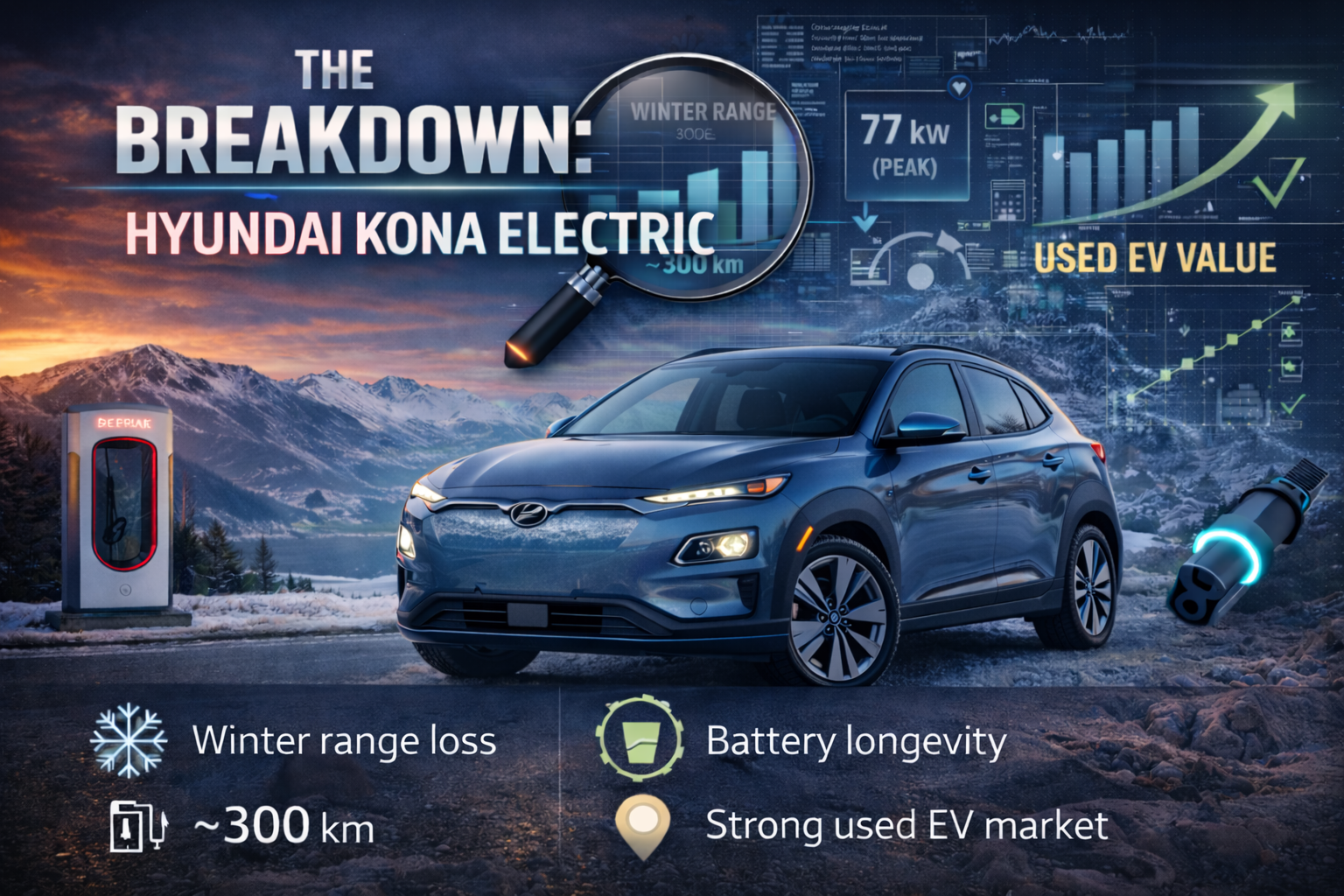
The Breakdown: Hyundai Kona Electric (2019–2023)
The Hyundai Kona Electric has quietly become one of Canada’s most popular used EVs — and for good reason. It’s compact, efficient, winter-capable (by EV standards), and now widely available at surprisingly affordable prices on the used market.
But not all Kona Electric model years are created equal.
Some years charge faster. Some handle winter better. Some are better long-term buys than others.
This is The Breakdown — a deep, no-nonsense look at the Hyundai Kona Electric from a used-EV buyer’s perspective, with a focus on battery health, winter performance, charging, depreciation, and real-world ownership in Canada.
Quick Specs Overview (Canada)
Body style: Subcompact crossover
Drivetrain: Front-wheel drive
Battery:
64 kWh (long-range, most common in Canada)
39.2 kWh (rare in Canada)
Rated range (64 kWh):
~415 km (EPA)
~400–415 km (Natural Resources Canada)
DC fast charging:
Up to ~77 kW peak
10–80% in ~45–55 minutes (real-world)
Model Year Breakdown: What Changed (and What Matters)
🔹 2019 Hyundai Kona Electric
The first year — and still a solid used buy
64 kWh battery standard in Canada
No heat pump (important for winter)
Slower cold-weather fast charging
Excellent efficiency in mild weather
Good if:
You drive mostly city or suburban
You charge at home
You find a clean, well-priced example
Watch for:
Reduced winter range
Slower DC charging below freezing
🔹 2020 Hyundai Kona Electric
Minor refinements, same fundamentals
Similar hardware to 2019
Slight software improvements
Still no heat pump in Canada
Verdict:
Functionally similar to 2019 — buy based on price and condition, not the year.
🔹 2021 Hyundai Kona Electric (⚠️ Important Year)
Battery recall drama — now mostly resolved
Global LG battery recall affected many Kona EVs
In Canada, many packs were replaced entirely
Some owners effectively got brand-new batteries
Why this matters:
A Kona with a confirmed battery replacement is one of the best used EV buys on the market.
👉 Internal link:
[Used EV Battery Recalls Explained – What Buyers Need to Know]
Buyer tip:
Ask for recall documentation. This can significantly increase long-term value.
🔹 2022–2023 Hyundai Kona Electric (Best Overall)
The sweet spot
Updated interior & infotainment
Heat pump included on most Canadian trims
Improved winter efficiency
Better charging stability in cold weather
Best choice if:
You live in a cold climate
You rely on public fast charging
You want the least compromise ownership experience
👉 Internal link:
[Best Used EVs for Canadian Winters]
Battery Health & Degradation Reality
Hyundai uses liquid-cooled lithium-ion batteries, which age well compared to air-cooled designs.
Real-world expectations:
1–3 years: ~95–98% health
4–5 years: ~90–94% health
6–8 years: ~85–90% health
These are averages, not limits — but Kona batteries are generally holding up very well in Canada.
👉 Internal link:
[EV Battery Degradation: What’s Normal in Canada?]
Warranty reminder:
8 years / 160,000 km battery warranty (Canada)
Winter Driving & Cold Weather Performance
Winter is where the Kona Electric shows both strengths and weaknesses.
❄️ Winter Range Loss
Expect:
~20–25% loss in mild winter conditions
~30–40% loss during deep cold snaps (-15°C and below)
Heat-pump-equipped models (2022+) perform noticeably better.
👉 Internal link:
[Winter Range Loss: How Cold Weather Really Affects EVs]
❄️ Traction & Handling
Front-wheel drive only
Very predictable in snow
Winter tires make a huge difference
👉 Internal link:
[Winter Tires on EVs: Do They Matter More Than on Gas Cars?]
Charging: Home vs Fast Charging Reality
🔌 Home Charging (Level 2)
7–9 hours for a full charge
Ideal ownership setup
Excellent overnight charging EV
👉 Internal link:
[Home EV Charging Guide for Canadians]
⚡ DC Fast Charging (Road Trips)
Peak ~77 kW
Tapers early compared to newer EVs
Cold weather slows charging significantly without a heat pump
Translation:
The Kona is fine for occasional road trips, but it’s not a long-haul champion.
👉 Internal link:
[EV Fast Charging in Canada: What Speeds Actually Matter]
Depreciation & Used Prices in Canada (2026)
One of the Kona Electric’s biggest strengths is value.
Typical used prices (64 kWh):
2019–2020: $22,000–$26,000
2021 (post-recall): $24,000–$29,000
2022–2023: $30,000–$36,000
👉 Internal link:
[Why Some Used EVs Are Dirt Cheap (And When to Avoid Them)]
Compared to new EV prices, the Kona offers exceptional cost-per-kilometre value.
Common Issues & Ownership Quirks
Nothing catastrophic — but a few things to know:
Slower DC charging than newer competitors
Smaller cargo area than it looks
Touchscreen lag on older software
Some owners report firm ride quality
Overall reliability has been strong, especially post-recall.
Who the Kona Electric Is Perfect For
✅ Urban & suburban drivers
✅ Daily commuters under 300 km/day
✅ Home-charging households
✅ Budget-conscious EV buyers
✅ First-time EV owners
🚫 Not ideal for:
Frequent long-distance road trippers
Buyers wanting AWD
People relying exclusively on DC fast charging
Verdict: Is the Kona Electric a Smart Used EV Buy?
Yes — especially in Canada.
If you buy the right year, confirm battery history, and understand winter realities, the Hyundai Kona Electric is one of the best all-around used EV values available today.
Best years: 2022–2023
Best value: 2021 with confirmed battery replacement
Good budget pick: 2019–2020 at the right price
It’s not flashy — but it’s efficient, reliable, and quietly excellent.
Sources & Further Reading
Hyundai Canada – Kona Electric Specifications
https://www.hyundaicanada.com/en/showroom/2023/kona-electricNatural Resources Canada – Fuel Consumption Guide
https://fcr-ccc.nrcan-rncan.gc.ca/enTransport Canada – EV Safety & Recalls
https://tc.canada.ca/en/road-transportationInsideEVs – Kona Electric Battery Recall Coverage
https://insideevs.comConsumer Reports – Hyundai Kona Electric Reliability
https://www.consumerreports.org