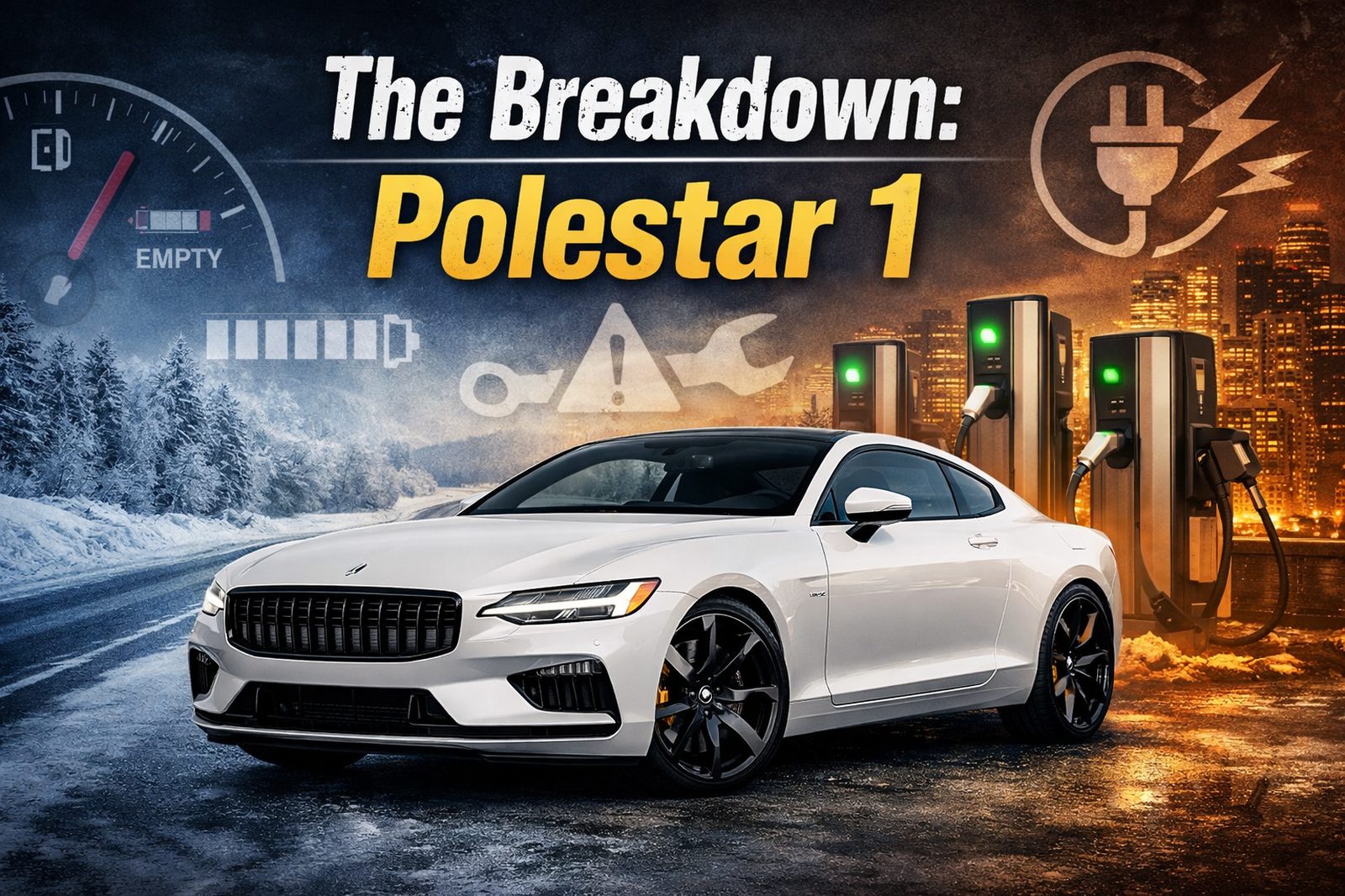
The Breakdown: Polestar 1
A carbon-fiber grand tourer with electric ambition — and real-world caveats for Canadian buyers
The Polestar 1 is not a typical electric vehicle — and it was never meant to be.
Produced in limited numbers between 2019 and 2021, the Polestar 1 is a high-performance plug-in hybrid grand tourer, built as a halo car to introduce Polestar as a standalone brand separate from Volvo. It blends Scandinavian design, a carbon-fiber body, dual electric motors, and a turbo- and supercharged gasoline engine into one of the most technically ambitious cars ever sold in Canada.
But ambition doesn’t always equal practicality — especially on the used market.
This Breakdown looks at what the Polestar 1 is actually like to own in Canada, covering real-world electric range, winter performance, charging, reliability, maintenance, and whether it makes sense as a used purchase today.
What the Polestar 1 Is (and Isn’t)
The Polestar 1 is a 2-door luxury GT coupe with a plug-in hybrid drivetrain, not a full battery-electric vehicle. It was designed as a statement car — showcasing Polestar’s engineering direction — rather than a mass-market model.
Key context:
Built largely by hand
Carbon-fiber reinforced polymer (CFRP) body
Very limited production
High original MSRP
Heavy reliance on advanced electronics and bespoke parts
This makes it fundamentally different from later Polestar models.
👉 [Polestar brand overview or Polestar 2 breakdown]
Powertrain & Performance Breakdown
The Polestar 1 uses one of the most complex drivetrains ever put into a production car:
2.0L turbocharged + supercharged inline-4 gasoline engine
Two rear electric motors
One integrated starter generator
Combined output: ~619 hp / 738 lb-ft torque
All-wheel drive
0–100 km/h: ~4.2 seconds
On the road, this translates to instant torque, effortless highway passing, and strong long-distance comfort — exactly what a grand tourer is meant to deliver.
The tradeoff is complexity. Compared to full EVs, the Polestar 1 has far more mechanical and electronic components, which directly impacts long-term ownership risk.
Electric Range: Real-World Expectations
Official ratings suggested up to ~124 km of electric-only range (WLTP), which was exceptional for a plug-in hybrid when launched.
Real-world Canadian results are more realistic:
Summer driving: ~85–100 km
Mixed driving: ~70–85 km
Winter conditions: ~45–65 km (sometimes less in deep cold)
Cold temperatures, cabin heating, and battery conditioning all reduce usable electric range.
For short daily commutes, the Polestar 1 can function much like an EV. Once the battery is depleted, however, fuel consumption rises quickly due to the vehicle’s significant curb weight.
Charging Experience
Home Charging
Level 2 AC charging only
Roughly 4.5–5 hours for a full charge
No DC fast-charging support
Home charging is essential to getting real value from the electric side of the drivetrain.
👉 [Home charging guide for EVs in Canada]
Public Charging
Works well on Level 2 public chargers
Not suitable for fast-charging road-trip strategies
Charging infrastructure matters less than with full EVs, but flexibility is limited
Winter Performance & Cold-Climate Reality
From a driving standpoint, the Polestar 1 performs confidently in winter:
AWD traction helps in snow
Stable highway behavior
Strong low-speed torque
From an efficiency standpoint, winter exposes its compromises:
Significant electric-range loss
Increased reliance on gasoline
Higher operating costs during colder months
Winter tires are essential, not optional.
👉 [Winter tires on EVs and hybrids]
Reliability & Long-Term Ownership Risks
This is where buyers need to be realistic.
Strengths
Volvo-derived safety systems
Solid structural build quality
Many examples are low-mileage due to limited production
Risks
Extremely complex hybrid drivetrain
Carbon-fiber body panels are expensive and difficult to repair
Limited aftermarket support and parts availability
Polestar-specific service expertise required
Battery degradation is generally less concerning than in full EVs, but hybrid system faults or electronic failures can be expensive outside warranty coverage.
👉 [Battery longevity and degradation in EVs]
Maintenance & Repair Costs
Unlike a full EV, the Polestar 1 still requires:
Engine oil and cooling service
Emissions-related components
High-performance brake maintenance
Specialized suspension parts
Ownership cost profile:
Routine maintenance: higher than EVs
Unexpected repairs: potentially very high
Insurance premiums: often elevated
This is not a low-cost vehicle to own long-term.
👉 [EV vs gas maintenance costs]
Used Market Pricing & Value in Canada
Original Canadian MSRP exceeded $155,000 CAD.
Current used market pricing typically falls between:
$85,000–$110,000 CAD, depending on mileage and condition
Depreciation has been steep, but that alone doesn’t make it a bargain. Buyers are purchasing a discontinued halo car with unique parts and limited long-term ownership data.
Who the Polestar 1 Makes Sense For
Good fit if you:
Want something rare and distinctive
Can charge at home consistently
Drive mostly short to medium distances
Accept higher ownership risk
Value design and exclusivity
Not ideal if you:
Want a simple, low-maintenance EV
Rely on DC fast charging
Prioritize long-term ownership certainty
Plan to keep the vehicle far beyond warranty
Final Verdict: Is the Polestar 1 Worth It Used?
The Polestar 1 is not a rational EV purchase — and that’s intentional.
It offers:
Stunning design
Strong electric-only capability for daily driving
Serious performance
Genuine exclusivity
It also brings:
High mechanical complexity
Expensive repairs if issues arise
Less practicality than modern EVs
For the right buyer, it’s a bold and rewarding choice.
For most used EV shoppers, simpler and more cost-effective alternatives make more sense.
👉 [Best used EVs for Canadian buyers]
Sources & References
Polestar Canada – Official Polestar 1 Overview
https://www.polestar.com/en-ca/polestar-1/InsideEVs – Polestar 1 Reviews & Real-World Ownership Insights
https://insideevs.com/Car and Driver – Polestar 1 Engineering, Performance & Reviews
https://www.caranddriver.com/