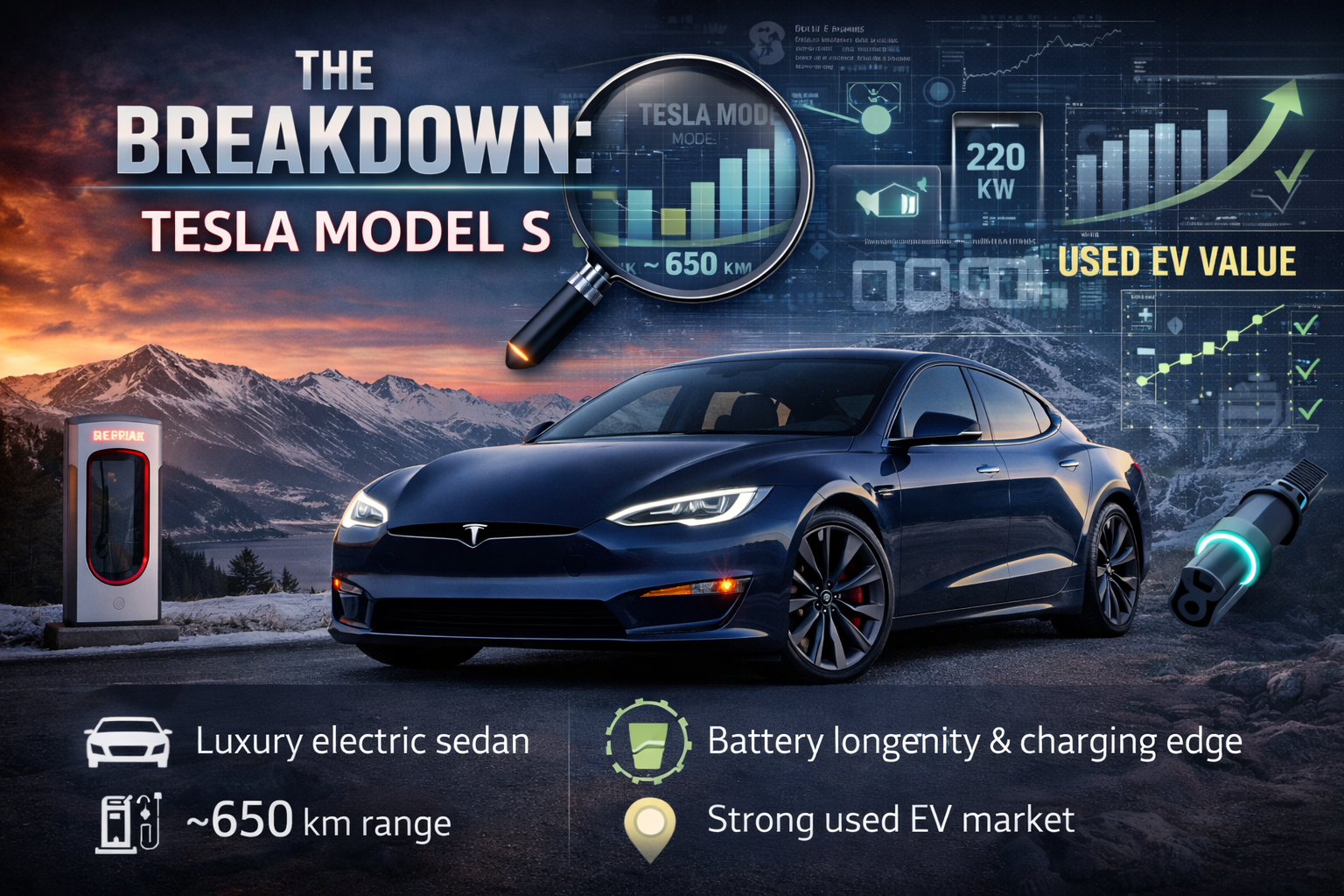
The Breakdown: Tesla Model S
A deep, buyer-focused analysis of Tesla’s original flagship EV — updated for Canadian drivers and the used EV market.
The Breakdown: Series — How to Read This
The Breakdown is our long-form, no-fluff series built specifically for Canadian EV buyers, with a strong emphasis on used-market reality. Each entry blends specs, real-world ownership data, winter performance, charging access, depreciation, and long-term reliability — with internal guides linked throughout so you can dig deeper where it matters.
This entry focuses on one of the most important EVs ever built.
Overview: What Is the Tesla Model S?
The Tesla Model S is a full-size luxury electric sedan that fundamentally changed how the world viewed electric cars. When it launched, it proved that EVs could offer long range, serious performance, and daily usability — without compromise.
Even today, the Model S remains one of the best long-distance EVs in Canada, largely due to Tesla’s charging advantage and years of real-world data.
🔗 Official Tesla Canada Model S page:
https://www.tesla.com/en_ca/models
Tesla Model S — Key Specs at a Glance
CategoryTesla Model SBody StyleFull-size electric sedanSeating5 adultsDrivetrainDual-Motor AWDPerformance VariantPlaid (tri-motor)Battery~100 kWh usable (variant-dependent)Estimated Range~560–650 km (variant-dependent)ChargingTesla NACS (Supercharger + AC)0–100 km/h~2.1–3.8 secondsDrive LayoutAWD (rear-biased)
Powertrain & Performance Breakdown
Dual Motor vs Plaid
Long Range (Dual Motor AWD)
Best efficiency and range
Ideal for Canadian road trips
Strong winter traction
Plaid
Tri-motor configuration
Supercar-level acceleration
Excessive for most buyers, but unmatched performance per dollar
Despite its size, the Model S feels composed at highway speeds and exceptionally planted in poor weather thanks to its low centre of gravity and AWD system.
Battery, Range & Charging — The Canadian Advantage
Real-World Range Expectations
Summer mixed driving: 520–600 km
Winter highway driving: 400–470 km
City driving benefits heavily from regenerative braking
Cold-weather range loss is normal for all EVs. For a deeper explanation of winter efficiency and how to manage it, see our winter hub:
👉 https://usedelectriccarscanada.ca/winter-climate
Tesla Supercharger Network
This remains the Model S’s biggest advantage in Canada.
Why it matters:
Highly reliable stations
Seamless plug-and-charge
Dense coverage along:
Trans-Canada Highway
BC Lower Mainland → Interior
Ontario–Quebec corridor
🔗 Tesla Supercharger overview:
https://www.tesla.com/supercharger
🔗 Learn how charging costs compare to gas:
https://usedelectriccarscanada.ca/charging-costs
Interior, Technology & Daily Usability


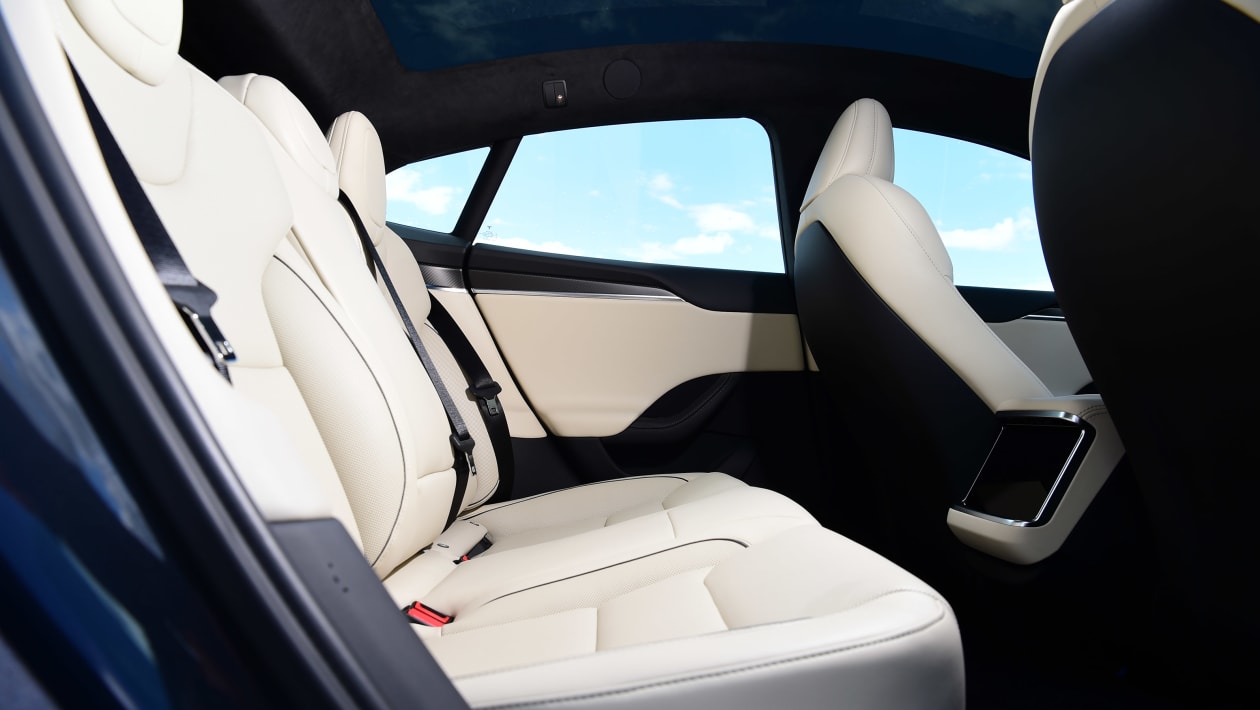
The Model S interior prioritizes software and simplicity over traditional luxury cues.
Interior Highlights
Large central touchscreen
Minimal physical buttons
Optional yoke steering (polarizing)
Premium materials, though not as plush as German rivals
Software & Features
Industry-leading over-the-air updates
Built-in navigation with live charger routing
Phone-as-key
Autopilot standard, Full Self-Driving optional
⚠️ Used-Buyer Note:
Full Self-Driving does not always transfer with resale. Always confirm before buying.
Winter Driving & Cold-Climate Performance
The Model S performs exceptionally well in Canadian winters, especially AWD versions.
Why it works:
Dual-motor AWD traction
Sophisticated traction control
Battery preconditioning
Strong cabin heating efficiency
What to expect:
~20–30% winter range reduction
Increased tire wear due to torque
Proper winter tires are essential
🔗 Related guide:
https://usedelectriccarscanada.ca/winter-climate/winter-tires-on-evs-do-they-matter-more-than-on-gas-cars
Cargo Space & Practicality
Older hatchback-style Model S vehicles remain especially desirable on the used market.
Large rear cargo area
Front trunk (frunk)
Flat-folding rear seats
Excellent road-trip practicality for a sedan
This practicality is one reason the Model S still appeals to families transitioning from gas sedans or wagons.
Ownership Costs & Long-Term Reliability
What You Don’t Pay For
Oil changes
Transmission servicing
Frequent brake replacements (thanks to regen)
What You Should Budget For
Tires (especially performance trims)
Suspension components on high-mileage cars
Insurance premiums (Plaid models)
Battery Health & Longevity
High-mileage Model S vehicles have demonstrated strong durability, often retaining 85–90% battery capacity after 200,000+ km.
🔗 Learn how to evaluate battery health when buying used:
https://usedelectriccarscanada.ca/battery-health
Used Market Outlook in Canada
The Tesla Model S is already one of the best-value used luxury EVs available.
Why Used Values Make Sense
Significant depreciation from new
Proven long-term reliability
Best charging network in the country
Large supply from early adopters
Used Buyer Sweet Spot
2017–2021 Dual Motor AWD models
Verified battery health
Supercharging enabled
Clean service history
🔗 Related buying insights:
https://usedelectriccarscanada.ca/buying-guides
https://usedelectriccarscanada.ca/buying-guides/are-used-electric-cars-worth-it
Tesla Model S vs Key Alternatives
The Model S continues to stand out for range and charging access, even as competitors improve.
Compared with rivals like the BMW i7, Porsche Taycan, and Mercedes-Benz EQS, the Model S prioritizes efficiency, software, and long-distance usability over traditional luxury finishes or handling precision.
Pros & Cons Summary
✅ Pros
Excellent real-world range
Best charging network in Canada
Outstanding performance
Proven battery longevity
Strong used-market value
❌ Cons
Minimalist interior isn’t for everyone
Performance models increase insurance and tire costs
FSD ownership can be confusing
Less traditional luxury feel than some rivals
Final Verdict: Is the Tesla Model S Still Worth It?
Yes — especially as a used EV in Canada.
The Tesla Model S remains one of the most complete long-distance electric vehicles ever made, and Tesla’s charging ecosystem continues to give it a real-world edge. For buyers prioritizing range, reliability, and nationwide charging access, a well-priced used Model S is still an outstanding choice.
Sources & Further Reading
Tesla Model S (Canada): https://www.tesla.com/en_ca/models
Tesla Supercharger Network: https://www.tesla.com/supercharger
Charging cost comparisons: https://usedelectriccarscanada.ca/charging-costs
Used EV ownership guides: https://usedelectriccarscanada.ca