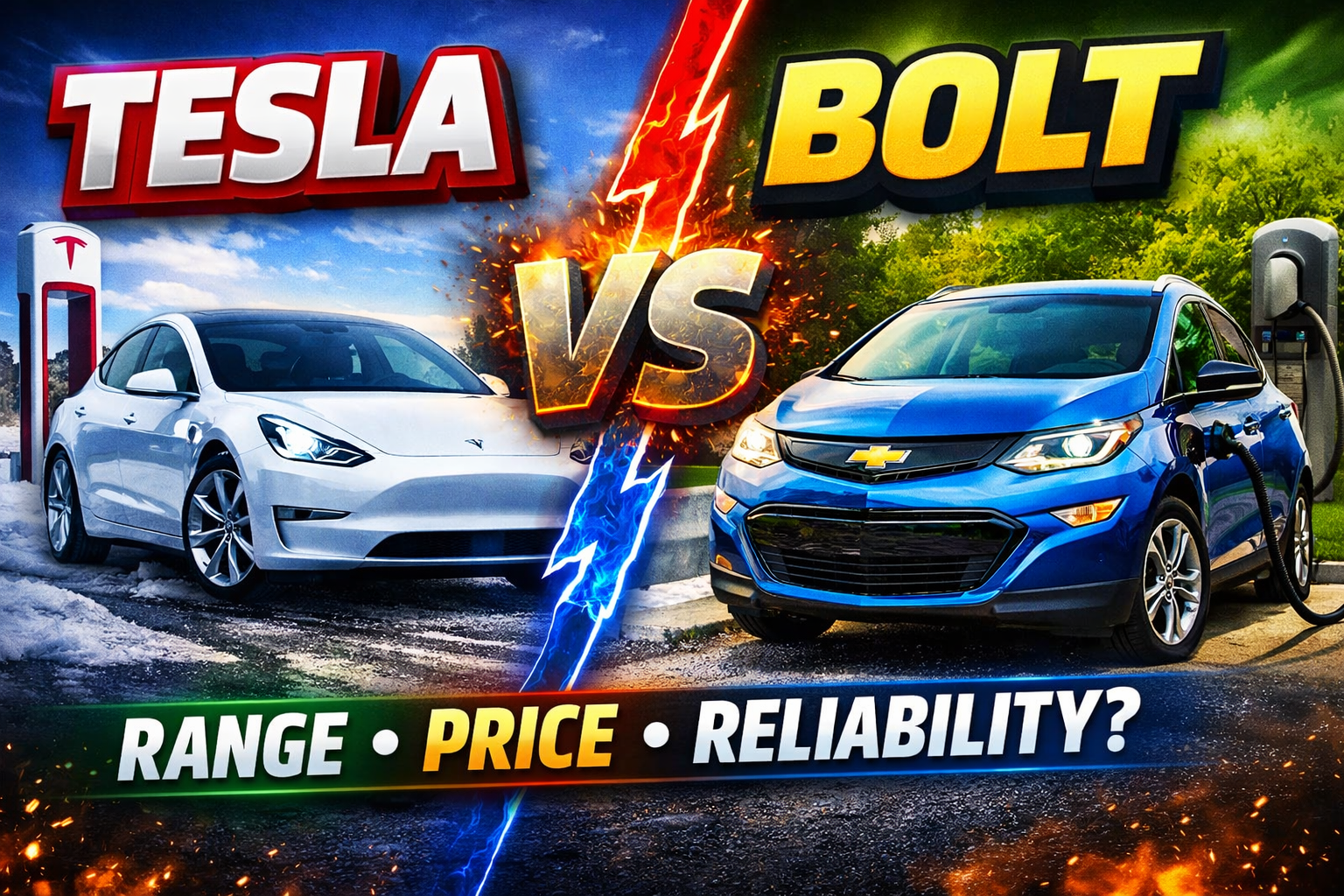
Tesla Model 3 vs Chevrolet Bolt: Used Buyer’s Comparison (Canada, 2025)
Two of the Most Popular Used EVs—Head to Head on Range, Reliability, Features, and Value
If you’re shopping for a used electric vehicle in Canada, odds are you’ve narrowed it down to two names:
The Tesla Model 3
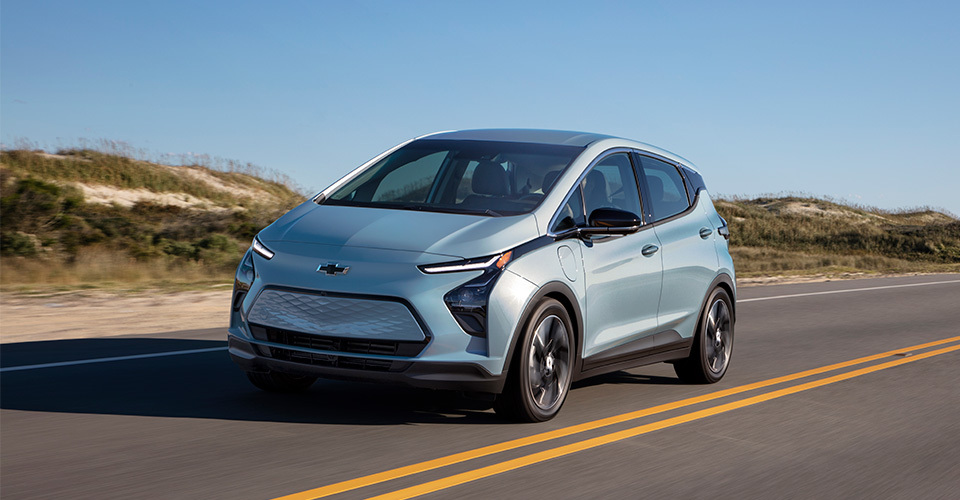
and the Chevrolet Bolt EV
They dominate the used EV market for a reason. Both offer real-world range, strong performance, and significantly lower ownership costs than gas cars. But they approach the EV experience from very different angles.
One is software-driven, fast, and premium-leaning.
The other is practical, efficient, and value-focused.
So which one actually makes more sense as a used EV in Canada?
For winter picks, checkout this guide.
Let’s break it down.

Quick Overview: Two EV Philosophies
Before diving into specs, it helps to understand what each car is trying to be.
Tesla Model 3:
A tech-forward, performance-oriented EV built around software, fast charging, and ecosystem integration.Chevrolet Bolt EV:
A no-nonsense electric car focused on efficiency, simplicity, and maximum range per dollar.
Neither is “better” in isolation — it depends on what kind of EV owner you want to be.
For a greater look at an electric cars viability in Canada.
Range & Efficiency (Real-World Canadian Perspective)
Tesla Model 3 (Used: 2018–2020)
Rated range: ~350–415 km (depending on trim)
Real-world winter range: ~65–75%
Early models do not have a heat pump
Excellent highway efficiency at moderate speeds
Strength:
Strong long-distance capability thanks to charging network
Weakness:
Winter range loss is more noticeable on pre-2021 cars
Chevrolet Bolt EV (2019–2022)
Rated range: 417 km
Real-world winter range: ~70–80%
Extremely efficient drivetrain
Conservative battery management
Strength:
Outstanding city and suburban efficiency
Predictable range year-round
Weakness:
Less aerodynamic at highway speeds
Range verdict:
➡️ Bolt wins on efficiency and consistency
➡️ Model 3 wins on road-trip confidence
Charging: This Is the Biggest Difference
Tesla Model 3
Access to Tesla Supercharger network
Reliable, well-maintained chargers across Canada
Plug-and-charge simplicity
Faster average DC fast-charging experience
This matters a lot if you:
Road trip often
Don’t have reliable home charging
Drive long distances year-round
Chevrolet Bolt EV
Uses CCS fast charging
Slower DC fast-charging speeds (55 kW max)
Excellent for home charging
Public fast charging requires more planning
Bolt owners tend to:
Charge overnight at home
Treat fast charging as occasional, not routine
Charging verdict:
➡️ Tesla wins decisively for public charging
➡️ Bolt is perfectly fine if you charge at home
Reliability & Long-Term Ownership
Chevrolet Bolt EV
This is where the Bolt quietly shines.
Simple drivetrain
Proven battery durability
Many cars received brand-new battery packs after recalls
Lower repair costs outside warranty
Downside:
Interior materials are basic
Slower infotainment
Tesla Model 3
More advanced — but also more complex.
Excellent motors and battery tech
Fewer mechanical issues than gas cars
More software-related quirks
Repairs can be expensive outside warranty
Tesla reliability has improved, but ownership experience varies more by service location.
Reliability verdict:
➡️ Bolt wins for simplicity and predictability
➡️ Tesla offers more tech, with more complexity
Interior, Tech & Daily Experience
Tesla Model 3
Minimalist interior
Large central touchscreen
Over-the-air updates
Advanced driver assistance (Autopilot)
Love it or hate it:
Everything lives on the screen
Few physical controls
Feels futuristic even years later
Chevrolet Bolt EV
Traditional layout
Physical buttons and controls
Smaller screens
Excellent one-pedal driving calibration
Feels:
Familiar
Easy to use
Less flashy, more functional
Interior verdict:
➡️ Tesla wins on tech and software
➡️ Bolt wins on usability and learning curve
Winter Driving in Canada
Tesla Model 3 (Pre-2021)
Resistive cabin heating
Greater winter range loss
Excellent traction control
RWD models require good winter tires
Chevrolet Bolt EV
Also resistive heating
Very efficient heater use
Front-wheel drive traction
Strong regen control in snow
Neither is perfect — newer EVs with heat pumps are better — but both are very usable with winter tires.
Winter verdict:
➡️ Slight edge to Bolt for efficiency
➡️ Tesla still very capable, especially on highways
Pricing & Value (Used Market, 2025)
Typical Canadian used prices:
Bolt EV: $18,000–$25,000
Model 3: $22,000–$30,000+
What you’re paying for:
Bolt = range per dollar
Tesla = ecosystem and charging convenience
Which One Should You Buy?
Choose the Chevrolet Bolt EV if:
You want maximum value
You mostly drive locally
You charge at home
You prefer simplicity and reliability
Budget matters more than brand
Choose the Tesla Model 3 if:
You road trip often
You rely on public charging
You value software and tech
You want access to Superchargers
You’re okay with higher repair risk
Final Verdict: Two Great EVs, Two Different Buyers
There’s no wrong choice here — just different priorities.
The Bolt is the smart, practical buy.
The Model 3 is the aspirational, ecosystem-driven buy.
For many Canadians, the Bolt makes more financial sense.
For others, Tesla’s charging network alone justifies the premium.
Know how you drive, where you charge, and what you value — and the decision becomes easy.