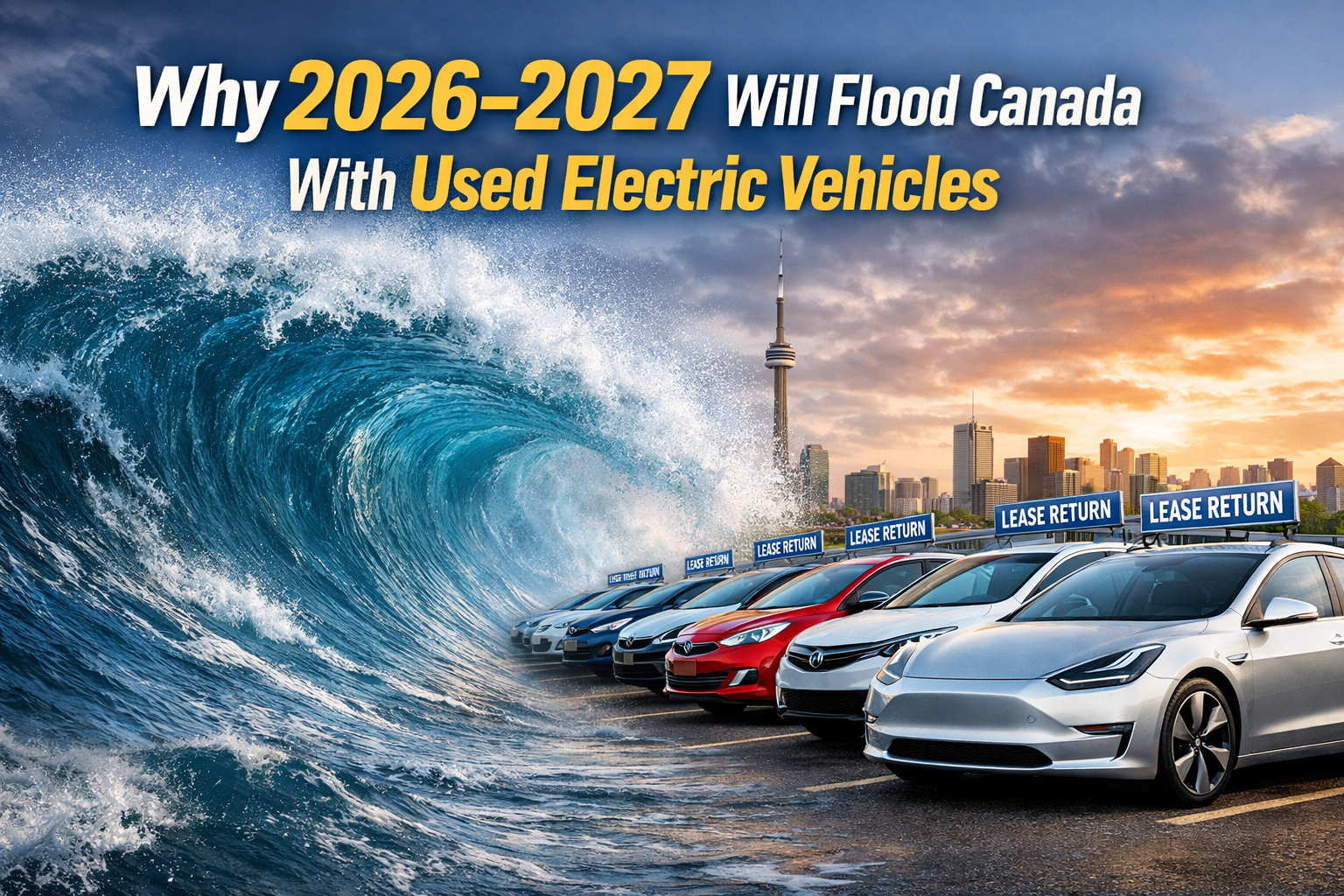
Why 2026–2027 Will Flood Canada With Used Electric Vehicles
What the Coming Off-Lease Wave Means for Prices, Choice, and Buyers
Over the next two years, Canada’s used electric vehicle (EV) market is set to change dramatically. Between 2026 and 2027, a large wave of early-generation EVs will come off lease and enter the used market — increasing supply, expanding choice, and putting downward pressure on prices.
For Canadian buyers who have been sitting on the sidelines, this shift could make 2026–2027 the best window yet to buy a used electric car.
Here’s what’s driving this change — and what it means for you as a used EV buyer.
The EV Lease Boom of 2020–2023 Is Ending
Between 2020 and 2023, EV adoption in Canada accelerated rapidly. Automakers pushed electric vehicles aggressively through short-term leases, driven by:
Federal and provincial EV incentives
Supply shortages for gas vehicles
Rising fuel prices
Rapid expansion of public charging networks
Many of these EVs were leased for 36 to 48 months, which puts their return to the market squarely in 2026 and 2027.
When leases end, vehicles typically follow one of three paths:
Returned to dealers and sold as certified used
Sold through auctions
Enter the private resale market
In all cases, used inventory increases — and prices tend to soften.
Which EVs Will Dominate the Used Market?
The off-lease wave won’t be evenly distributed. Certain models are expected to make up a large share of used EV listings.
Most Common Off-Lease EVs (Expected)
Tesla Model 3
Chevrolet Bolt EV / EUV
Hyundai Kona Electric
Kia Niro EV
Ford Mustang Mach-E
Volkswagen ID.4
These vehicles were among the highest-volume leased EVs in Canada, particularly in urban and suburban markets.
Many of them are already well-understood platforms, which reduces uncertainty for second-hand buyers.
👉 Related guide:
Are Used Electric Cars Worth It in Canada?
https://usedelectriccarscanada.ca/buying-guides/are-used-electric-cars-worth-it
Why Increased Supply Matters More Than Incentives
New EV headlines often focus on government incentives, but for used buyers, supply matters more than rebates.
As thousands of similar EVs hit the market:
Sellers compete on price
Buyers gain leverage
Dealers discount older inventory faster
This dynamic is already visible in select markets, but it should become nationwide by 2026.
For used buyers, depreciation is no longer a risk — it’s an advantage.
👉 Cost breakdown:
Real Cost of Owning a Used EV in Canada
https://usedelectriccarscanada.ca/charging-costs/real-cost-of-owning-a-used-ev
Battery Fear Is No Longer the Wild Card
One reason used EVs were once viewed cautiously was battery uncertainty. That concern has faded.
Real-world data from automakers, fleets, and independent studies now shows that:
Most modern EVs retain 80–90% battery capacity after 6–8 years
Degradation is slow and predictable
Battery warranties (often 8 years / 160,000 km) frequently still apply
This matters because the 2026–2027 off-lease EVs:
Are old enough to be affordable
Are young enough to remain reliable
👉 Buyer checklist:
How to Check EV Battery Health Before Buying
https://usedelectriccarscanada.ca/buying-guides/how-to-check-ev-battery-health
Charging Infrastructure Has Quietly Improved
Charging anxiety has also declined — not because charging is perfect, but because it’s good enough for most use cases.
Between 2020 and 2025:
DC fast charger coverage expanded along major corridors
Urban Level 2 charging increased significantly
Home charging adoption accelerated
According to data from Natural Resources Canada, Canada’s public charging network has more than doubled in recent years, with reliability improving alongside expansion.
For used EV buyers, this means fewer compromises than early adopters faced.
👉 Charging guide:
Home Charging Setup: Complete Canadian Guide
https://usedelectriccarscanada.ca/charging-costs/home-charging-guide
Why Winter No Longer Disqualifies Used EVs
Canadian winters remain a legitimate concern — but not a dealbreaker.
Newer EVs returning from lease:
Have better thermal management
Often include heat pumps
Are more efficient in cold weather than early models
Range loss in winter is real, but predictable and manageable — especially for commuters and urban drivers.
👉 Winter breakdowns:
Best Used EVs for Canadian Winters
https://usedelectriccarscanada.ca/winter-climate/best-evs-for-winter
How Much Range Do You Really Lose in Winter?
https://usedelectriccarscanada.ca/winter-climate/how-much-range-do-you-really-lose-in-winter
What This Means for Used EV Buyers
Between 2026 and 2027, Canadian buyers can expect:
More choice across brands and body styles
Lower prices driven by off-lease volume
Better battery confidence than ever before
Reduced early-adopter risk
Stronger value compared to gas vehicles
For many buyers, the question is no longer “Are used EVs worth it?” — but “Which one fits my needs best?”
Should You Wait or Buy Now?
Not everyone needs to wait until 2026.
You may want to buy sooner if:
You drive high fuel mileage
You can charge at home
You find a well-priced off-lease EV today
But if you’re flexible and value maximum selection and leverage, the 2026–2027 window is likely to be the most buyer-friendly period yet.
Sources & References
Natural Resources Canada — EV charging infrastructure data
Transport Canada — Vehicle adoption trends
Statistics Canada — Vehicle registration and lease data
Automaker battery warranty disclosures (Tesla, GM, Hyundai, Kia, Ford, Volkswagen)
Fleet and degradation studies from long-term EV usage reports
Bottom Line
The used EV market in Canada isn’t slowing down — it’s maturing.
And for buyers, maturity means lower risk, better pricing, and smarter choices.