The Breakdown: Rivian R1S
A deep, no-nonsense look at Rivian’s electric SUV — from specs and tech to real-world ownership and future used-market potential.
The Breakdown: Series — What This Is
The Breakdown is our long-form, research-driven series where we strip an EV down to its essentials:
What it really offers on paper
How it performs in the real world
What ownership looks like in Canada
Where it will likely land as a used EV
This isn’t hype or hate — it’s clarity.
Overview: What Is the Rivian R1S?
The Rivian R1S is a full-size, three-row, all-electric SUV designed to blend luxury, off-road capability, and cutting-edge EV tech. It competes in a space that barely existed before it launched: a rugged, adventure-first electric SUV that still works as a family hauler.
Rivian positions the R1S as a do-everything vehicle:
Daily driver
Road-trip cruiser
Winter warrior
Off-road adventure rig
Key Specs at a Glance
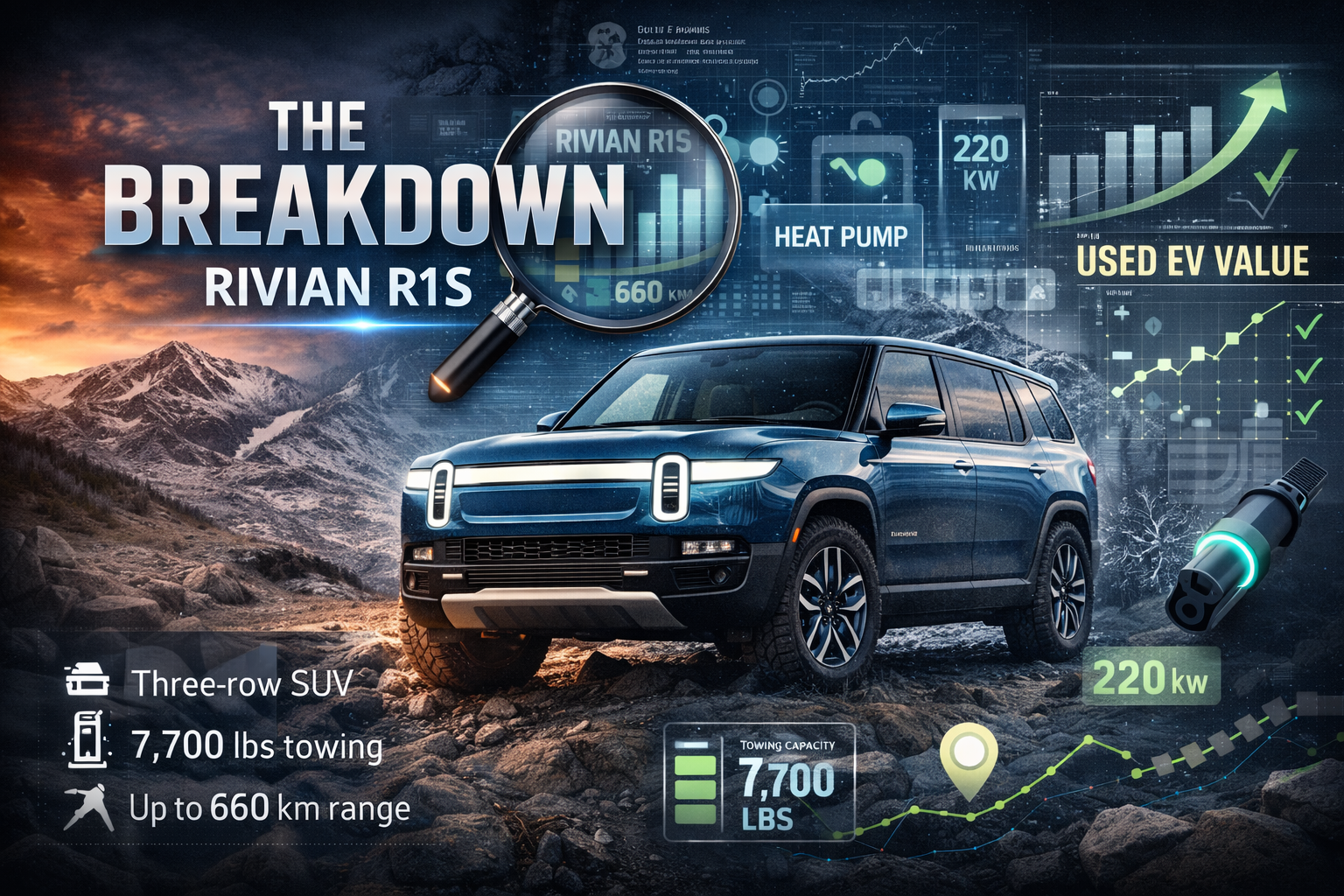
The Rivian R1S is a three-row electric SUV designed to accommodate either five or seven passengers, making it suitable for families as well as adventure-focused buyers. It is offered with either a dual-motor all-wheel-drive system for improved efficiency or a quad-motor all-wheel-drive setup that delivers maximum traction and off-road control. Buyers can choose between Large and Max battery packs, with an estimated real-world range of approximately 505 to 660 kilometres, depending on configuration and driving conditions.
Charging is handled through the CCS standard, supporting both DC fast charging and Level 2 AC charging for home use. Performance remains a standout despite the vehicle’s size, with 0–100 km/h times ranging from roughly 3.0 to 4.5 seconds. The R1S can tow up to 3,500 kilograms (about 7,700 pounds) and features an adaptive air suspension that allows for up to 368 millimetres of ground clearance, reinforcing its capability as one of the most versatile electric SUVs currently on the market.
Powertrain & Performance Breakdown
Motor Configurations
Dual-Motor AWD
More efficient
Better range
Lower cost
Quad-Motor AWD
One motor per wheel
Extreme torque vectoring
Superior off-road control
Real-World Performance
Instant torque makes the R1S feel much faster than its size suggests
Quad-motor versions rival performance SUVs while weighing over 3 tonnes
Adaptive suspension dynamically adjusts ride height for:
Highway efficiency
Snow & ice
Trails & obstacles
Battery, Range & Charging (Canadian Reality Check)
Battery Options
Large Pack
Best balance of cost and range
Max Pack
Long-distance focused
Heavier, more expensive
Charging Capabilities
DC Fast Charging (CCS)
Up to ~220 kW peak
~10–80% in ~35–45 minutes (ideal conditions)
Level 2 Home Charging
~11.5 kW onboard charger
Full overnight charge
🔗 Official specs & configurations:
👉 https://rivian.com/en-CA/r1s
Interior, Tech & Usability
Interior Highlights
Vegan leather & sustainable materials
Massive panoramic glass roof
Minimalist dashboard with dual large screens
Exceptional second-row legroom
Tech Stack
Over-the-air (OTA) updates
Built-in navigation with charging integration
Advanced driver-assist suite (Highway Assist)
Vehicle-wide software control (suspension, drive modes, regen)
Storage & Practicality
Front trunk (frunk)
Hidden under-floor storage
Flat-folding rows
Excellent cargo volume for road trips and gear
Winter Driving & Canadian Conditions
The R1S is one of the most winter-capable EVs on the market.
Why It Works in Cold Climates
True AWD (not front-biased)
Excellent weight distribution
Heat pump system (newer builds)
High ground clearance for snowbanks
Strong traction control logic
⚠️ Like all EVs:
Expect 15–30% range loss in extreme cold
Winter tires are non-negotiable
Towing & Adventure Use
The Rivian R1S offers serious towing capability for an electric SUV, with a maximum towing capacity of approximately 7,700 pounds, making it suitable for hauling boats, campers, or utility trailers. A standard factory hitch comes equipped from the start, and integrated trailer stability control helps maintain confidence and control at highway speeds or in crosswinds. Importantly for EV owners, the R1S also supports regenerative braking while towing, reducing brake wear and helping manage descents more smoothly — a feature that sets it apart from many traditional gas-powered SUVs when towing heavy loads.
This makes the R1S one of the very few EVs that can legitimately tow boats, campers, or trailers without being a compromised experience.
Ownership Costs & Maintenance
Maintenance Expectations
No oil changes
No transmission service
Fewer moving parts than ICE SUVs
Brake wear reduced via regen
Potential Long-Term Costs
Air suspension repairs (post-warranty)
Tire wear (heavy vehicle + torque)
Insurance premiums (vehicle value)
Used Market Outlook (Why This Matters)
While currently rare in Canada, the Rivian R1S is a future used-EV heavyweight.
Why the Used Market Will Grow
Lease returns (2026–2028)
Early adopters upgrading
Import pathways improving
Price normalization as Rivian scales
Who a Used R1S Will Be Perfect For
Families wanting a premium EV SUV
Outdoor enthusiasts
Buyers cross-shopping:
Large gas SUVs
Luxury plug-ins
Premium EV crossovers
Rivian R1S vs Alternatives (Quick Comparison)
The Rivian R1S stands out for its rare ability to blend true off-road capability with a premium, family-friendly interior, but its limited availability in Canada and high purchase price remain its biggest drawbacks. The Tesla Model X excels as a long-distance electric SUV thanks to Tesla’s extensive Supercharger network and strong on-road efficiency, though it lacks the rugged build and trail readiness of the Rivian. The Kia EV9 delivers impressive interior space and strong overall value for a three-row electric SUV, but it falls short in outright performance and advanced capability compared to higher-end rivals. Meanwhile, the BMW iX focuses heavily on luxury materials, refinement, and sharp road manners, yet its absence of a third row and limited utility make it less versatile for families or adventure-focused buyers.
Pros & Cons Summary
✅ Pros
Exceptional AWD capability
True 3-row EV
Premium materials
Strong towing
OTA updates & modern tech
❌ Cons
Limited Canadian availability (for now)
Large size = efficiency trade-off
Expensive new
Long-term service network still growing
Final Verdict: Is the Rivian R1S Worth Watching?
Absolutely.
The Rivian R1S represents a new class of EV — one that doesn’t ask buyers to choose between:
Capability vs sustainability
Family vs adventure
Performance vs practicality
As the used market develops, this will likely become one of the most desirable large electric SUVs in Canada.
Sources & Further Reading
Rivian Official Canada Page: https://rivian.com/en-CA/r1s
Used EV ownership insights: https://usedelectriccarscanada.ca
Charging & battery guides: https://usedelectriccarscanada.ca/charging-costs