Our battery degradation resale value piece covers how state-of-health translates into price. This piece answers a different question: why mileage itself — the number every used-car shopper instinctively anchors on — means something genuinely different on an EV than it does on a gas car, backed by real fleet data on what actually drives degradation.
Quick answer: On a gas car, mileage is largely a proxy for mechanical wear — more kilometres generally means more wear on an engine with hundreds of moving parts. An EV's drivetrain has drastically fewer wearing parts, so mileage itself matters less mechanically and more as a rough proxy for battery cycle count and, critically, how that mileage was accumulated. A large fleet-data study of 22,700 EVs found average battery degradation of 2.3% per year, but with real, measurable variance driven by charging habits, not distance: vehicles where DC fast charging made up more than 12% of charging sessions degraded at 2.5% per year, versus 1.5% per year for low-DC-fast-charging vehicles — and among frequent fast chargers, those using high-power (100kW+) sessions more than 40% of the time degraded at 3.0% per year, double the low-usage rate. The practical takeaway: a higher-mileage EV that was mostly charged at home on Level 2 can genuinely be a better buy than a lower-mileage one that relied heavily on DC fast charging.
Why EV mileage isn't the same signal as gas-car mileage
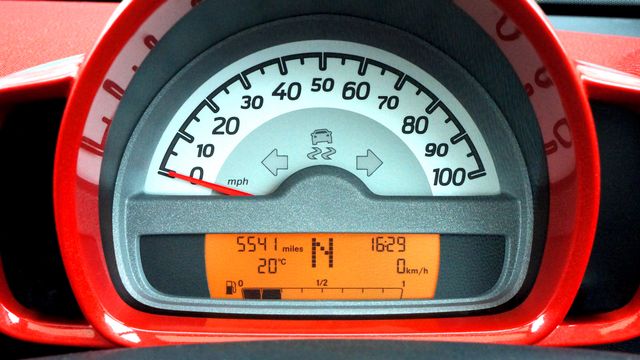
A gas engine has hundreds of moving, wearing parts — pistons, valves, a timing chain or belt, a complex fuel and exhaust system — and the more kilometres it's driven, the more cumulative wear those parts have absorbed, which is exactly why odometer reading has always been such a central used-car pricing variable. An EV's drivetrain is fundamentally simpler: an electric motor has essentially one major moving part (the rotor) and no combustion, no oil, no exhaust system, and dramatically less to mechanically wear out over distance. This is the same underlying fact behind the 40-50% lower EV maintenance costs covered in our first-time buyer's guide — there's simply less to wear out.
That doesn't mean mileage is irrelevant on an EV — it's a reasonable proxy for how many charge cycles the battery has likely gone through, and cycle count does relate to degradation. But it's a much rougher proxy than it is for a gas engine, because two EVs with identical mileage can have gone through very different real charging histories, and — as the data below shows — that history matters more than the raw distance number.
What the data actually shows
A large-scale analysis of 22,700 EVs across 21 models found average battery degradation of 2.3% per year — a useful baseline figure on its own. But the more interesting finding is how much that average varies based on charging behaviour rather than distance driven. Vehicles where DC fast charging accounted for less than 12% of charging sessions showed 1.5% annual degradation; vehicles above that threshold showed 2.5% — a meaningfully faster rate driven by how the car was charged, not how far it was driven. Within the higher-frequency DC fast-charging group, the specific power level used mattered too: vehicles using high-power sessions (above 100kW) more than 40% of the time degraded at 3.0% per year, double the rate of vehicles that fast-charged frequently but mostly at lower power levels (2.2% per year for those using high-power sessions less than 40% of the time).
A few other factors showed up in the same analysis, worth knowing even though they're secondary to the charging-behaviour finding: vehicles in consistently hot climates (above 25°C more than 35% of days) degraded about 0.4 percentage points faster per year than those in milder climates — a genuinely small effect in most of Canada's climate, where sustained heat above 25°C for a third of the year is uncommon outside a handful of regions. Higher daily charge-cycling (essentially, how much of the battery's capacity gets used and replenished per day) added roughly 0.8 percentage points between low- and high-utilization scenarios. And state-of-charge extremes mattered less than commonly assumed — keeping a battery within a moderate 20-80% range showed negligible benefit over normal use; the real acceleration in degradation only showed up when a vehicle spent over 80% of its total time at extreme charge levels (very low or very high), a usage pattern that's uncommon for most daily drivers.
What this actually means when you're comparing two used EVs
Put concretely: a used EV with 80,000 km that was charged almost entirely at home overnight, with only occasional DC fast charging for road trips, likely has a healthier battery than a 50,000 km example that was charged predominantly at high-power public fast chargers — even though the lower-mileage car looks like the "safer" buy on paper. This is a genuinely counterintuitive finding for anyone shopping with gas-car instincts, where lower mileage is reflexively better.
The practical challenge, honestly, is that charging history isn't something a typical used-car listing discloses, and it's much harder to verify than an odometer reading. This is exactly where a documented, independent battery health check — see our independent battery testing piece — earns its value: rather than trying to reconstruct a car's charging history from limited clues, a real state-of-health reading tells you the result of that history directly, which is ultimately what matters for your purchase decision regardless of how the car got there.
The bottom line
Mileage on a used EV is a real but rough signal — useful as a general proxy for charge-cycle count, but a much weaker indicator of actual condition than it is on a gas car, because real fleet data shows charging behaviour (specifically, how often and how aggressively a car relied on DC fast charging) drives meaningfully more degradation variance than distance alone. Don't automatically favour a lower-mileage EV over a higher-mileage one without checking actual battery health — the number on the odometer is telling you less than you'd assume from gas-car shopping habits.
FAQ
Does higher mileage always mean a worse used EV battery? Not necessarily — real fleet data shows charging behaviour (especially frequent, high-power DC fast charging) drives more degradation variance than distance driven alone. A higher-mileage, gently charged EV can beat a lower-mileage, heavily fast-charged one.
How much does frequent DC fast charging actually accelerate battery degradation? A large fleet study found EVs with over 12% of charging sessions as DC fast charging degraded at 2.5% per year versus 1.5% for lower fast-charging usage — and heavy users of high-power (100kW+) fast charging specifically degraded at 3.0% per year, double the low-usage rate.
Does climate affect EV battery degradation as much as charging habits? Less so, according to the same data — consistently hot climates (25°C+ for over a third of the year) added roughly 0.4 percentage points of annual degradation, a smaller effect than charging-frequency differences, and one that applies to relatively few parts of Canada.
How can I find out a used EV's actual charging history? You generally can't directly — charging history isn't typically disclosed in listings. An independent battery health check tells you the resulting state of health directly, which matters more for your decision than reconstructing the history itself.
Sources: Geotab, "EV Battery Health: Key Findings from 22,700 Vehicle Data Analysis". Degradation rates are fleet averages across the study's specific vehicle sample — individual results vary by model, battery chemistry, and specific usage pattern.