
Our guide on whether used EVs are worth it in Canada answers the big-picture question. This one is narrower and more practical: if you've only ever owned gas cars, what actually changes day to day, which used models make that transition easiest, and — just as important — what parts of the "EV learning curve" you can safely stop worrying about.
Quick answer: For most Canadians, switching to an EV changes less than you'd expect: the average Canadian drives under 45 km a day, comfortably inside the range of any EV on the used market, healthy or not. What actually changes is where you refuel (mostly at home, overnight, instead of at a gas station) and how much you spend doing it — the Canadian Automobile Association estimates EV owners save 40-50% on maintenance versus a comparable gas vehicle, and charging costs 5-10 times less than filling up per equivalent distance. For a first EV, the Chevrolet Bolt EV/EUV, Hyundai Kona Electric, and Nissan Leaf are consistently the easiest used models to live with — simple, well-understood, widely serviced, and forgiving of a learning curve. Don't overthink DC fast-charging network coverage or theoretical maximum range for your first car; for daily driving, it matters far less than people assume before they own one.
What actually changes, day to day
The single biggest mental shift, and the one that trips up first-time EV owners the most, isn't about driving — it's about refuelling. A gas car gets "topped up" in one deliberate stop when it's low. An EV, for most owners most of the time, gets plugged in at home overnight and is simply full (or close to it) every morning, the same way your phone is. You stop thinking about "when do I need to get gas" almost entirely, and public charging becomes something you use for road trips or the occasional day you didn't plug in, not your default refuelling method.
The other real, measurable change is cost. Charging an EV costs roughly 5 to 10 times less than filling a comparable gas vehicle for the same distance, and maintenance runs 40-50% lower — no oil changes, far less brake wear thanks to regenerative braking (our regenerative braking math piece breaks down exactly why), and a simpler drivetrain overall with fewer wearing parts. One Canadian per-kilometre analysis puts EV maintenance and repair costs at roughly 3.1 cents/km over a vehicle's life versus 6.1 cents/km for a gas equivalent — genuinely close to half.
What doesn't change nearly as much as people assume
This is worth saying plainly, because a lot of pre-purchase anxiety about EVs centers on things that turn out not to matter much in daily use. Range anxiety is the big one: with most Canadians driving under 45 km a day, even a used EV with meaningfully degraded battery health — see our battery health check guide for how to verify this before buying — still has range to spare for typical daily driving. Winter range loss is real and worth planning around for longer trips (our winter-climate content covers this in depth), but it doesn't erase the basic math for a short commute.
Charging speed and public network coverage are the other area first-time buyers tend to overthink. If you can charge at home — even on a standard household outlet overnight, let alone a proper Level 2 charger — DC fast charging becomes a road-trip tool, not a daily necessity, and worrying extensively about which public network has the best coverage in your area matters far less for a first EV than making sure you have a reliable way to charge where you park overnight.
Which used EVs make the switch easiest
Not every EV is equally forgiving for a first-time owner, and the right pick for someone switching from gas isn't necessarily the newest or most feature-packed one — it's the one that's simple, well-understood, and easy to get serviced.
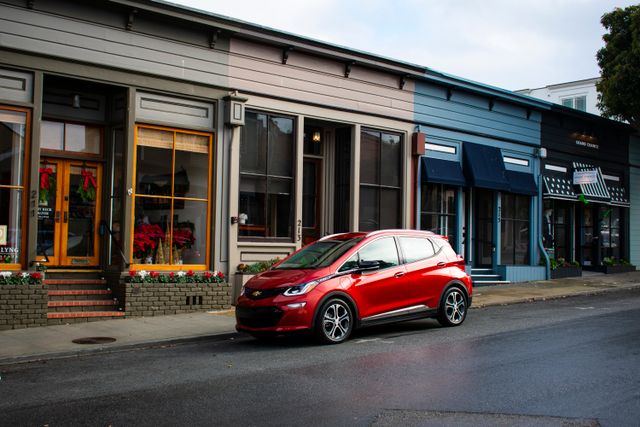
Chevrolet Bolt EV / Bolt EUV are consistently strong first-EV picks: straightforward hatchback/small-SUV practicality, a simple single-motor drivetrain, real-world range that comfortably covers daily use, and — since GM sold a lot of them — a genuinely deep used inventory and parts availability. Our Breakdown on the Bolt EUV and our Bolt EV vs. Bolt EUV comparison cover the specifics if you're choosing between the two.
Hyundai Kona Electric is another genuinely easy first EV — a normal-feeling compact SUV that doesn't ask you to adapt to anything unusual, with solid real-world range and a reputation as one of the more dependable used EV choices on the market.
Nissan Leaf deserves a place on this list specifically for affordability and simplicity, with the honest caveat that older, air-cooled-battery examples (pre-2018 roughly) degrade faster in hot climates than liquid-cooled competitors — less of a concern in most of Canada's climate, but worth knowing.
What these three have in common, beyond being individually solid: none of them ask a first-time buyer to learn anything unusual. No NACS/CCS adapter complications to sort out on day one (see our NACS vs. CCS adapter guide if that becomes relevant later), no unusual charging quirks, and a large enough used population that a competent independent shop or dealer service department has almost certainly worked on one before.
The one thing worth doing differently as a first-time buyer
If there's one habit worth adopting specifically because you're new to EVs, it's this: get a real battery health check before you buy, not after. On a gas car, a first-time buyer leans on an oil-change history and a mechanic's inspection to gauge condition; on an EV, the equivalent diligence step is a documented state-of-health reading, since that number tells you far more about the car's real remaining life than mileage alone. Our complete used EV inspection checklist and battery health guide both walk through exactly how to do this.
The bottom line
Switching from gas to your first used EV changes less about how you actually drive than most people expect — the average Canadian's daily driving fits comfortably within any EV's range — and more about where and how you pay for energy, with real, well-documented savings on both fuel and maintenance. Stick to a simple, well-understood used model like the Bolt EV/EUV, Kona Electric, or Leaf for your first EV, get a real battery health check before buying, and don't spend your energy worrying about maximum range or exhaustive fast-charger coverage — for daily use, it matters far less than it seems like it should before you've actually lived with one.
FAQ
Will I run out of range switching to a used EV as my first car? Unlikely for daily use — most Canadians drive under 45 km a day, well within the range of virtually any used EV on the market, even one with meaningfully degraded battery health.
How much will I actually save switching from gas to an EV? The CAA estimates 40-50% lower maintenance costs, and charging typically costs 5-10 times less than filling up for the same distance — a real, measurable saving rather than a marketing claim.
What's the easiest used EV for a first-time buyer? The Chevrolet Bolt EV/EUV, Hyundai Kona Electric, and Nissan Leaf are consistently the most forgiving first picks — simple, well-understood, widely serviced, and free of unusual charging or drivetrain quirks.
Do I need to worry about DC fast-charging network coverage for my first EV? Not much, if you can charge at home. Fast charging becomes primarily a road-trip tool rather than a daily necessity once home charging is available.
Sources: Government of Canada, "Benefits of driving an electric vehicle"; RIDEZ, "EV Maintenance Costs Canada: 7 Hidden Facts Exposed". Individual savings and range needs vary — use these figures as general benchmarks rather than guarantees for your specific driving pattern.