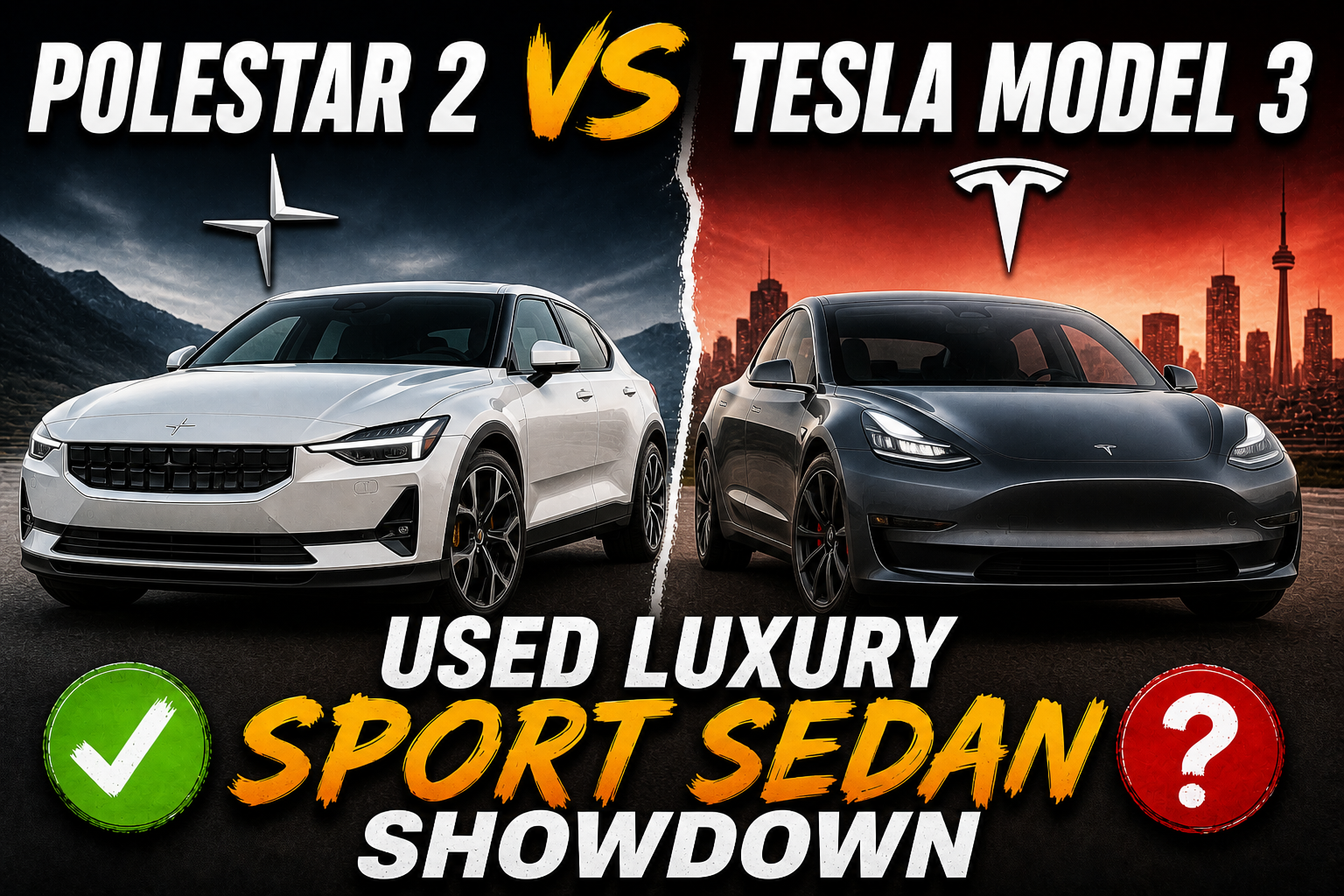
The Tesla Model 3 practically defined the electric sport sedan category, and it remains the default choice for most Canadian used-EV shoppers in this segment. The Polestar 2 is the car most often positioned as its "anti-Tesla" alternative — same general size and mission, but built by a Volvo-affiliated brand with a very different philosophy on interior materials, software, and driving character. On the used market specifically, the comparison gets more interesting than it looks on paper, because the two cars depreciate at genuinely different rates.
Quick answer: The Model 3 holds resale value better and offers a stronger charging network and slightly more range. The Polestar 2 depreciates faster — which, from a buyer's seat rather than a seller's, translates into meaningfully lower prices for comparable age and mileage, along with a more premium-feeling interior and a more conventional infotainment experience for buyers who find Tesla's minimalism off-putting.
The depreciation gap is the real story here
This is the single most important fact for a used buyer to understand. The Model 3 retains roughly 53% of its value over five years — strong for any vehicle, let alone an EV. The Polestar 2, by contrast, has lost up to 40% of its value in just the first two years of ownership in some tracked data. That's a dramatically steeper curve, and it flips the used-buying calculus in the Polestar's favour: current KBB valuations put a 2022 Polestar 2 Long Range at roughly $23,046, against $24,825 for a 2022 Model 3 Standard Range — meaningfully cheaper for a car in the same size and performance class, and the gap widens further back in the used market. As one comparison summarized it, you might find a low-mileage 2022 Polestar 2 for close to what you'd pay for a considerably older 2021 Model 3.
Steep depreciation is a real downside if you're the original owner selling early. If you're buying used, it's the opposite — you're the one benefiting from someone else absorbing that loss.
Build quality and interior: genuinely different philosophies
The Polestar 2 leans into traditional premium-car cues: high-grade textiles, vegan leather, real metal trim, and solid, deliberate switchgear — an interior built to feel expensive in a familiar, Scandinavian-minimalist way. The Model 3's interior takes the opposite approach: ultra-minimalist, screen-centric, and deliberately stripped of most physical controls. Some buyers find the Model 3's approach refreshingly clean; others find it spartan, especially coming from a traditional gas vehicle. This is a real, substantive difference in daily-driving character, not just marketing language — it's worth sitting in both before deciding, because it maps closely to personal preference rather than one being objectively better.
Software: Android Automotive vs. Tesla's own OS
The Polestar 2 runs Android Automotive OS, which brings built-in Google Assistant voice commands, Google Maps, and access to the Google Play Store directly in the car — an experience that will feel immediately familiar to most Android phone users. Tesla runs its own proprietary software stack, tightly integrated with the Tesla ecosystem (Supercharger routing, the Tesla app, Autopilot features) but less familiar out of the box. Both platforms receive over-the-air updates that meaningfully improve the car over time — this is one area where both brands are genuinely ahead of most traditional automakers, EV or otherwise.
Reliability: mostly software, not mechanical
Owner survey and forum data suggest the Polestar 2 is generally dependable, with reported issues skewing toward software glitches rather than mechanical failures — a pattern common across most modern EVs, Tesla included. One notable exception worth knowing about if you're shopping a 2021-2024 model: a rearview camera display recall affected that range of model years, addressed via a 2024 software update. When shopping used, confirm the recall has been applied via the VIN, the same diligence you'd apply to any recall history check as part of a complete inspection checklist.
Where the Model 3 still wins
Two areas favour the Model 3 clearly enough to matter for some buyers. Range: the Model 3 offers up to roughly 30 additional EPA-estimated miles over a comparable Polestar 2 trim, a real if not enormous gap. And charging network: Tesla's Supercharger network remains more extensive and more reliable than the Chargepoint and Electrify America networks the Polestar 2 depends on — see our public charging networks comparison for the full Canadian picture. Performance also favours the Model 3 at the base-trim level — 283 horsepower versus the base Polestar 2's 231 hp — though this gap narrows or reverses at higher Polestar trims with dual-motor setups.
What this means for warranty and insurance as a lower-volume brand
Polestar sells in meaningfully lower volumes than Tesla in Canada, which has practical downstream effects worth factoring in: parts availability and service network density are both thinner, and resale value for a lower-volume brand can be more volatile and harder to predict than for a high-volume nameplate. None of this is a dealbreaker, but it's worth confirming realistic service access in your specific region before buying, and reviewing what remains on the factory warranty — a lower-volume brand's warranty coverage is exactly the kind of thing worth double-checking by VIN rather than assuming.
The bottom line
If charging network breadth, maximum range, and best-case resale value matter most, the Model 3 remains the stronger overall package. But the Polestar 2's steep early depreciation is precisely what makes it an interesting used buy — a genuinely well-built, premium-feeling alternative available for meaningfully less money than a comparable Model 3, provided you're comfortable with a lower-volume brand's thinner service network and less predictable long-term resale. For a buyer who's decided against Tesla's minimalist interior philosophy specifically, the Polestar 2 is the most credible used alternative in this segment right now.
FAQ
Is the Polestar 2 cheaper than the Tesla Model 3 used? Generally yes, at comparable age and mileage — the Polestar 2 has depreciated up to 40% in its first two years in some tracked data, compared to the Model 3 retaining roughly 53% of its value over five years, which creates a meaningful used-price gap in the Polestar's favour.
Is the Polestar 2 reliable? Owner data generally points to solid dependability, with most reported issues being software-related rather than mechanical. A notable rearview camera display recall affected 2021-2024 models, addressed via a 2024 software update — worth confirming by VIN on any used example.
Which has better range, the Polestar 2 or Model 3? The Model 3 offers up to roughly 30 additional EPA-estimated miles over a comparably trimmed Polestar 2.
Sources: CarBuzz, "Polestar 2 vs Tesla Model 3: The Better Used EV Choice?"; Recharged, "Used Tesla Model 3 vs Polestar 2: 2026 Comparison Guide".