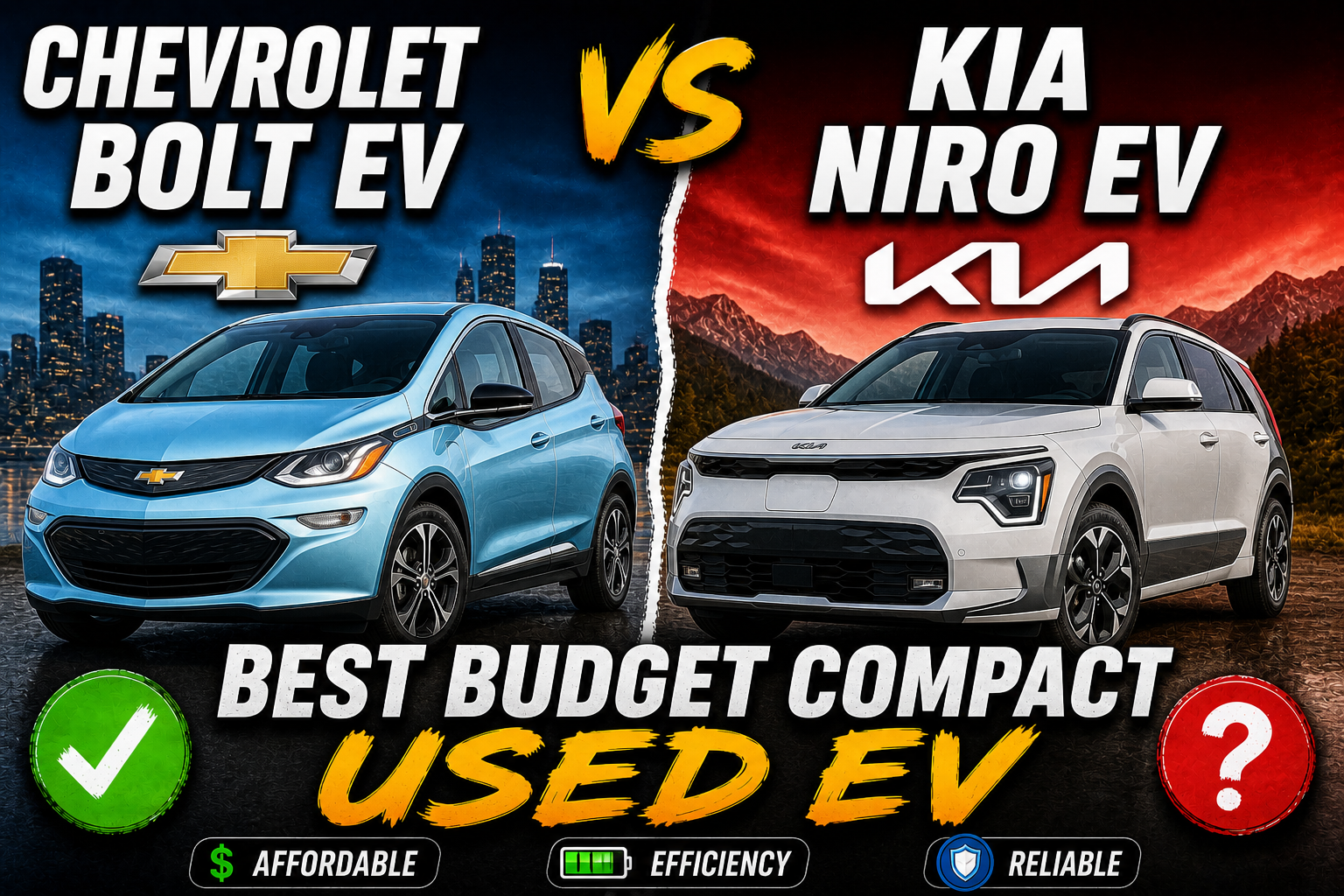
For buyers prioritizing price above all else, the Chevrolet Bolt EV and Kia Niro EV are the two names that come up most often in the budget compact EV conversation. They're not quite direct competitors — the Bolt is a hatchback, the Niro EV a small crossover — but they occupy the same price tier and get cross-shopped constantly for exactly that reason. The comparison here comes with a genuine wrinkle worth understanding before you shop either one: GM's well-known Bolt battery recall, which sounds like a red flag but often works out in a used buyer's favour.
Quick answer: The Bolt EV is typically the cheaper of the two per mile of range, and a Bolt with completed recall battery replacement work can offer a genuinely stronger battery warranty position than its age suggests. The Niro EV commands higher prices but generally comes with fresher model years and more remaining factory warranty. Verify recall completion status on any Bolt before buying — it changes the calculation significantly.
The Bolt's battery recall: what actually happened, and why it matters for used buyers
Between 2017 and 2019, GM issued a major recall covering 68,667 Bolt EVs worldwide (50,925 in the US) after finding that a rare combination of two manufacturing defects in the same battery cell could cause fires during charging. The remedy evolved over time — an initial November 2020 software update temporarily capped charging at 90% as an interim measure, followed by a comprehensive replacement plan announced in 2021 after further fire incidents on already-"fixed" vehicles. The final resolution: complete battery module replacement, at no cost to owners, across all affected vehicles.
Here's the part that matters for a used buyer: a Bolt that received this replacement effectively has a newer battery pack than its model year suggests, often with an extended battery warranty tied to the replacement date rather than the original in-service date. That's a genuine silver lining — a properly remedied 2018 or 2019 Bolt can be a stronger battery bet than an unremedied car from a "safer" model year. The critical step is verification: confirm recall completion status directly through a dealership or GM's dedicated line (1-833-EVCHEVY) before buying, using the VIN. A Bolt with unconfirmed or incomplete recall work is a real risk worth walking away from; one with confirmed, completed work is arguably a better-than-average used EV battery bet.
Pricing and used market availability
The Bolt EV consistently shows up as one of the lowest-priced used EVs per mile of range on the market, a pricing advantage that reflects both its older average age in the secondhand pool (2019-2023 model years are the most common) and genuine value given its EPA range of up to 259 miles on newer examples. The Niro EV commands meaningfully higher asking prices, reflecting both newer typical model years (2023-2025+) and its crossover body style, which carries a premium over a hatchback in most used-vehicle markets regardless of powertrain.
Range: close enough not to be a deciding factor
Both deliver genuinely competitive range for the budget segment — the Bolt EV rated up to 259 miles on 2020+ model years, the Niro EV in the mid-250-mile range on official EPA ratings. Real-world highway performance is comparable between the two. This isn't where the decision should be made; price, battery/recall status, and remaining warranty matter more.
Reliability and warranty positioning
Because most used Niro EVs on the market are newer (2023+), buyers typically encounter more remaining factory warranty coverage than on a comparably priced Bolt — a real advantage if warranty protection matters more to you than upfront price. The current-generation Niro EV also hasn't faced anything resembling the Bolt's battery controversy in North America, which some buyers will weight heavily even though, as covered above, a properly remedied Bolt's battery risk is arguably resolved.
The practical takeaway: don't let recall history alone push you away from the Bolt. The right question isn't "did this car have a recall" — it's "was the recall work actually completed, and can I verify it." A Bolt that passes that check is a legitimately strong budget buy; one that doesn't is a legitimate pass.
What to check before buying either
For any Bolt: confirm recall completion status by VIN through Chevrolet directly, not just the seller's word.
For any Niro EV: confirm remaining factory battery and bumper-to-bumper warranty coverage by VIN — newer stock generally means more coverage left, but verify rather than assume.
For both: a direct battery State of Health reading, per our battery health check guide, rather than relying on the dash range estimate.
For both: cross-reference against our best used EV model years guide for specific year-by-year notes.
The bottom line
Both are legitimate budget-tier used EV choices, and the "right" one depends on what you're optimizing for. If minimizing purchase price per mile of range is the priority and you're willing to do the recall verification homework, the Bolt EV is hard to beat — and a confirmed-remedied Bolt is a better bet than its recall history alone suggests. If you'd rather pay more for a newer vehicle with more remaining factory warranty and don't mind the crossover body style over a hatchback, the Niro EV is the stronger pick. Either way, this is a category where the specific vehicle's paperwork — recall completion, remaining warranty — matters more than the badge.
FAQ
Is it safe to buy a used Chevrolet Bolt EV given the battery recall? Yes, provided the recall remedy (complete battery module replacement) has been verified as completed on that specific VIN. GM replaced affected battery modules at no cost, and a properly remedied Bolt often has an effectively newer battery than its model year suggests, with warranty coverage tied to the replacement date.
Which is cheaper, a used Bolt EV or a used Kia Niro EV? The Bolt EV is typically cheaper per mile of range, reflecting its generally older average age on the used market. The Niro EV commands higher prices, reflecting newer typical model years and crossover body style.
How do I check if a used Bolt's recall has been completed? Verify by VIN directly through a Chevrolet dealership or GM's dedicated line (1-833-EVCHEVY) — don't rely solely on a seller's claim that the work was done.
Sources: Recharged, "Kia Niro EV vs Chevy Bolt EV: Used EV Comparison"; Green Car Reports, "2017-2019 Chevy Bolt EV fire recall: GM will replace all battery modules".