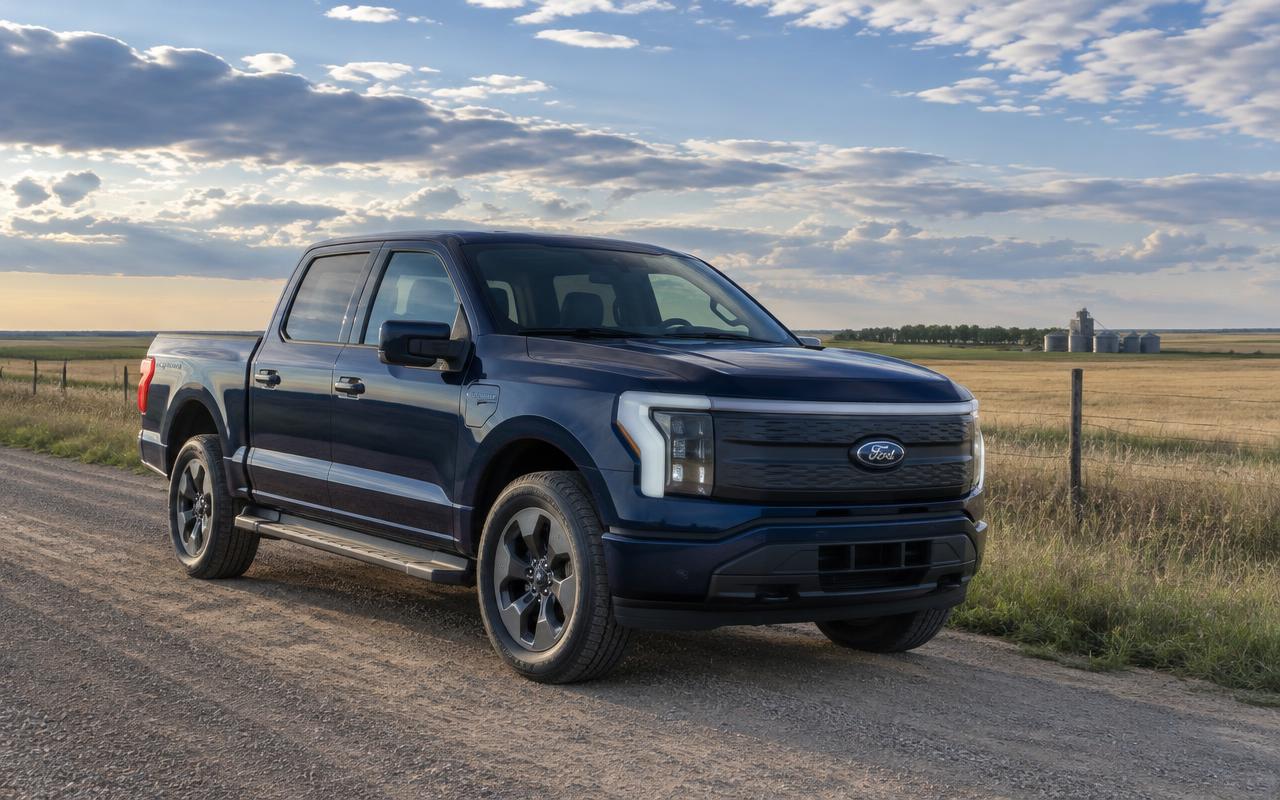
A story making the rounds on a Canadian F-150 Lightning owners' forum sums up the truck's biggest reputation problem in one anecdote: a Saskatchewan dealership manager reportedly warned a prospective buyer that the Extended Range Lightning would struggle with a 260 km round trip in Canadian winter conditions, claiming drivers would need to recharge after just 130 km one-way in the cold. It's the kind of story that spreads fast in truck-buyer circles — and real owner-reported data suggests the truth is more nuanced than either the dealership's warning or Ford's marketing numbers would have you believe.
Quick Specs
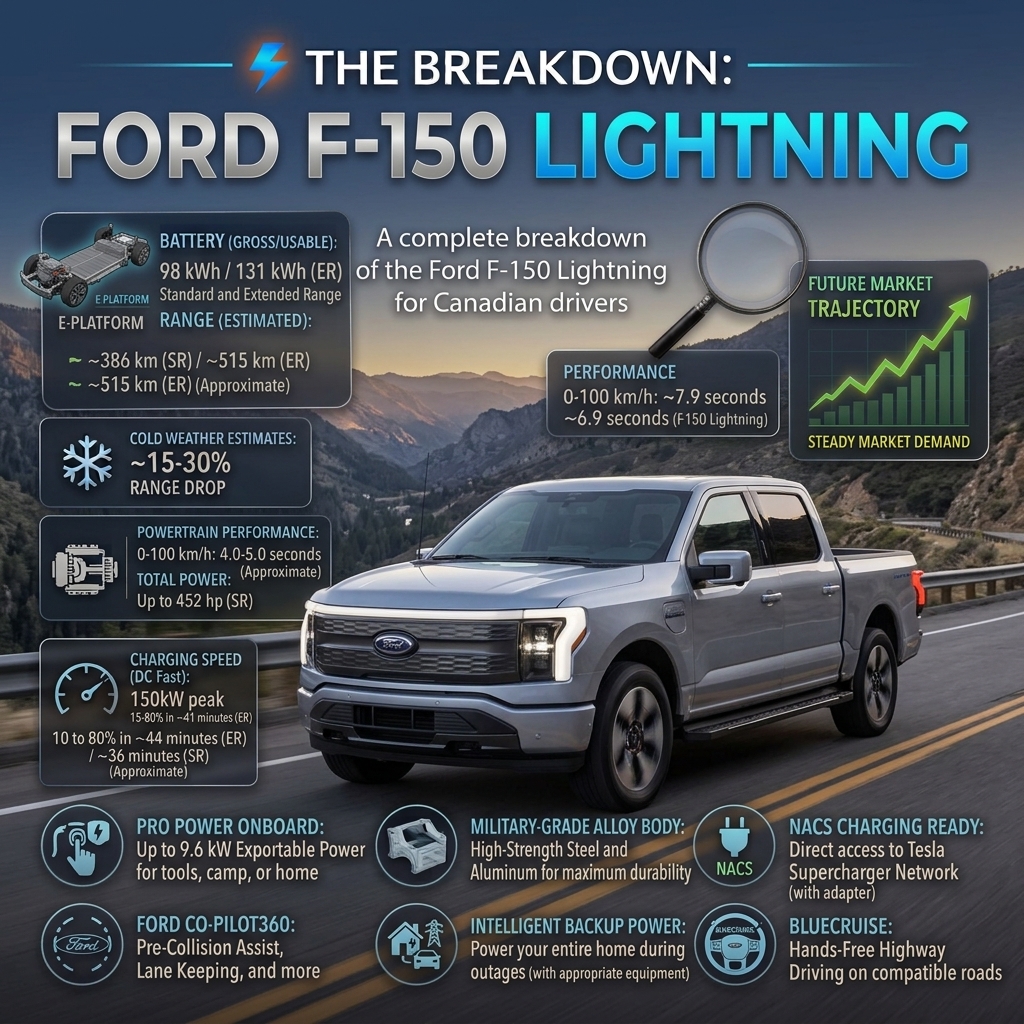
The Lightning comes in two battery configurations: a 98 kWh Standard-Range pack rated for roughly 370 km, and a 131 kWh Extended-Range pack rated for roughly 515 km. DC fast charging takes the battery from 15-80% in under 45 minutes on a suitable charger. On the used market in Canada, Lightnings currently span roughly $45,495 to $73,988, with 2022 models averaging around $58,746 and 2023-2024 models averaging in the low-to-mid $60,000s.
Range & Efficiency
Ford's rated range figures are generated under standardized test conditions that, like every EV, the Lightning won't fully match in real Canadian winter driving — the gap here is simply larger than average because of the truck's weight, frontal area, and towing capability, all of which work against efficiency at highway speeds regardless of temperature.
Charging
The Lightning's fast-charging speed is genuinely strong on paper (15-80% in under 45 minutes), but real-world owner reports flag a practical problem worth knowing about before you rely on it for a road trip: one Canadian owner specifically noted that Petro-Canada's fast chargers are "more often down than working" along certain routes — a charging-network-reliability issue rather than a truck problem, but one that matters just as much to your actual trip planning. Check our public fast charger pricing guide for a fuller network-by-network picture before you commit to a route dependent on any single network.
Reliability & Known Issues
Beyond the winter-range questions covered below, the Lightning is a first-generation EV built on Ford's existing F-150 platform rather than a clean-sheet EV design — worth factoring into your pre-purchase inspection the same way you would for any first-generation vehicle from any manufacturer, with particular attention to software/infotainment glitches, which have been a more common complaint category than drivetrain issues in owner forums.
Winter Performance
This is genuinely the Lightning's defining ownership question for a Canadian buyer, and the real data is more useful than either the alarmist dealership anecdote or Ford's optimistic marketing numbers. A Calgary-based owner reported achieving roughly 230 km of range at highway speeds below -20°C on an Extended Range model — well short of the 515 km rated figure, but also nowhere near the dealership's claimed 130 km one-way limit. An Alaska-based Lariat ER owner reported an entire winter averaging 1.2-1.3 miles per kWh, with maximum usable range around 233 km in severe cold. Multiple owners specifically credited two habits with meaningfully improving real-world winter range: preconditioning the battery while still plugged in before departure, and using heated seats instead of relying on cabin heat, which draws considerably more energy from the pack. The honest summary: budget for something in the range of 40-55% of rated range in serious prairie or northern cold, not the dealership's worst-case number and not Ford's best-case one either — and treat preconditioning as mandatory rather than optional for winter ownership.
Driving Experience
The Lightning drives like a genuinely quick, heavy truck — instant torque makes it feel far more responsive off the line than any gas F-150, and the low centre of gravity from the underfloor battery pack gives it noticeably better composure in corners than its gas counterpart. The tradeoff is the same one every heavy EV makes: that responsiveness and weight both work against range, especially once you're towing or hauling.
Used Market Value
Used Lightning pricing has settled into a fairly tight band by model year rather than showing the wide spread you see on a Model Y — reflecting a shorter production history and a buyer pool that's more purpose-driven (truck buyers who specifically want an EV truck) than opportunistic. If you're cross-shopping it against the other major EV truck on the Canadian used market, our F-150 Lightning vs. Rivian R1T comparison covers exactly that decision.
Final Verdict
The F-150 Lightning is a genuinely capable truck that takes a real, meaningful hit in serious Canadian winter conditions — somewhere in the realistic 40-55% range-retention territory rather than the extremes either a worried dealer or Ford's own marketing might suggest. It's a strong choice for a buyer whose driving patterns and charging access actually match that reality (established home charging, routes with reliable fast-charging backup, and a realistic sense of range needs in deep cold) and a genuinely risky one for one who hasn't planned around it.
Sources: F150lightningforum.com, Canadian winter owner thread; CarGurus.ca, used Ford F-150 Lightning listings. Real-world range in extreme cold varies significantly by driving style, preconditioning habits, and specific conditions — treat the figures here as directional, not a guarantee for your specific situation.