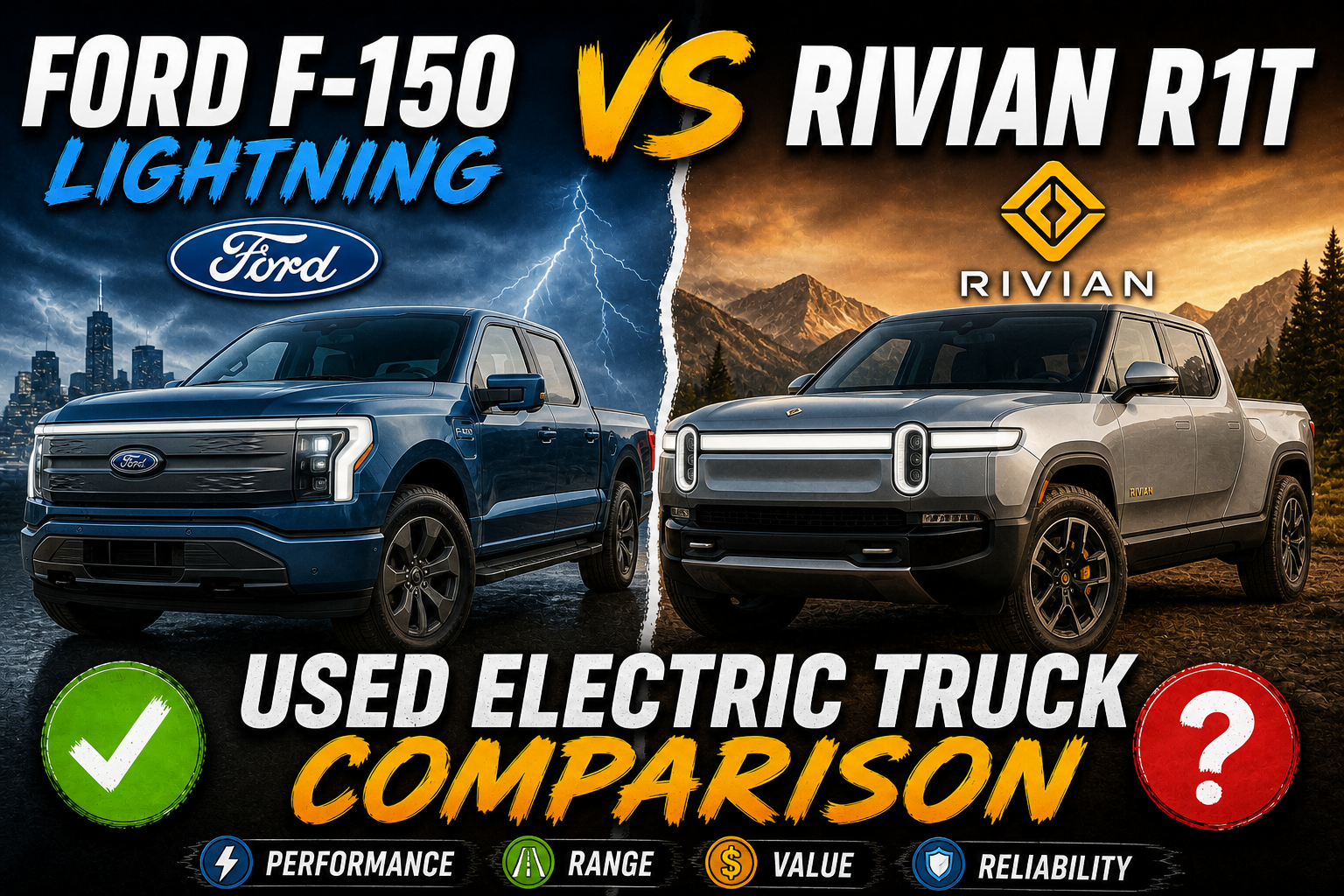
The used electric truck market in Canada is still thin, but two names dominate it: the Ford F-150 Lightning, built on a familiar platform with a legacy dealer network behind it, and the Rivian R1T, a from-scratch adventure truck from a much younger, lower-volume brand. Both are genuinely capable, but they're built for slightly different jobs, and the gap between them matters more once you're actually towing, camping, or relying on backup power than it does on a spec sheet.
Quick answer: The Lightning generally wins on price accessibility, dealer network size, and home backup power capability. The R1T wins on maximum range, peak DC charging speed, and off-road capability. Both lose significant range under heavy towing — plan for a 40-60% cut depending on trailer size and conditions, regardless of which one you choose.
Towing and payload: closer than the marketing suggests
On paper, the Rivian R1T's dual/quad-motor configurations can tow up to 11,000 lbs, edging out the Lightning's extended-range max of 10,000 lbs with the tow package (7,700 lbs on standard-range trims). Payload capacity is similar between the two, in the 1,700-2,000 lb range depending on trim.
The number that actually matters more than either max tow rating: real-world range loss while towing. Independent testing consistently shows heavy towing cutting an EV truck's range by 40-60% depending on trailer size, weight, and driving conditions — a bigger practical consideration than the difference between an 10,000 lb and 11,000 lb max rating for the vast majority of buyers who won't tow anywhere near either truck's ceiling regularly.
Range and charging: Rivian's clearer advantage
This is where the R1T pulls ahead more decisively. The Lightning's extended-range battery (roughly 131 kWh) delivers 300-320 miles EPA-estimated and DC fast-charges around 150 kW. The R1T's dual-motor Max pack (up to roughly 149 kWh) reaches up to 410 miles and accepts a notably higher peak DC charging rate around 220 kW. For a buyer prioritizing maximum range or road-trip charging speed, the R1T has a real, meaningful edge — not a marginal one.
Backup power: the Lightning's standout feature
If home backup power matters to you — and given the wildfire-driven power shutoffs covered in our charging during a wildfire power shutoff guide, it's a genuinely relevant consideration for more Canadian buyers than it used to be — the Lightning has the clearer story. Ford's Pro Power Onboard system can power parts of a home with the right transfer switch setup, in addition to multiple 120V outlets and 240V capability on some trims, functioning effectively as a mobile generator for both jobsites and home emergencies. The R1T offers multiple 120V outlets geared toward campsite and jobsite tool use, but doesn't offer the same documented home-backup integration as the Lightning's system. If V2H capability is a deciding factor, the Lightning has both the more mature system and — as the longer-running implementation, in production since 2022 — the better real-world track record.
Bed, interior, and use-case fit
The two trucks are genuinely built for different priorities. The Lightning offers a full-size 5.5-foot bed and follows traditional truck ergonomics — a more conventional work-truck feel inside. The R1T's bed is shorter at roughly 4.5 feet but adds a lockable "Gear Tunnel" storage compartment ahead of the rear wheels, plus air suspension and available tri/quad-motor configurations that lean into off-road capability more directly than the road-focused Lightning. If your use case is closer to job-site hauling and towing, the Lightning's layout suits that better; if it's adventure and off-road use, the R1T is purpose-built for it.
Price and used-market reality
The Lightning generally carries a lower starting price than a similarly equipped R1T, particularly at mid-level trims, and benefits from more traditional dealer incentives and discounts — both of which have fed a real used-market opportunity as new Lightning pricing has softened. The R1T commands higher pricing, especially for tri- and quad-motor variants with larger battery packs, though it tends to hold value well among the adventure-focused buyer segment that seeks it out specifically. Neither truck has deep used inventory in Canada yet — this remains a market where you may need to search nationally rather than locally to find the specific configuration you want.
What to check regardless of which one you're considering
Given how thin the used inventory is for both trucks right now, a thorough inspection checklist matters more here than for a higher-volume model where you can simply walk away from a questionable listing and find another easily. Pay particular attention to towing history (ask directly, and check for hitch wear or aftermarket towing equipment), battery health if the truck has seen regular heavy-load use, and — for the Rivian specifically, given the brand's shorter track record — realistic service network access in your region before buying. Factor total ownership cost, not just purchase price, into your comparison; our true cost of ownership guide is a useful starting framework, though electric truck-specific costs (tire wear under heavier curb weight, in particular) run higher than for a passenger EV.
The bottom line
The Lightning is the more accessible, more service-network-friendly choice with a genuinely useful home backup power feature, ideal for buyers who want a familiar truck-ownership experience with an electric drivetrain underneath. The R1T is the range and performance leader with a more adventure-oriented design, better suited to buyers prioritizing maximum capability over dealer network convenience. Whichever you choose, plan realistically for range loss under towing — it affects both trucks similarly, and it's the single biggest factor in whether either one fits your actual use case.
FAQ
Which has more range, the F-150 Lightning or the Rivian R1T? The R1T, by a meaningful margin — up to 410 miles on its dual-motor Max pack versus 300-320 miles for the Lightning's extended-range battery.
Can either electric truck power my home during an outage? The F-150 Lightning has the more developed system — Ford's Pro Power Onboard can power parts of a home with a compatible transfer switch, and it has the longer real-world track record since 2022. The Rivian R1T's onboard power is geared more toward campsite and jobsite use.
How much range do electric trucks lose while towing? Expect a 40-60% reduction depending on trailer size, weight, and driving conditions — this applies to both the Lightning and the R1T, and it's a bigger practical factor than either truck's maximum tow rating for most buyers.
Sources: Recharged, "Ford F-150 Lightning vs Rivian R1T: 2025 Comparison"; Edmunds, "Electric Tow Test! Ford F-150 Lightning vs. Rivian R1T".