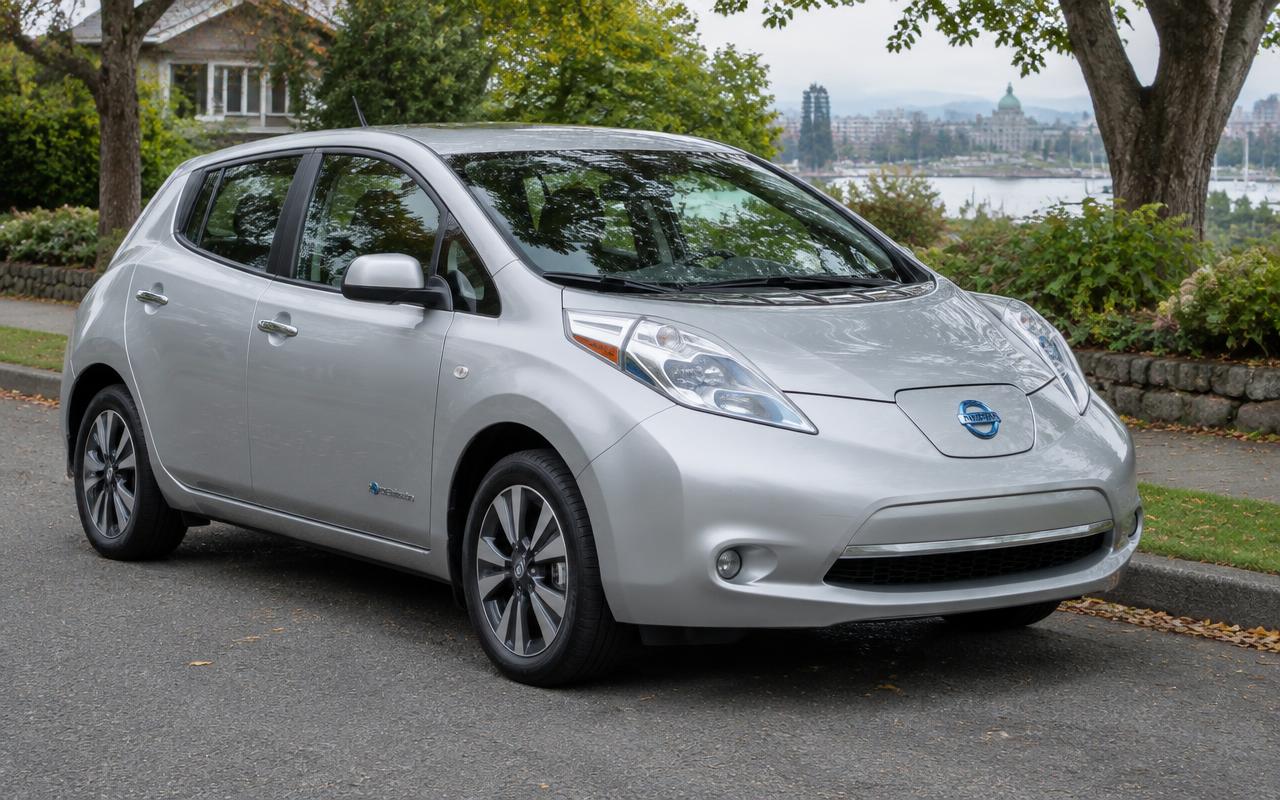
Ask almost anyone with a passing interest in EVs why they're nervous about battery degradation, and there's a decent chance the answer traces back — knowingly or not — to the Nissan Leaf. As one industry outlet put it bluntly: "Everyone Is Afraid Of EV Battery Degradation. It's All The Nissan Leaf's Fault." That reputation is rooted in a real engineering decision Nissan made and never fully walked back, and it's worth understanding precisely — because the actual data on how today's used Leafs are holding up tells a more forgiving story than the car's reputation suggests.
Quick Specs
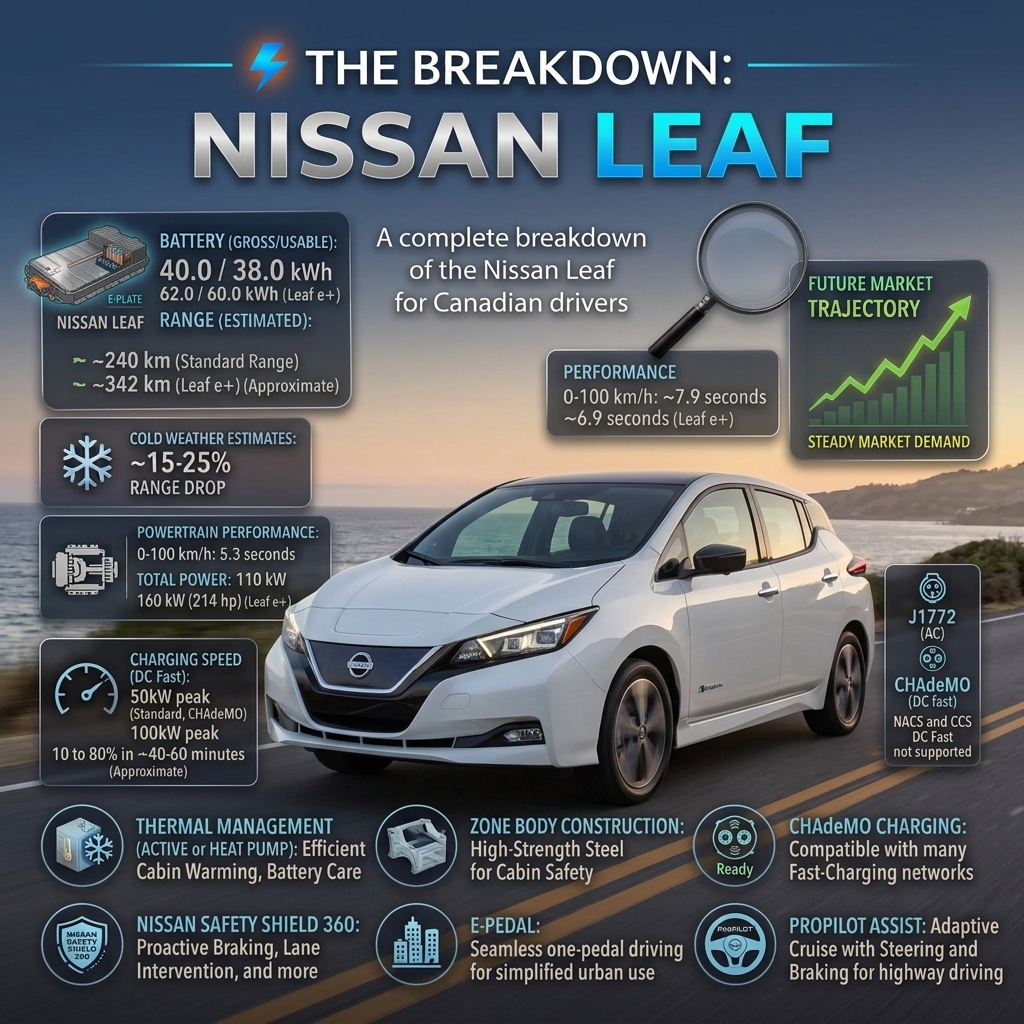
The Leaf comes in two very different battery configurations depending on year and trim: a 40 kWh pack (147 hp, SV and base trims) and a larger 62 kWh pack (214 hp, Plus trims), with energy consumption in the roughly 1.9-2.4 Le/100km range depending on configuration. New MSRP ran from $44,298 (SV) up to $52,898 (SL Plus) in recent model years, but the used market is where the Leaf's real value proposition lives — used listings start as low as roughly $12,000, making it comfortably the cheapest entry point into EV ownership in Canada.
Range & Efficiency
Real-world range varies enormously by pack size and, more than almost any other EV on this list, by climate history — more on that below. The 62 kWh Plus variants roughly double the usable range of the base 40 kWh cars, which matters enormously for anyone considering a Leaf as a primary vehicle rather than a pure city runabout.
Charging
This is where the Leaf shows its age most clearly: it's one of the only modern EVs still using the CHAdeMO fast-charging standard rather than CCS, which has been steadily losing network support in Canada as networks consolidate around CCS and Tesla's NACS. Worth checking directly with whichever public network you plan to rely on before buying, since CHAdeMO availability is shrinking, not growing.
Reliability & Known Issues
Here's the actual engineering fact behind the Leaf's degradation reputation: unlike virtually every other mainstream EV, the Leaf uses a passively air-cooled battery pack with no active liquid thermal management system, which genuinely does make it "more susceptible to heat-related degradation" than competitors, according to battery-analytics firm Recurrent. That's real, and it's the mechanism behind years of Leaf horror stories. But the actual fleet data — drawn from over a billion real-world miles — tells a more balanced story than the reputation implies: Leafs retain an average of 93% of original range at 3 years and 91% at 5 years, which is respectable by any standard. The nuance that matters for a used buyer: it's not uniform across the model's history. Early Gen 1 cars with the original 24 kWh pack (2011-2014) show the worst degradation on the used market today, and the 30 kWh pack used in 2016-2017 models is "also known for degradation," while 2015-and-later cars with Nissan's revised "lizard battery" chemistry "better tolerates heat and resists degradation" meaningfully better than what came before. AutoTrader's own research on the 2020 model year also flags "multiple safety recalls related to battery thermal management and charging systems" worth checking against the specific VIN you're considering. Given all of this, the single highest-value thing you can do before buying any used Leaf is get an independent battery-health test — see our battery health buying guide — and specifically ask where the car spent its life, since a Leaf that's lived somewhere cool has a real advantage over an identical one that spent years in a hot climate.
Winter Performance
The flip side of the Leaf's cooling-system weakness is a genuinely interesting one: without a thermal management system actively working against the cold either, real-world data shows Leaf range dropping to roughly 78% of rated capacity in winter conditions versus 95% in summer — a meaningful hit, though broadly in line with what most non-heat-pump EVs experience in serious Canadian cold. Budget for it accordingly if you're in a colder province.
Driving Experience
The Leaf is unmistakably a city car in its driving character — light steering, a soft ride, and (on later e-Pedal-equipped models) genuinely useful one-pedal driving that makes stop-and-go traffic meaningfully less tiring. It's not going to feel quick or particularly composed at highway speeds compared to newer EVs, and that's a fair trade-off given what it costs.
Used Market Value
At a starting point around $12,000, the Leaf is doing something almost no other EV on the Canadian used market can: putting genuine, functional electric ownership within reach of a true budget buyer. Our Nissan Leaf vs. Hyundai Kona Electric comparison digs specifically into how well each holds up over time if you're weighing the two directly.
Final Verdict
The Nissan Leaf's battery-degradation reputation is a genuine engineering trade-off, not an urban myth — but real fleet data shows it holding up better on average than most people assume, provided you're buying a 2015-or-later car and can verify its climate history and current state of health before you commit. For the right buyer — someone prioritizing rock-bottom entry cost and mostly city driving over range and charging-network flexibility — it's still one of the most genuinely affordable ways into EV ownership in Canada.
Sources: InsideEVs, "Everyone Is Afraid Of EV Battery Degradation. It's All The Nissan Leaf's Fault"; Recurrent, "Used Nissan Leaf Range & Battery Health (Real-world Data)"; AutoTrader.ca, 2020 Nissan Leaf research page. Battery condition varies significantly car to car — treat the figures here as fleet averages, not a guarantee for any individual vehicle, and get an independent battery-health check before buying.