Rivian's R1T shares its platform with the R1S, already covered in our Rivian R1S Breakdown, and cross-shops directly against Ford's electric truck in our F-150 Lightning vs. Rivian R1T comparison. What it doesn't share with either of those reference points is a mature used market — Rivian's Canadian sales only ramped up meaningfully in 2026, which changes how you should actually approach buying one used today.
Quick Specs
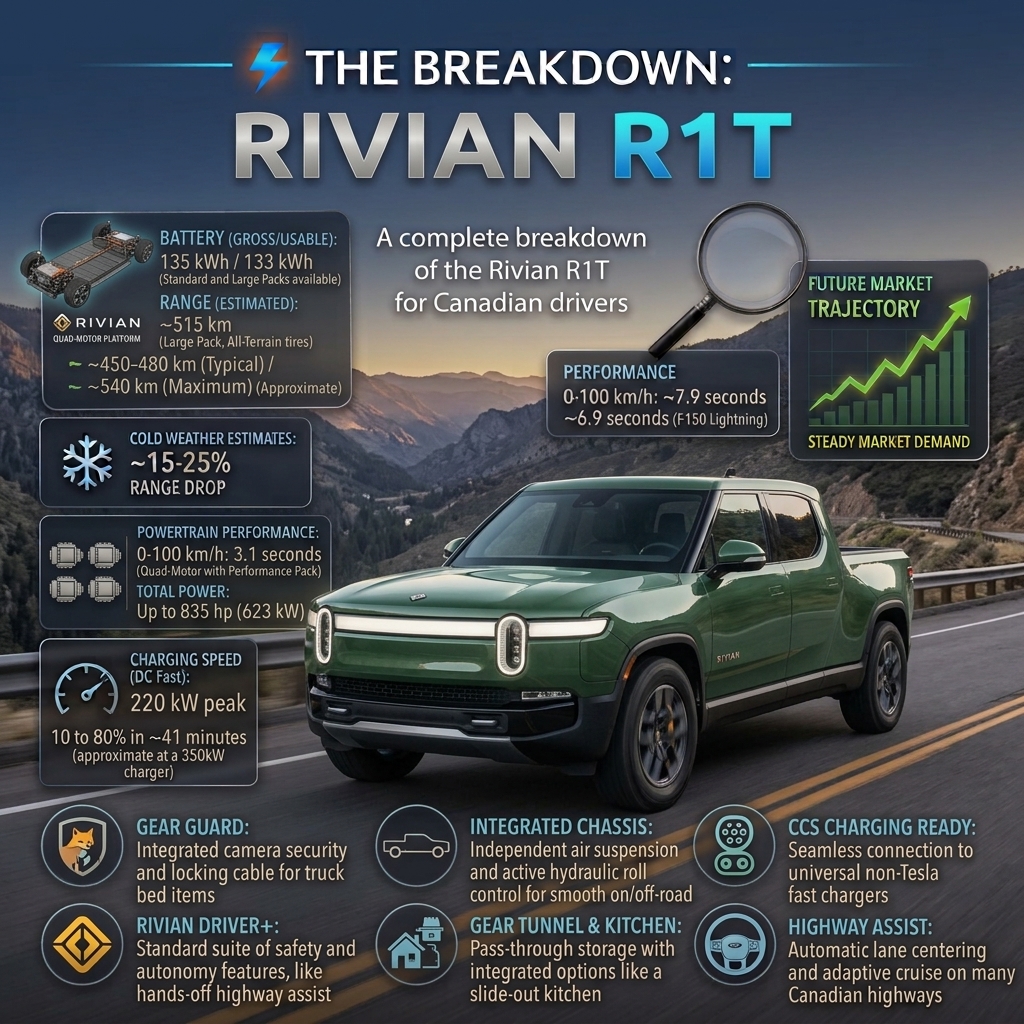
Canadian R1T pricing spans roughly $144,990 to $193,990 across four trims. The entry Dual-Motor Standard Pack pairs a 397 kW motor with a 97 kWh battery; higher trims step through Large Pack, tri-motor, and quad-motor configurations, with the range-topping quad-motor variant rated at 515 km. DC fast charging runs 10-80% in roughly 41 minutes at up to 220 kW on CCS1 or NACS.
Range & Efficiency
The R1T's efficiency numbers reflect what you'd expect from a genuinely heavy, powerful electric truck — strong absolute range on the larger packs, but real-world efficiency that trails lighter EVs by a meaningful margin, especially at highway speeds or when towing.
Charging
Support for both CCS1 and NACS gives R1T owners broad access across Canadian fast-charging networks, including Tesla's Supercharger network — a genuine practical advantage over trucks locked to a single connector standard, and one that matters more with every passing year as the industry consolidates around NACS.
Reliability & Known Issues
This is the section where it's worth resisting both the alarmist and the dismissive take, because the real data supports neither. A detailed three-year review of Rivian ownership data found reliability concerns concentrated specifically in software and electrical systems — early models saw infotainment freezes, charging handshake failures, and inconsistent regenerative braking, with NHTSA complaint data "concentrated in safety systems and electrical items." Specific documented hardware issues include a seat-belt fastener recall, High Voltage Distribution Box ground-strap failures that could cause power loss, and cold-weather headlight failures — nine active recall campaigns affect 2025-2026 models, though two were resolved entirely through over-the-air updates rather than a dealer visit. Early 2022-2023 production also saw real build-quality variability: inconsistent panel gaps, interior trim rattles, and door-seal alignment issues, generally addressed case-by-case through Rivian's mobile service network rather than requiring a traditional dealership. The fair overall read, from the same review: this pattern is "consistent with industry norms for a modern software-defined vehicle," and Rivian's 2026 Gen-2 refresh — a new zonal electrical architecture, in-house drive units, and a rewritten software platform — meaningfully improved on the early cars' issues. One independent reliability tracker rates both R1T and R1S at 2.6-2.7 out of 5, a "caution" tier that reflects those early production years more than current build quality. The honest summary for a used buyer: this is a "credible, defensible" choice if you're comfortable with software-defined-vehicle quirks and Rivian's newer service model, but it doesn't yet carry the multi-decade reliability track record of an established truck brand — weight that appropriately in your decision.
Winter Performance
Canadian winter conditions take a real bite out of any EV this size and weight, and Rivian's own guidance for Ontario/Quebec/Manitoba-style winters points to a 25-40% range reduction from rated figures — plan trips around the lower end of that range in serious cold rather than the EPA/NRCan-rated number.
Driving Experience
The R1T drives with genuinely startling performance for a full-size truck — instant torque, a low centre of gravity from the underfloor battery, and (on tri- and quad-motor trims) genuinely sports-car-adjacent acceleration wrapped in a full-size pickup body. It's a fundamentally different driving character than a traditional truck, closer to a very large, very quick SUV than a conventional workhorse.
Used Market Value
Be realistic about what "used Rivian R1T" actually means in Canada right now: with meaningful Canadian sales only really underway through 2026, the used market here is thin, skewed toward very recent model years, and won't offer the kind of price discount a more established used-EV market provides. If you're specifically shopping used to save money relative to new, the R1T isn't yet the vehicle for that strategy in Canada the way an older Bolt EV or Model 3 is.
Final Verdict
The R1T is a genuinely capable, quick, and well-equipped electric truck with real, documented early-production reliability growing pains that Rivian appears to be meaningfully addressing through its Gen-2 refresh — but buying one "used" in Canada today mostly means buying a very recent model at a price that hasn't yet had time to depreciate. It's a strong choice for a buyer drawn to the R1T specifically rather than someone purely hunting for used-EV value.
Sources: The Weekly Driver, "Rivian Reliability in 2026: What Three Years of R1T and R1S Owner Data Shows"; ThinkEV.ca, "Rivian Canada 2026: R1T, R1S Prices and R2 Release Date". The Canadian R1T used market is still immature — pricing and availability will shift meaningfully as more units age into the secondhand market.