Walk into almost any used-EV lot in Canada and you'll find more Model Ys than anything else. It's the best-selling electric vehicle on the planet, and by a wide margin the most cross-shopped used EV in the country — our own Model Y vs. Hyundai Ioniq 5 comparison exists specifically because so many buyers end up deciding between exactly these two cars. That volume cuts both ways for a used buyer: it means huge selection and a mature secondhand market, but it also means the Model Y's used pricing spans an unusually wide range — and the temptation to fixate on model year, the way you would with a gas car, is exactly the wrong instinct here.
Quick Specs
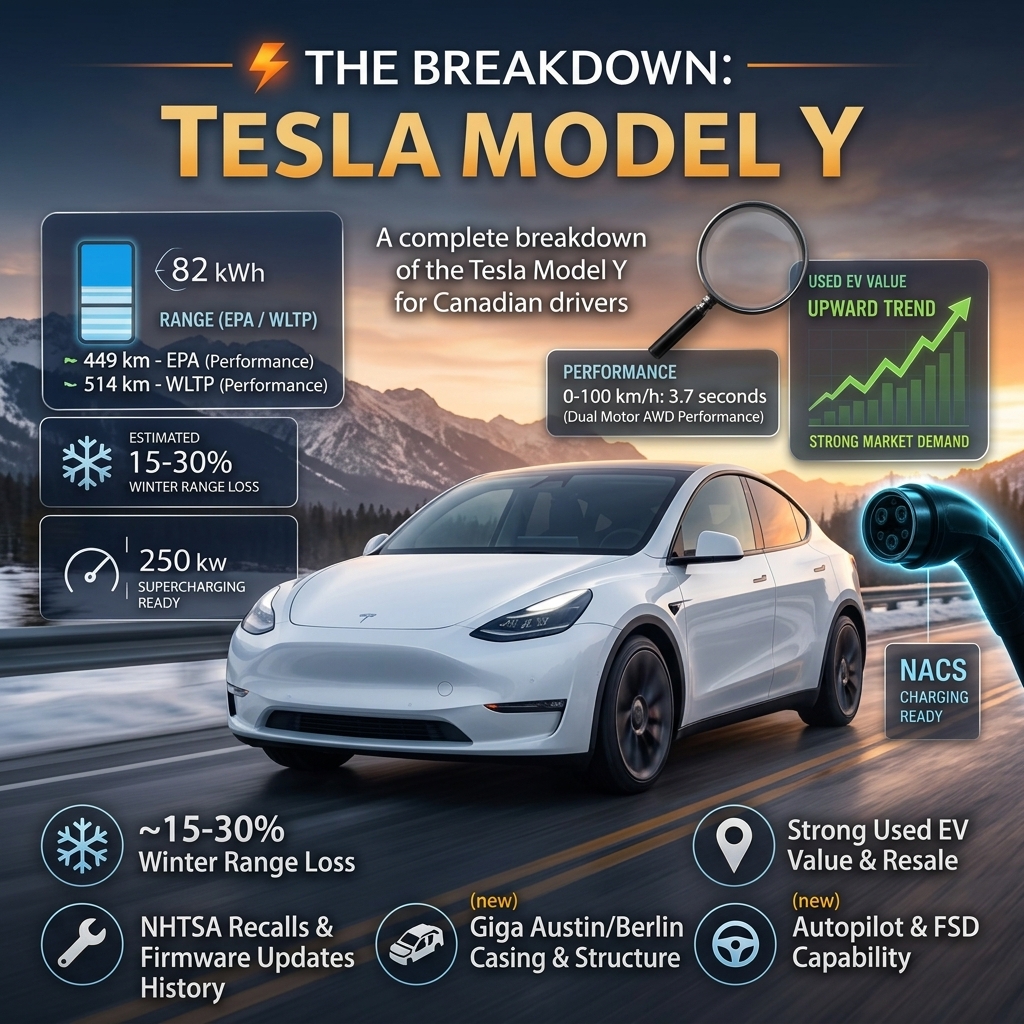
Current-generation Model Y trims run Long Range RWD ($64,990 new, 6.9s 0-100km/h, 525 km range), Long Range AWD ($68,990 new, 5.0s, 501 km), and Performance AWD ($73,990 new, 3.7s, 445 km), with efficiency in the 15.3-17.3 kWh/100km range. Those are new-vehicle figures — what actually shows up on the used market in Canada right now skews considerably older and cheaper: used listings span roughly $23,600 to $55,000, with a median closer to $33,600. Peak DC fast-charging on the Tesla Supercharger network adds up to 322 km of range in 15 minutes.
Range & Efficiency
The Model Y's real-world efficiency is genuinely competitive rather than just marketing-sheet impressive — 15-17 kWh/100km is on the better end of the compact-SUV EV field, translating to real-world range that generally lands close to its rated figures in mild weather. For a rough sense of what that means for your wallet on a daily basis, run your own numbers through our EV vs. gas savings calculator.
Charging
Access to the Supercharger network is still the Model Y's single biggest practical advantage over most non-Tesla competitors — dense coverage, consistently reliable uptime, and the fastest charging curve most Canadian drivers will encounter day to day. If you're weighing what that actually costs per session versus a home charge, our public fast charger pricing guide breaks down Tesla's non-member and member rates specifically.
Reliability & Known Issues
Here's the finding that should reshape how you shop for a used Model Y: a detailed 2026 buying guide specifically declined to name a "worst year to avoid," concluding instead that "a 2024 Tesla Model Y deserves consideration as a used electric SUV, but its condition matters more than the nameplate alone." That's a genuinely different message than the usual "avoid the first model year of anything" wisdom that applies to a lot of gas cars — and it lines up with how the Model Y is actually built: as an over-the-air-updated, continuously-revised platform rather than a car that gets meaningfully redesigned only once every several years. The practical upshot: skip the model-year fixation and spend your diligence budget on independently verified battery health, a clean accident history, and confirmation that Autopilot hardware and software match what the listing claims — see our used EV inspection checklist and how to check EV battery health before buying guides for exactly how to do that.
Winter Performance
Like every EV, the Model Y loses meaningful range in genuine Canadian cold — see our cold snap vs. heat dome guide for the broader mechanics of why. Practically, the Model Y's heat pump (standard on most model years) and battery preconditioning tend to make it one of the more cold-weather-competent options in its class when both are used properly before a trip, though no EV escapes a real range hit below -10°C or so.
Driving Experience
The Model Y drives like what it is: a tall hatchback with a low centre of gravity and instant torque, which translates to quick, confident acceleration (even the base Long Range RWD's 6.9-second 0-100 km/h feels quicker off the line than the number suggests) and flat, planted cornering that most compact SUVs in this price range can't match. The cabin is minimalist to a fault for some buyers — nearly every control runs through the central touchscreen — which is worth experiencing in person before you commit, since it's a genuine love-it-or-hate-it design choice rather than a minor quirk.
Used Market Value
The wide used-price spread ($23,600-$55,000) reflects a genuinely broad range of ages, trims, and options rather than market confusion — an early Long Range RWD with high mileage sits at one end, a newer, low-mileage Performance AWD at the other. That breadth is actually good news for shoppers: there's a real Model Y at almost every budget point in the used EV market, which isn't true of most competitors.
Final Verdict
The Model Y earns its position as Canada's most cross-shopped used EV honestly — strong efficiency, the best charging network access in the country, and a wide enough used-market spread that there's a configuration for nearly every budget. The single most important mindset shift for a used buyer: stop hunting for a "safe" model year and start demanding real battery-health and accident-history documentation on the specific car in front of you, since that matters far more here than it would on a comparable gas SUV.
Sources: Recharged, "Tesla Model Y Worst Year to Avoid Used (2026 Guide)"; Ingenext, "Tesla Model Y Guide: Range, Models and Pricing"; Tesla North America Guide, Model Y Canada pricing. Trim availability, pricing, and specifications change over model years and time — confirm current figures for the specific model year you're considering.