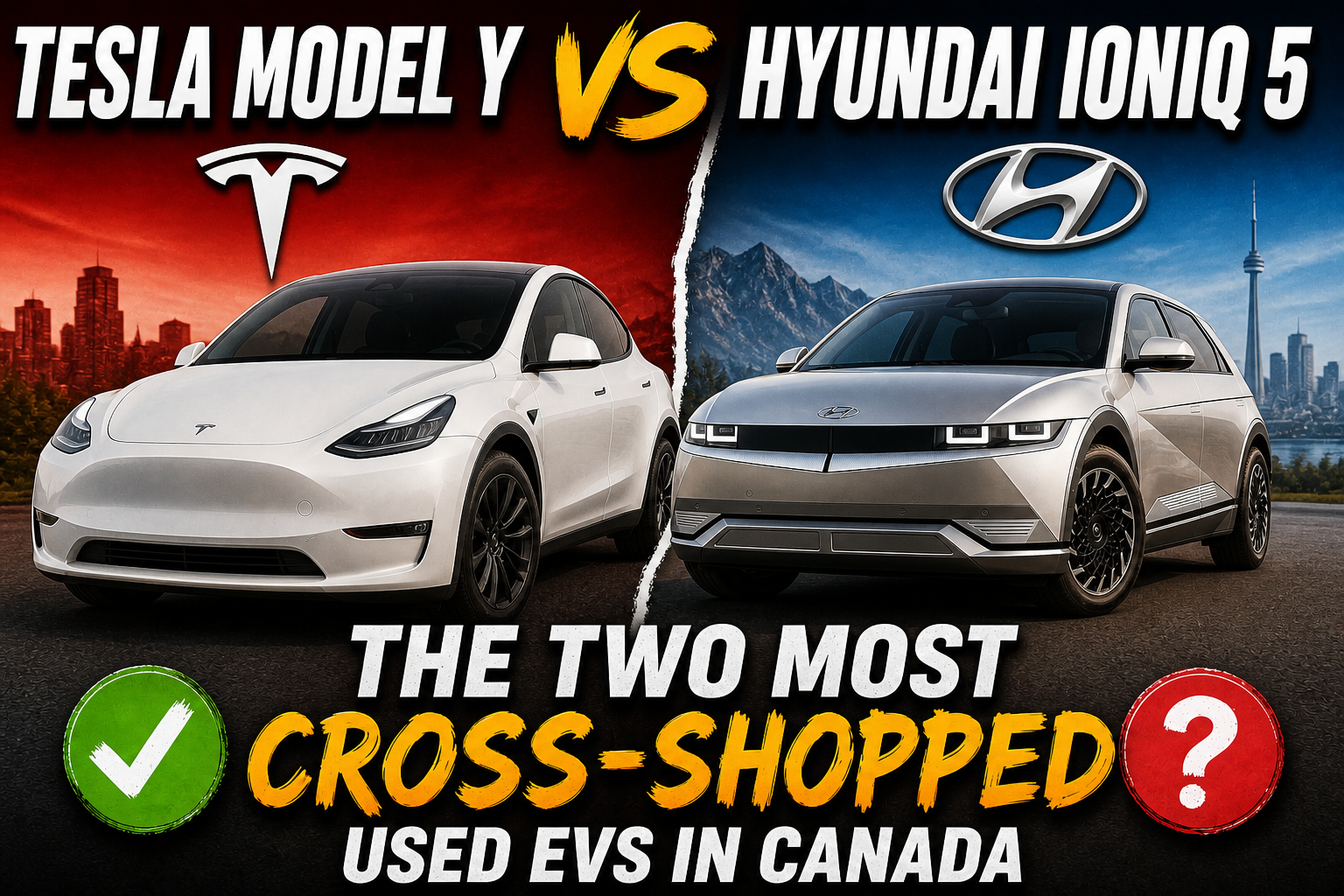
If you're shopping for a used electric SUV in Canada right now, there's a very good chance you've already cross-shopped these two. The Tesla Model Y is Canada's best-selling EV by a wide margin and the default reference point for the whole category; the Hyundai Ioniq 5 is the mainstream alternative buyers most often compare it against — different design philosophy, different ownership model, genuinely different strengths. This is a deeper look than the typical spec-sheet comparison, focused on what actually changes once you own either car.
Quick answer: The Model Y generally wins on charging network breadth (native Supercharger access) and highway efficiency; the Ioniq 5 wins on interior comfort, faster peak DC charging speed thanks to its 800-volt architecture, and — depending on model year and lease-driven used supply — sometimes better feature-per-dollar value. Neither is a clearly "better" car; they suit different priorities.
Charging access: Tesla's structural advantage, with a real asterisk
This remains the single biggest practical difference between the two. The Model Y has native NACS port access to Tesla's Supercharger network — the largest, most reliable fast-charging network in North America — plus adapter capability for third-party CCS stations when needed.
The Ioniq 5's charging story depends heavily on model year, which is exactly the kind of detail a used-car spec sheet glosses over. Early Ioniq 5 model years (2022-2024) shipped CCS-only, meaning Supercharger access requires a NACS-to-CCS1 adapter — typically $150-230 CAD — and non-Tesla drivers pay a real premium at Superchargers without a paid membership, roughly 30-40% more per kWh unless you subscribe to Tesla's non-Tesla charging membership (around $13/month), which becomes cost-effective after about 80-100 kWh of monthly charging. Newer 2025+ Ioniq 5 models ship with a native NACS port and skip the adapter step entirely. There's also a technical limitation worth knowing: only newer V3 and V4 Supercharger stations accept non-Tesla vehicles — older V2 stalls remain Tesla-only, so route planning matters more for an adapter-equipped Ioniq 5 than for a Model Y. For the fuller Canadian charging picture, see our public charging networks guide.
Where the Ioniq 5 claws an advantage back: its 800-volt architecture allows genuinely faster peak DC charging rates than the Model Y's 400-volt system at a compatible high-power CCS station — relevant on longer road trips if you're not relying on Superchargers specifically.
Range and efficiency: Model Y's quiet edge
Independent testing consistently shows the Model Y delivering a real highway efficiency advantage — often cited as a 10-20 mile edge in comparable range testing — over the Ioniq 5, largely down to Tesla's more aerodynamically optimized shape and drivetrain tuning. Rated range for both sits in a similar ballpark depending on trim (roughly 250-300 miles for the Model Y Long Range/AWD, 230-290 miles for the Ioniq 5 depending on battery size), but the Model Y tends to hold closer to its rated number at highway speeds specifically. Battery degradation on well-maintained examples of either car is typically similar — in the 5-15% capacity loss range — making individual vehicle condition, not brand, the bigger factor. Our guide on checking EV battery health before buying applies equally to both.
Cabin philosophy: software-first vs. balanced
This is where the two cars genuinely diverge in character, not just spec. The Model Y is unapologetically software-first — nearly every function routes through its central touchscreen, over-the-air updates continually reshape the ownership experience, and the interior leans minimalist to the point some buyers find it stark. The Ioniq 5 balances modern EV tech with more conventional physical controls and a noticeably more spacious, "lounge-like" cabin feel that tends to read as more comfortable on longer drives, particularly for rear passengers.
Neither approach is objectively better — this is closer to a genuine preference question than a spec comparison, which is part of why these two get cross-shopped so often. If you're coming from a traditional gas SUV and want a gentler transition, the Ioniq 5's cabin tends to feel more familiar. If you want the most current-generation, software-centric EV experience, the Model Y delivers that more fully.
Used pricing and market dynamics
The Model Y has experienced steeper early depreciation than a typical compact SUV, driven by Tesla's high sales volume and its history of aggressive new-vehicle price cuts, which drag comparable used values down with them — the practical result is that a well-equipped 2022-2023 Model Y Long Range can price very competitively against a newer gas-powered compact SUV. The Ioniq 5, meanwhile, benefits from lower original MSRPs and aggressive lease programs that are feeding a growing wave of off-lease used inventory into the Canadian market through 2026 — meaning well-optioned Ioniq 5 Limited trims can sometimes offer stronger feature value per dollar than a comparably priced Model Y.
Neither car has a fixed, permanent pricing advantage — the used market for both shifts with new-vehicle pricing moves and incentive programs, so it's worth comparing current listings directly rather than relying on general reputation.
Service experience: a real, underrated difference
Tesla's service model is centralized and largely app-based — service is scheduled and often diagnosed remotely through the Tesla app, with mobile service available in many areas, but with fewer physical service locations overall compared to a traditional dealer network. Hyundai relies on its conventional dealer network, which means more physical locations but a more traditional (and sometimes slower) service booking experience. If you live somewhere with limited Tesla service presence, this is worth weighing seriously — it affects real ownership experience more than most buyers expect going in.
The bottom line
The Model Y and Ioniq 5 are Canada's most-compared used EVs for good reason — they represent genuinely different approaches to the same job. The Model Y wins on charging network breadth and highway efficiency; the Ioniq 5 wins on cabin comfort, peak DC charging speed, and — depending on the specific listings you're comparing — used-market value. Check the Ioniq 5's specific model year for NACS port support if Supercharger access matters to you, and compare actual current listings rather than general reputation, since used pricing dynamics for both shift over time.
FAQ
Can a used Tesla Model Y and a used Hyundai Ioniq 5 both charge at the same public stations? Yes, with a caveat. The Model Y has native access to Tesla Superchargers. A used Ioniq 5 can access Superchargers too, but only newer 2025+ models have the native NACS port — earlier models need a NACS-to-CCS1 adapter and typically pay a per-kWh premium without a paid membership.
Which has better range, the Model Y or the Ioniq 5? Rated range is similar between comparable trims, but the Model Y tends to hold closer to its rated figure at highway speeds due to better aerodynamic efficiency — often cited as a 10-20 mile real-world advantage in independent testing.
Which is a better value on the used market, the Model Y or the Ioniq 5? It depends on current listings rather than a fixed rule — the Model Y has seen steeper depreciation from Tesla's aggressive new-vehicle pricing, while a growing wave of off-lease Ioniq 5s is increasing used supply. Compare actual current pricing for the trim and mileage you want rather than relying on general reputation.
Sources: Recharged, "Used Tesla Model Y vs Hyundai Ioniq 5: 2026 Comparison"; Tesla North America Guide, "NACS Adapter Guide 2026"; Consumer Reports, "Which Electric Vehicles Can Charge at a Tesla Supercharger?".