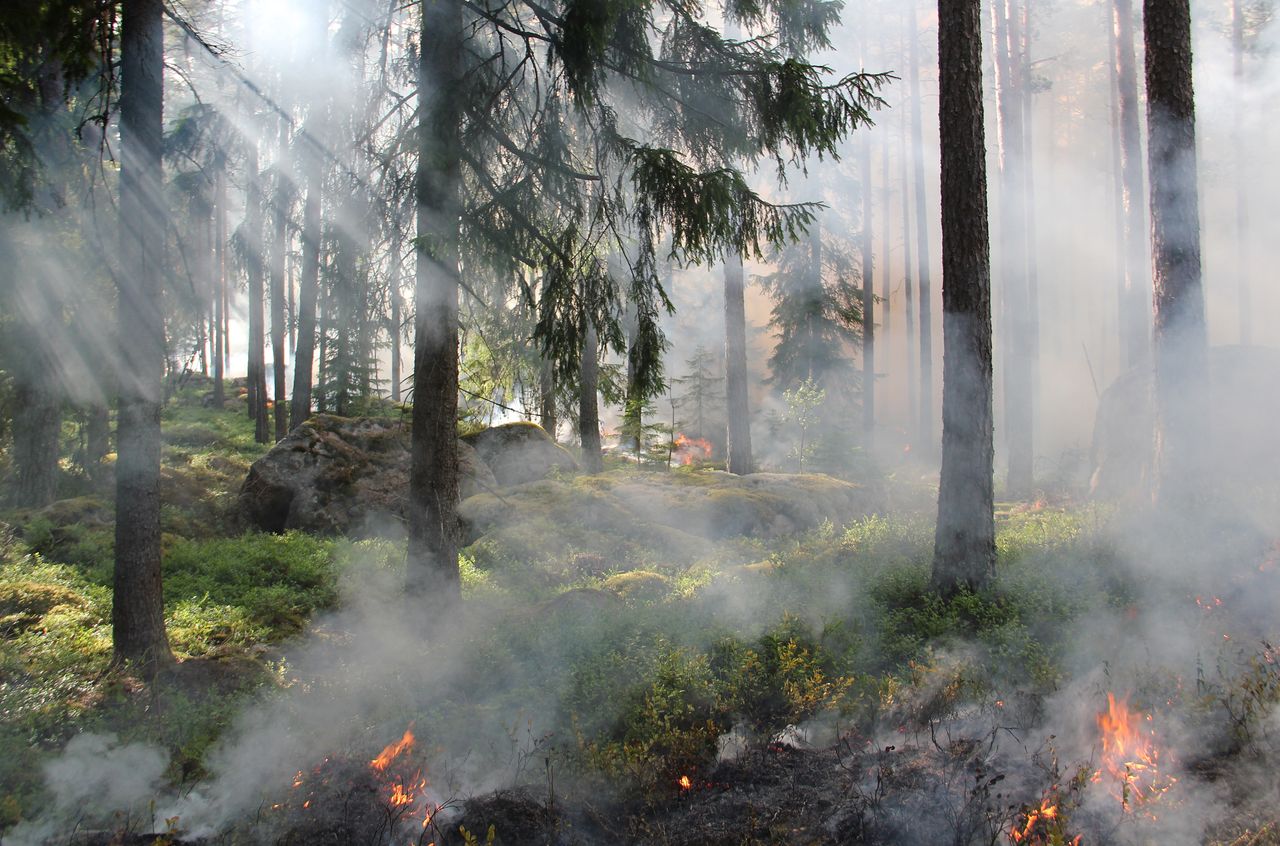
In early August 2026, the Bald Range wildfire tore through the hills west of Okanagan Lake, British Columbia, at what officials called "extraordinary speed" — covering roughly 15 kilometres in a matter of hours. More than 20,000 people were ordered out of Summerland, Peachland, and the surrounding area overnight. Some residents had to be rescued by helicopter after becoming trapped. Highway 97 northbound was closed by the RCMP to funnel traffic away from the fire, and Premier David Eby declared a provincial state of emergency the next morning.
If you owned a used EV in Summerland that night, would you have trusted it to get your family out?
That's not a rhetorical question anymore. Wildfire evacuations are now a near-annual event across BC, Alberta, and increasingly Ontario and the Prairies, and more Canadians are driving EVs than ever — including a growing number of used ones with smaller batteries, older cells, and less range buffer than the car had when new. This piece breaks down what actually happens to an EV's range under evacuation conditions, what the research says the real risk is, and what a used-EV owner in a fire-prone region should do to prepare.
Quick answer: A used EV's range is generally sufficient to get you out of harm's way — most Canadian wildfire evacuations involve driving 20–150 km to a reception centre or safe town, well within range for the great majority of used EVs even accounting for heat, traffic, and AC load. The bigger risk isn't range itself — it's charging after you've evacuated, when thousands of displaced EVs are competing for a handful of chargers in towns that weren't built for the sudden demand.
What actually eats into your range during an evacuation
Two things happen simultaneously in a wildfire evacuation that don't happen on a normal summer drive: extreme heat, and stop-and-go traffic on roads that were never designed to move an entire town at once.
Heat. According to Recurrent Auto's research analyzing real-world data from nearly 30,000 EVs, range loss climbs sharply as temperatures rise: roughly 5% loss at 32°C (90°F), jumping to 17–18% loss at 37°C (100°F) — temperatures that are common during BC and Prairie heat domes, and that often coincide with the highest wildfire risk. Interestingly, the same research found that EVs with heat pumps show slightly worse high-heat range retention than those with simple resistive AC (85% range retained at 100°F vs. 87%), because the heat pump's compressor has to work harder to reject heat from both the cabin and the battery pack simultaneously.
Traffic. Evacuation routes bottleneck fast — that's the nature of thousands of vehicles funneling onto one or two highways at once. Idling and crawling in stop-and-go traffic with the AC running is one of the least efficient things you can do to an EV (or a gas car, for that matter), but for an EV it shows up directly as a range number ticking down on the dash, which can spike anxiety at exactly the wrong moment.
Neither of these is usually a dealbreaker on its own. A used Chevrolet Bolt EV, Hyundai Kona Electric, or Tesla Model 3 with a genuinely healthy battery has 300+ km of realistic range even after heat and traffic losses are factored in — comfortably enough to cover the vast majority of evacuation distances in Canada, which typically run from a town to the nearest reception centre or larger city, not cross-province. If you want the full breakdown of how range holds up under stress (the same physics apply whether the extreme is heat or cold), our guide on how much range you really lose in winter is a useful companion read — heat and cold degrade range through different mechanisms, but the buffer-planning logic is identical.
The real risk isn't range — it's the charger you're driving toward
This is the part that gets missed in most range-anxiety takes, and it's backed by actual research into evacuation behaviour. A University of Alberta study on EV charging behaviour during wildfire evacuations found that the critical infrastructure failure point isn't vehicles running out of charge mid-evacuation — it's "concentrated demand at charging stations," where too many evacuated EVs converge on the same limited chargers in the same nearby town, creating severe delays right when people need to keep moving or need power restored for other emergency needs. The same study found that prior disaster experience and risk perception strongly shape how EV owners actually behave — people who've been through a fire before plan differently than people who haven't.
That reframes the question. It's not "will my EV make it out" — for the vast majority of trips, it will. It's "what happens three hours later when I'm in a reception town with 40% charge, 500 other evacuees are in the same town, and there are six public chargers." That's a real, documented bottleneck, and it's the scenario worth actually planning for.
Compounding this: wildfires frequently trigger public safety power shutoffs in and around the fire zone — meaning the charging infrastructure closest to the evacuation might be dead on arrival even if it's physically undamaged. If you're relying on a Level 2 charger at a friend's place or a public station in a town that's also lost power, you need a backup plan, not just a backup destination.
What this means specifically for a used EV
A new EV with 450 km of rated range and a used EV with the same model name but 90,000 km on the odometer are not the same evacuation vehicle. Battery degradation is real, and it eats directly into your safety margin — the buffer between "enough range to get out comfortably" and "cutting it close."
This is exactly why State of Health matters more for wildfire-region buyers than it might for someone in, say, downtown Toronto with a short commute and chargers on every block. If you're shopping for a used EV and live anywhere near BC's interior, the Prairies, or northern Ontario's fire-prone corridors, treat battery health as a non-negotiable check, not a nice-to-have — our guide on how to check EV battery health before buying walks through exactly how to pull a real State of Health reading rather than trusting the dash estimate alone. A car showing 85% SoH has meaningfully less evacuation buffer than one at 95%, even if both display similar range numbers on a cool day in the dealer lot.
It's also worth factoring into where you buy. Our province-by-province buying guide covers regional pricing and incentives, but if you're specifically weighing a used EV purchase in a wildfire-prone interior BC or Alberta community, range buffer and charging redundancy deserve as much weight as sticker price.
A practical evacuation-readiness checklist for EV owners
A few habits close most of the gap between "range anxiety" and "actually prepared":
Don't let your daily charge float below 50% during fire season. Unlike a gas car where topping up takes five minutes at any of a dozen nearby stations, EV charging redundancy is thinner. Treat fire season (typically May–September in BC and the Prairies) like hurricane season — keep a bigger buffer than you would in October.
Know two charging options outside the immediate area, not just one. If your usual fast charger is in the same town you'd be evacuating from, it's not a real backup. Check public charging network coverage along the routes you'd actually take, and identify a station 100+ km out in a direction away from typical fire risk in your area.
If you have home charging, understand your power-shutoff exposure. A home Level 2 charger is useless during a public safety power shutoff. If you're in a high-risk zone, a portable battery backup or a plan to charge at a relative's house outside the shutoff zone is worth having before you need it, not after.
Pack like range matters, because during an evacuation it briefly does. Running the AC less aggressively, avoiding unnecessary detours, and not treating the trip as a race all help preserve range during the drive itself.
Get your battery's real State of Health checked, especially on a used vehicle you didn't buy new. This is the single biggest lever you control, and it's a one-time check that pays off for the life of the car.
The bottom line
An EV's range is very rarely the thing that fails during a Canadian wildfire evacuation — the physics of heat-related range loss, even stacked with evacuation traffic, still leaves most used EVs with a comfortable margin for the distances involved. The actual failure point, backed by both real events like Bald Range and academic research into evacuation behaviour, is charging infrastructure getting overwhelmed after the drive, compounded by power shutoffs that can take out the charger you were counting on. For used-EV owners specifically, battery health is the variable that determines how much margin you actually have — which makes a proper State of Health check, not just a glance at the dash range estimate, the most useful thing you can do before fire season, not during it.
FAQ
Will my used EV's range be enough to evacuate a wildfire? For the vast majority of Canadian wildfire evacuations — typically 20 to 150 km to a reception centre or nearby town — yes, even accounting for heat-related range loss and evacuation traffic. The exception is a used EV with significantly degraded battery health (below roughly 85% State of Health) combined with a long evacuation distance and extreme heat; that combination is worth planning around specifically.
Does hot weather affect EV range as much as cold weather? Less severely, but it's not negligible. Real-world data shows roughly 5% range loss at 32°C and 17–18% at 37°C, compared to losses of up to 30% in sub-freezing winter conditions. See our winter range loss data for the cold-weather comparison.
What's the biggest EV-specific risk during a wildfire evacuation? Charging bottlenecks after you've reached safety, not running out of range during the drive itself. Research on evacuation charging behaviour has identified concentrated demand at limited charging stations as the primary infrastructure failure point, especially when combined with wildfire-triggered power shutoffs.
Should I avoid buying a used EV if I live in a wildfire-prone area? No — but you should weigh battery health and charging redundancy more heavily than a buyer in a low-risk area would. A used EV with verified strong battery health and a clear backup charging plan is a perfectly reasonable evacuation vehicle.
Sources: Al Jazeera, "British Columbia issues evacuation orders ahead of fast-moving wildfires" (Aug 2026); Government of Canada, 2026 Wildfire Season Update — July; Recurrent Auto, "What A/C Does To Your Range"; University of Alberta, "Electric Vehicles and Resilient Evacuations" study.