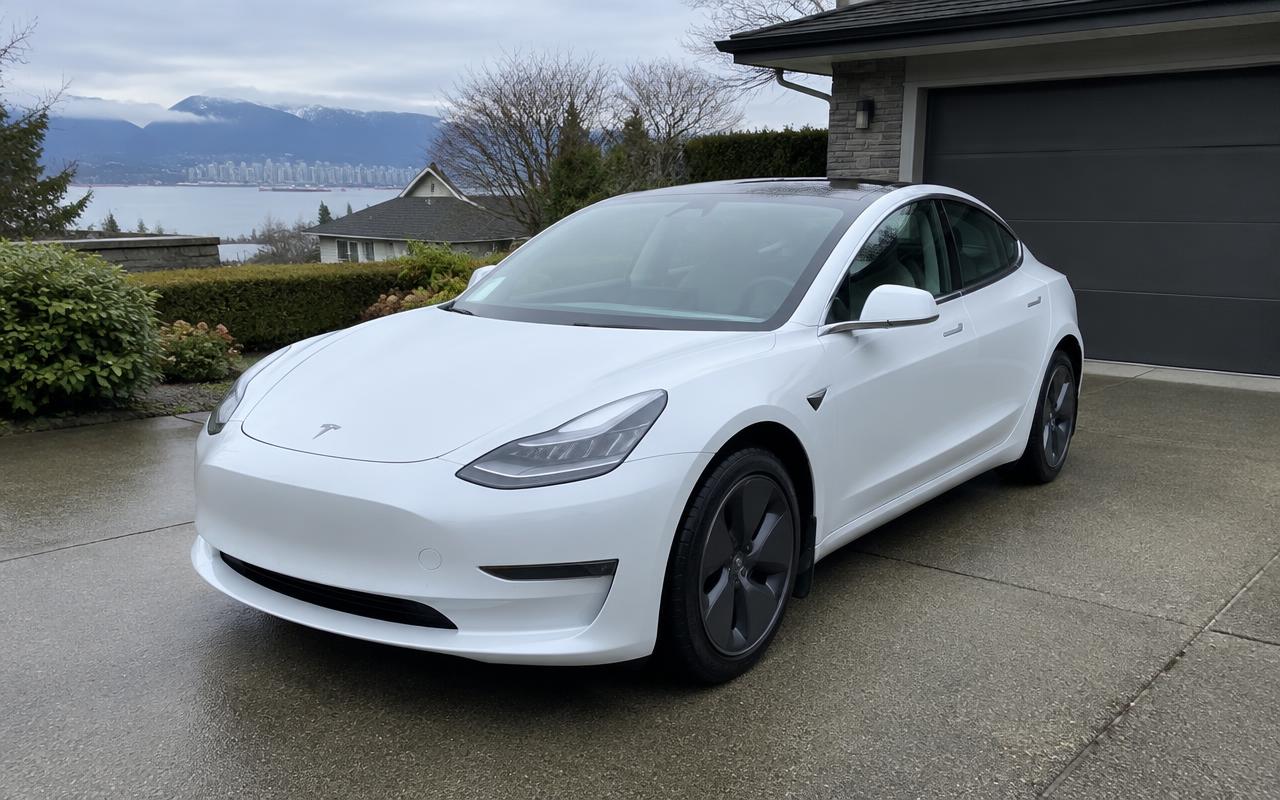
The Tesla Model 3 is one of the most common used EVs on Canadian lots, and the first choice most shoppers face is Standard Range (later sold as Rear-Wheel Drive) or Long Range. New, that decision cost real money: in 2021 the Standard Range Plus started at $37,990 and the Long Range AWD at $46,990. On the used market the gap has shrunk, and that changes the math.
Quick answer: If you have home charging and a typical commute, a Standard Range or RWD Model 3 has enough range year-round. The 2022 and newer RWD versions with LFP batteries are especially easy to live with, because Tesla recommends charging them to 100%. Pay more for the Long Range if you don't have home charging, regularly drive long highway stretches in winter, or want AWD. In today's market, the Long Range often costs only about $4,000 to $6,000 more at similar age and kilometres, roughly half the original price difference.
First, figure out which "Standard Range" you're looking at
"Standard Range" covers more than one car:
| Version | Model years | Battery type | Rated range | Worth knowing | |---|---|---|---|---| | Standard Range Plus | 2019–2021 | Nickel-based | About 385–425 km, depending on year | Heat pump only from the 2021 model year | | Model 3 RWD | 2022–2023 | LFP (lithium iron phosphate) | 438 km (272 mi EPA) | Tesla recommends regular charging to 100% | | Long Range AWD | 2019–2023 | Nickel-based | 576 km for 2022 (358 mi EPA) | Dual motor, faster peak Supercharging |
The refreshed Model 3 that arrived for 2024 also comes in RWD and Long Range versions, but there are fewer on the used market so far.
How to spot an LFP car: On LFP cars, Tesla's charging screen recommends setting the limit to 100%. Owners also report that the seventh character of the VIN is "F" on LFP cars. Ask the seller for a photo of the charge screen.
Range on paper vs. range in a Canadian January
Every EV loses range in the cold, and the Model 3 is no exception. Recurrent's real-world data shows how much a heat pump helps: a Model 3 with a heat pump lost 13% of its real-world range in freezing weather, while one without lost 21%. That alone is a reason to favour 2021 and newer cars in either trim.
Battery chemistry matters less for winter range than many buyers assume. Recurrent's analysis found cars with LFP batteries didn't perform noticeably worse than nickel-based versions in freezing weather. Where LFP does struggle is charging speed when the battery is cold. Tesla improved that in December 2024, when its V3 and V4 Superchargers began heating the batteries of Standard Range RWD Model 3s and Model Ys in cold weather, warming them up to four times faster than before.
For planning, be conservative. In Recurrent's winter observations, the Model 3 delivered roughly half of its advertised range. On the coldest days, with short trips and the heat running, plan on roughly 50% to 65% of the rated number:
| | Rated range | Cold-snap planning range (50–65%) | |---|---|---| | Model 3 RWD (2022, LFP) | 438 km | About 220–285 km | | Model 3 Long Range (2022) | 576 km | About 290–375 km |
These are planning estimates, not test results. For how other models compare, see how much range you really lose in winter and our explainer on heat pumps vs. resistive heating.
What this means for a real commute
| Your situation | Standard Range / RWD | Long Range | |---|---|---| | 30–80 km round trip with home charging | Plenty, even in a cold snap | More than you need | | 100–150 km round trip with home charging | Works; plug in every night | More buffer on the coldest days | | No home charging | More public charging stops each week | Fewer charging sessions | | Regular winter highway trips | Works, with more stops | Fewer, shorter stops | | Steep, unplowed streets | Fine on good winter tires | AWD helps you get moving |
The LFP advantage shows up at home. Because Tesla recommends charging LFP cars to 100%, an RWD owner can use the full rated range every day. Long Range owners with nickel-based batteries usually keep their everyday charge limit below 100%, which narrows the real-world gap between the two.
Charging away from home is a different story. The Long Range charges faster at its peak, and LFP packs don't reach the same peak DC fast-charging speeds. If you'll Supercharge often, that matters more than the range numbers.
AWD: helpful, but not your main winter safety feature
AWD helps you get moving on ice and up snowy hills. It doesn't help you stop or steer. Good winter tires do far more for winter safety on either trim. See whether winter tires matter more on EVs. If you live on a steep street that rarely gets plowed, AWD is a genuine plus. In most cities, a RWD Model 3 on proper winter tires is fine.
Battery warranty and long-term risk
Both trims carry an 8-year battery and drive unit warranty that guarantees at least 70% of the original capacity. The distance limit differs: 160,000 km for Standard Range and RWD, and 192,000 km for Long Range. The clock starts when the car was first delivered, so a 2021 car's coverage ends in 2029.
Model 3 batteries have a strong track record. In Recurrent's study, only about 0.34% of Model 3s had needed a battery replacement, among the lowest rates of any model it tracked. Tesla also offers a Battery and Drive Unit Extended Service Agreement for eligible Model 3s and Model Ys in Canada, which kicks in when the factory battery warranty ends.
For more on chemistry, read our LFP vs. NMC battery explainer.
The price gap today
The used market has shrunk the original $9,000 difference:
- CarGurus.ca puts the national average used Model 3 at about $29,124. The 2022 model year has the most listings, averaging about $31,315.
- Clutch's July 2026 report found used Model 3s sold for an average of $29,165, about 8% less than a year earlier.
- Recent listings near Montreal show the gap at similar age: a 2021 Standard Range Plus with 64,176 km at $25,499, and a 2021 Long Range AWD with 74,560 km at $29,889. Clutch listed a 2021 Long Range with 71,000 km at $31,490.
Listings change daily, so treat these as a snapshot. But the pattern holds: the Long Range premium is now often in the $4,000 to $6,000 range for comparable cars. If you'll use the extra range, that's good value. If you won't, it's money you can keep.
Model 3 pre-purchase checklist
- Confirm the model year and battery type (LFP or nickel-based)
- Confirm a heat pump (2021 model year and newer)
- Get a battery health reading. See independent battery tests vs. the dashboard estimate
- Check the battery warranty end date and kilometres left
- Read the history report for any damage near the battery. Our vehicle history report guide explains what to look for
- Budget for winter tires if they're not included
For a full model overview, see The Breakdown: Tesla Model 3. Looking for one? Browse used Tesla listings currently for sale in Canada.
FAQ
Is the LFP Model 3 bad in Canadian winters?
No. Recurrent's data found its winter range holds up about as well as the nickel-based versions. It does charge more slowly when the battery is cold, so warm the battery up first by setting a Supercharger as your destination in the navigation.
Is a used Long Range worth the extra money?
Usually yes if you don't have home charging or you drive long highway stretches, since the used premium is now much smaller than the original price gap. With home charging and a normal commute, the Standard Range or RWD is enough.
Which Model 3 years have a heat pump?
The 2021 model year and newer.
Sources: CarGurus.ca, 2021 Tesla Model 3 trims and pricing; CarGurus.ca, Model 3 national average price; CarGurus.ca, Montreal-area listings; Clutch, 2021 Model 3 Long Range listing; Clutch, Used Car Pricing Report (July 2026); Carvana, 2022 Model 3 range and LFP; Drive Tesla Canada, LFP in 2022 RWD Model 3; Drive Tesla Canada, LFP full-charge recommendation and warranty; Tesla Motors Club, LFP VIN identification; InsideEVs, Recurrent heat pump vs. no heat pump data; InsideEVs, Recurrent winter range vs. EPA; Carscoops, LFP vs. NCA in freezing weather; Drive Tesla Canada, Supercharger battery heating; Basenor, LFP peak charging speed; Drive Tesla Canada, Tesla battery warranty terms; Tesla Canada, vehicle warranty and Battery ESA; Business Insider, Recurrent battery replacement rates. Prices are a November 2026 snapshot.