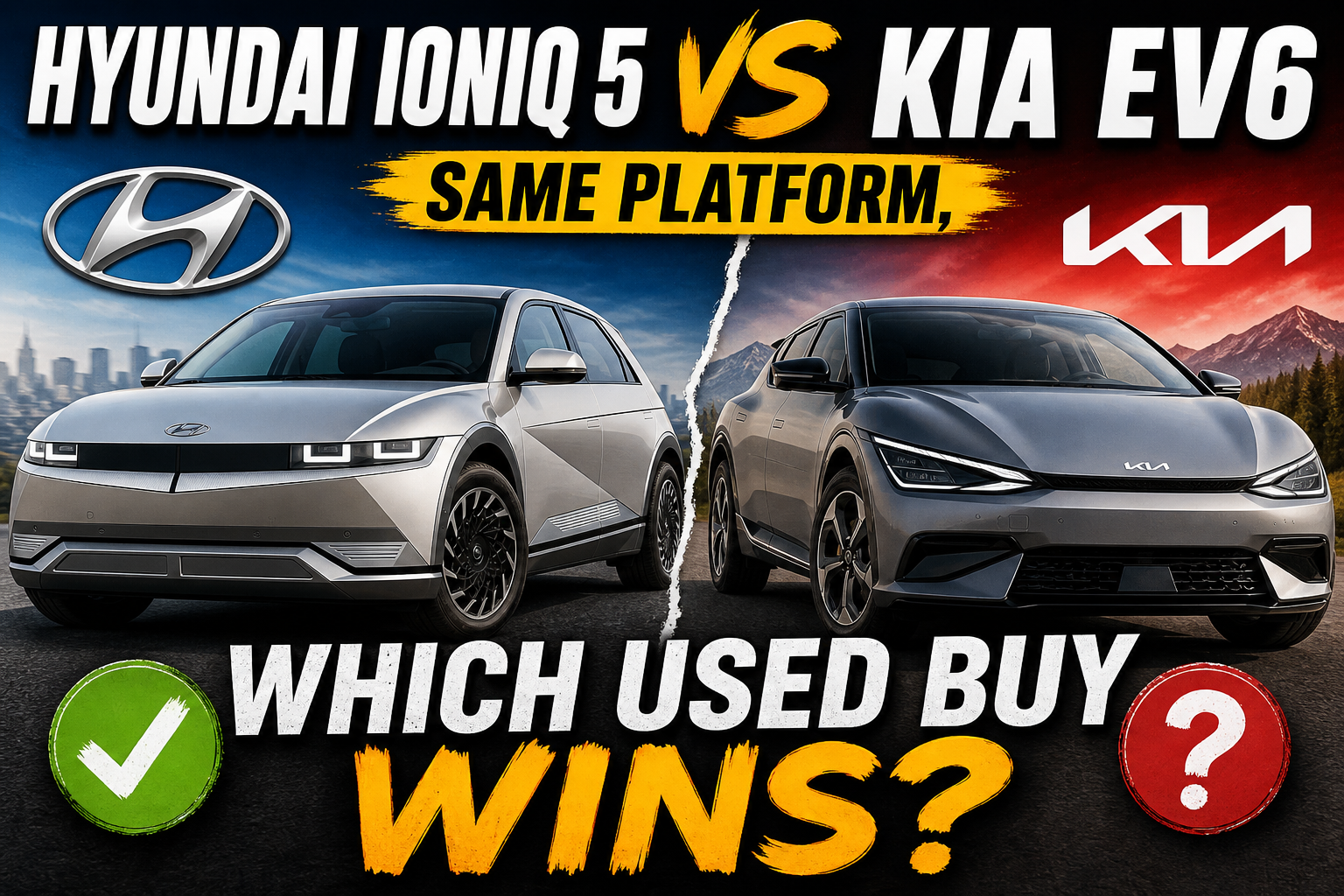
Under the skin, a used Hyundai Ioniq 5 and a used Kia EV6 are close to the same car. Both ride on Hyundai Motor Group's E-GMP platform, share the same battery packs, the same 800-volt fast-charging architecture, and largely the same motors. This is one of the most-searched EV comparisons anywhere for exactly that reason — buyers correctly sense the cars are mechanically similar and want to know what actually separates them. The honest answer: less than styling suggests, but more than "badge-engineered twins" implies, and the differences that do exist matter more once you're shopping used than they do on a new-car spec sheet.
Quick answer: Choose the Ioniq 5 for interior space, cargo flexibility, and slightly better documented visibility. Choose the EV6 for a sportier driving feel, a quieter cabin, and — based on current reliability data — a modest edge in fewer complaints and recalls. Neither is a wrong choice; the deciding factor for most used buyers should be individual vehicle condition and remaining battery warranty, not brand.
Interior space: the Ioniq 5's clearest advantage
The Ioniq 5 offers meaningfully more cabin flexibility — its boxier, taller body delivers what's often described as limo-like rear legroom, sliding and reclining rear seats, and 19.1 cubic feet of cargo space behind the rear seats. The EV6's lower, coupe-influenced roofline costs it both headroom (roughly an inch less than the Ioniq 5, more with a moonroof-equipped GT-Line trim) and cargo capacity (17.7 cubic feet). Some taller drivers report head clearance issues getting in and out of the EV6, and its lower-mounted seating position places the steering wheel in a way that can block instrument panel visibility for certain body types. If cargo space or rear passenger comfort is a priority — family use, road trips with gear — the Ioniq 5 is the more practical pick.
The EV6 does hold one practical edge: a 2,300 lb tow rating versus the Ioniq 5's 1,650 lbs, worth knowing if you're planning to tow even a small trailer.
Driving feel: EV6 leans sporty, Ioniq 5 leans comfortable
Despite the EV6's sportier styling, independent testing has generally found the two drive more similarly than their appearance suggests — both deliver quick acceleration and a comfortable ride. Where they do diverge: the EV6 uses heavier, more progressive steering and a quieter, more "planted" highway feel, while the Ioniq 5 leans into softer suspension tuning and a brighter, more minimalist cabin. Neither is dramatically sportier in real-world driving than the other, but the EV6 edges toward driver engagement and the Ioniq 5 toward comfort.
Controls philosophy differs too, in a way that matters day-to-day: the EV6 keeps physical top-level buttons for climate and seat heating, while the Ioniq 5 buries more of these functions in touchscreen menus — a small thing that becomes a real preference once you're living with the car rather than test-driving it.
Reliability: a real, data-backed gap — and it favours the EV6
This is where used buyers should pay closest attention. Reliability tracking data shows the Kia EV6 currently scoring 57/100 versus the Hyundai Ioniq 5's 54/100 — a modest but real edge. The gap widens on complaint volume: EV6 owners report 48.9 complaints per 10,000 vehicles sold, compared to 63.4 for the Ioniq 5. Recall history tells a similar story — the Ioniq 5 has accumulated 18 total recalls over its production run so far, compared to 8 for the EV6.
The electrical system is the most common problem area for both nameplates, but the Ioniq 5 shows a considerably higher complaint volume there (554 complaints tracked vs. 204 for the EV6), and a similar pattern holds for powertrain-related issues (182 vs. 56). None of this points to a car that's unreliable in absolute terms — both remain solidly in "mixed to good" reliability territory for a mainstream EV — but if reliability track record is a tiebreaker for you, the data currently favours the EV6.
Charging and range: near-identical, with one Canada-specific wrinkle
Battery and charging specs are close enough to call a wash: both offer a standard-range option (roughly 58-63 kWh, 220-240 miles EPA) and a long-range option (77-84 kWh, close to 300 miles), both DC fast-charge in the 235-258 kW range thanks to the shared 800-volt architecture, and both include Vehicle-to-Load (V2L) capability for powering external devices — genuinely useful for camping, job sites, or emergency power.
The one wrinkle worth knowing about if you're shopping used: newer 2025+ Ioniq 5 and EV6 models ship with a native NACS port, giving direct access to Tesla Supercharger stations without an adapter. Most used examples currently on Canadian roads still use the older CCS1 port and require a NACS-to-CCS1 adapter (roughly $150-230 CAD) to charge at a Supercharger. If Supercharger access matters to you, check the specific model year rather than assuming — this is a genuine year-to-year difference within each nameplate, not just between the two brands. See our public charging networks guide for the fuller picture on charging access in Canada.
Used pricing: more Ioniq 5 inventory, EV6 requires more hunting
Because Hyundai launched the Ioniq 5 earlier and backed it with aggressive lease programs, there's simply more used Ioniq 5 inventory feeding the market right now, including well-equipped Limited trims that can offer strong feature value per dollar. EV6 examples in the same price bracket require more searching. Neither car has a dramatic pricing advantage over the other at equivalent trim and mileage — the practical difference is selection, not sticker price.
What actually matters for a used buy: battery health and warranty, not badge
Both cars share the same underlying battery technology, and battery degradation for either is typically 5-15% capacity loss on a well-maintained example — largely a function of charging habits and climate history rather than which badge is on the hood. Both carry a 10-year/100,000-mile battery warranty from the original in-service date, so the single most important thing to verify on either car is how much of that warranty remains, by VIN, rather than assuming coverage based on model year alone. Our guide on how to check EV battery health before buying applies equally to both, and for the underlying battery chemistry both share, our EV battery types guide is a useful companion read.
The bottom line
The Ioniq 5 and EV6 are close enough mechanically that the deciding factor for most used buyers should come down to which cabin and driving character you prefer, plus the specific reliability history and remaining warranty on the individual car in front of you — not a blanket brand preference. If interior space and cargo flexibility matter most, the Ioniq 5 wins. If you want a quieter, sportier-feeling drive and slightly better documented reliability, the EV6 edges ahead. Either way, prioritize a real battery health check and VIN-specific warranty confirmation over trim level or styling.
FAQ
Are the Hyundai Ioniq 5 and Kia EV6 basically the same car? Mechanically, yes — they share Hyundai Motor Group's E-GMP platform, the same battery options, and largely the same motors. The differences are in body style, cabin layout, driving character, and — based on current data — reliability complaint volume.
Which is more reliable, the Ioniq 5 or the EV6? Current reliability tracking gives the EV6 a modest edge — 57/100 versus 54/100 for the Ioniq 5, with fewer owner complaints and fewer total recalls (8 vs. 18).
Can a used Ioniq 5 or EV6 charge at Tesla Superchargers? Only 2025+ model years with a native NACS port can plug in directly. Most used examples on Canadian roads have a CCS1 port and need a NACS-to-CCS1 adapter (roughly $150-230 CAD) for Supercharger access.
Sources: Cars.com, "Hyundai Ioniq 5 Vs. Kia EV6: What's Really the Difference"; Recharged, "Used Kia EV6 vs Used Hyundai Ioniq 5 Under $30k (2026 Guide)"; Auto Reliability Index, Hyundai Ioniq 5 vs Kia EV6 Reliability; Tesla North America Guide, NACS Adapter Guide 2026.